
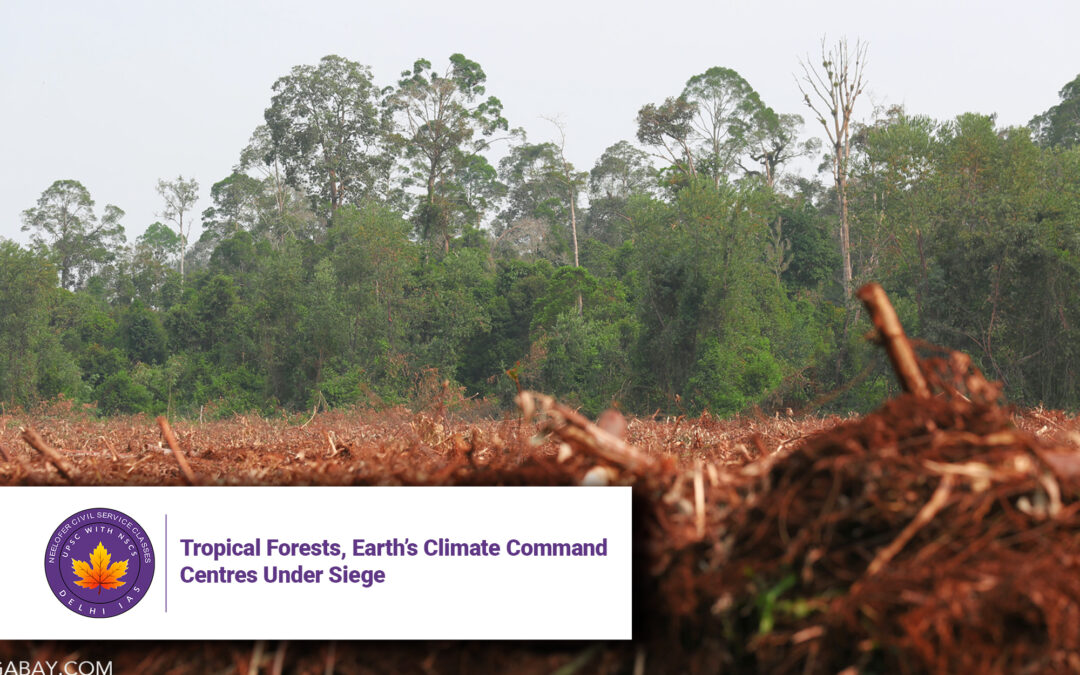
Tropical Forests, Earth’s Climate Command Centres Under Siege
Why in News?
The world is facing twin crises — climate change and biodiversity collapse. Tropical forests, often called the “lungs of the Earth,” are critical in regulating climate, supporting biodiversity, and sustaining indigenous livelihoods. However, rapid deforestation driven by economic pressures, infrastructure expansion, and unsustainable land use is placing these vital ecosystems under severe threat.
Introduction
Tropical forests span the equatorial belt, covering vast areas such as the Amazon Basin in South America, the Congo Basin in Central Africa, and the rainforests of Southeast Asia and the Indo-Malayan region. These forests are not just a collection of trees but living, breathing climate regulators. They influence rainfall, regulate weather patterns across continents, store carbon, protect soil fertility, and anchor human and ecological life.
Yet, these critical ecosystems are being destroyed at an alarming rate for cattle ranching, palm oil, timber extraction, mining, and infrastructure projects. Losing them is not merely an ecological tragedy; it is a direct blow to humanity’s ability to combat climate change.
The Climate Machinery of Tropical Forests
Tropical forests are unparalleled in their ecological functions:
-
Carbon Storage and Climate Regulation: They absorb and store massive amounts of carbon dioxide, sequestering up to 1.8 gigatonnes of CO₂ annually. This is vital in reducing the impacts of fossil fuel emissions.
-
Rainfall and Weather Systems: They regulate rainfall across continents, influence monsoon cycles, and maintain regional water security.
-
Biodiversity Hotspots: They are home to countless species of plants, animals, and microorganisms found nowhere else on Earth.
India, though not home to rainforests on the scale of the Amazon or Congo, still hosts important tropical moist deciduous and evergreen forests in the Western Ghats, Northeast, Andaman & Nicobar Islands, and parts of central India. These areas are key to maintaining India’s monsoon systems.
Deforestation: The Domino Effect
Deforestation is not just about tree loss; it disrupts the entire climatic balance. According to Global Forest Watch, the world lost over 4 million hectares of tropical primary forest cover in 2023 alone, with Indonesia, Brazil, and the Democratic Republic of Congo among the worst affected.
The impacts include:
-
Loss of Rainfall Regulation: Forest destruction disrupts evapotranspiration, reducing rainfall and contributing to prolonged droughts.
-
Moisture Transport Disruption: Narrow bands of moisture, which transport water vapor across continents, are broken.
-
Erratic Monsoon Patterns: India’s dependence on monsoon cycles means deforestation contributes to irregular rainfall, harming agriculture and water security.
A Global Issue with Local Roots
The drivers of deforestation vary but are often linked to:
-
Economic Pressures: Agribusiness, logging, and commercial plantations.
-
Infrastructure Expansion: Roads, dams, and mining projects often cut deep into forest landscapes.
-
Poor Governance: Weak enforcement of environmental laws and corruption.
In India, deforestation is fueled by hydroelectric projects, mining in biodiversity-rich states, and road construction in sensitive areas. The expansion of palm oil plantations in Southeast Asia and large-scale cattle ranching in the Amazon are prominent global examples.
India’s Tropical Forests: Anchors of the Monsoon
India’s tropical forests act as anchors for the monsoon system. For instance, the Western Ghats are a UNESCO World Heritage Site that intercepts monsoon winds, creating vital water catchments. Similarly, forests in Arunachal Pradesh, Nagaland, and Meghalaya regulate local rainfall patterns. Loss of these forests increases flood risks, disrupts farming cycles, and accelerates biodiversity decline.
Hope in Restoration and Carbon Finance
Despite grim trends, there is still scope for positive change. Studies show that if global efforts to restore degraded forests succeed, they could deliver 30% of the climate mitigation needed to meet the Paris Agreement targets.
-
India’s National Mission for a Green India aims to expand forest cover and improve ecosystem services.
-
Payment for Ecosystem Services (PES) models like REDD+ (Reducing Emissions from Deforestation and Forest Degradation) offer financial incentives for protecting or restoring forests.
The Role of Technology and Indigenous Wisdom
Technology and traditional knowledge must work together to safeguard forests.
Technology Tools:
-
Satellite-based forest monitoring.
-
Drone-based inventory.
-
AI-enabled MRV (Monitoring, Reporting, and Verification) systems to track illegal activities, quantify carbon sequestration, and provide transparent climate finance data.
Indigenous Wisdom:
Indigenous communities have lived in harmony with tropical forests for generations, with deep knowledge of flora, fauna, water cycles, and sustainable harvesting. Legal recognition of indigenous land rights under laws like India’s Forest Rights Act can empower these communities as forest custodians.
A New Climate Diplomacy on Forests
India should elevate forest conservation as a central issue in global climate diplomacy. By positioning forests as a core part of its strategy in forums like the UN Climate Change Conferences, India can:
-
Champion global carbon finance mechanisms.
-
Promote biodiversity restoration projects.
-
Build sustainable supply chains to reduce pressure on forests.
Forests Are More Than Carbon Stocks
Viewing forests only as carbon storage units is a narrow perspective. They are dynamic systems that maintain soil fertility, influence rainfall, protect human health, and preserve biodiversity. Losing them is both an ecological disaster and a strategic failure in climate action.
It is essential that governments, businesses, and citizens unite to protect these “climate command centres” before silence replaces their living heartbeat.
Conclusion
Tropical forests are not just natural resources; they are critical infrastructure for planetary health. Their destruction accelerates climate change, erodes biodiversity, and destabilizes weather systems. India’s role in global forest conservation can be significant, provided it strengthens local protections, harnesses technology, supports indigenous communities, and pushes for stronger international commitments.
The message is clear: safeguarding tropical forests is not optional — it is a necessity for our survival.
5 Q&A Section
Q1. What makes tropical forests crucial in combating climate change?
A1. Tropical forests regulate rainfall, store massive amounts of carbon dioxide, influence weather systems, and are biodiversity hotspots. Losing them disrupts climate stability and accelerates global warming.
Q2. Which tropical forests are most significant globally?
A2. The Amazon Basin in South America, the Congo Basin in Africa, and the rainforests of Southeast Asia and the Indo-Malayan region are among the most significant tropical forests worldwide.
Q3. How does deforestation impact India’s monsoon system?
A3. Forests like those in the Western Ghats and Northeast intercept monsoon winds and regulate rainfall. Deforestation disrupts these systems, leading to erratic rainfall, droughts, and floods.
Q4. What role can technology play in forest conservation?
A4. Satellite monitoring, drones, and AI-enabled MRV systems help detect illegal encroachments, measure carbon sequestration, and create transparent forest management systems.
Q5. How can indigenous communities contribute to forest preservation?
A5. Indigenous people possess traditional knowledge of forest ecosystems, sustainable harvesting, and biodiversity management. Recognizing their land rights and involving them in governance strengthens conservation efforts.

