
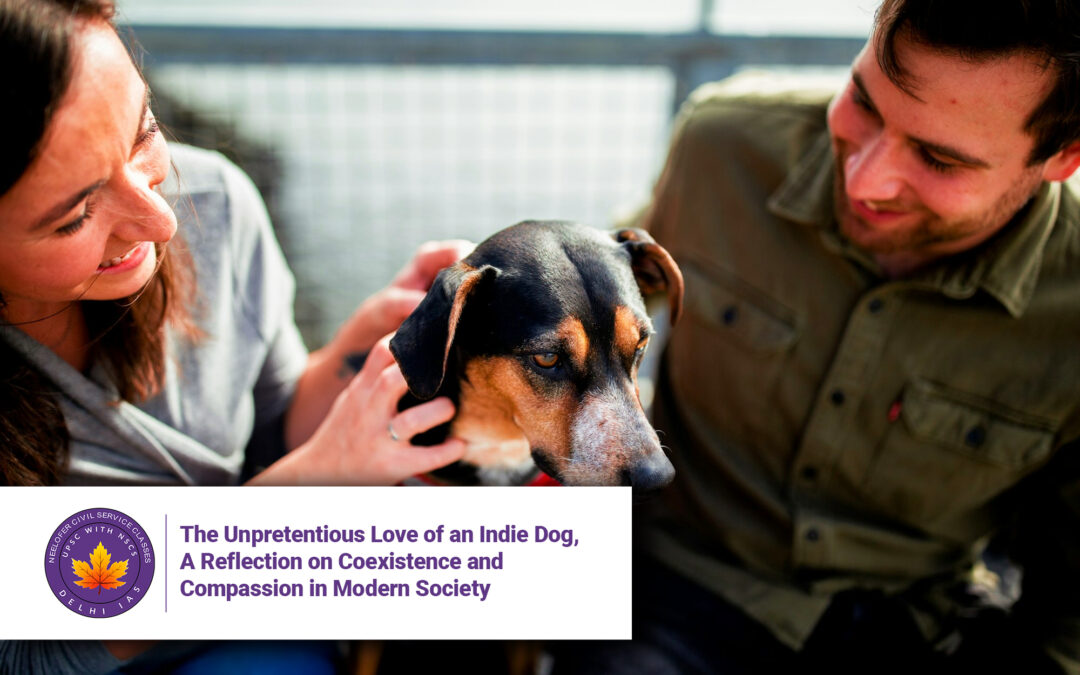
The Unpretentious Love of an Indie Dog, A Reflection on Coexistence and Compassion in Modern Society
Why in News?
In a world increasingly defined by performative displays of affection and loyalty, the story of Chutney, an indie (Indian stray) dog, offers a profound commentary on the essence of love and coexistence. Adopted by a family in Kolkata, Chutney’s unassuming presence challenges societal expectations of what it means to care for another being. His story emerges against the backdrop of heated debates over stray dog management in India, sparked by recent Supreme Court directives and subsequent modifications. While arguments rage between animal rights advocates and those concerned about public safety, Chutney represents a middle path—one that emphasizes quiet companionship over dramatic gestures. This narrative not only highlights the human-animal bond but also serves as a metaphor for broader societal issues, including intolerance, displacement, and the need for empathy in an increasingly polarized world.
Introduction
The relationship between humans and animals, particularly dogs, has evolved significantly over centuries. From working animals to beloved pets, dogs have occupied various roles in human societies. In contemporary India, the plight of stray dogs has become a contentious issue, with opinions divided between eradication and compassion. The recent Supreme Court order on stray dogs, later modified to allow for more nuanced management, has intensified this debate. Amidst this turmoil, the story of Chutney, an indie dog who defies stereotypes of what a “good” pet should be, provides a refreshing perspective. His unpretentious way of showing love—through mere presence rather than performative acts—invites us to reconsider our definitions of care and loyalty. This article explores Chutney’s story as a lens through which to examine larger themes of coexistence, compassion, and the societal pressures that shape our interactions with the world around us.
Key Issues and Background
1. The Stray Dog Debate in India
India is home to an estimated 35 million stray dogs, whose presence in urban and rural areas has sparked ongoing conflict. Concerns over rabies, dog bites, and public safety often clash with animal welfare advocates’ calls for humane treatment. The Supreme Court’s recent intervention—first ordering the removal of all strays to shelters, then revising it to allow sterilized and vaccinated dogs to be returned to their locations—reflects the complexity of this issue. The debate has become highly polarized, with both sides accusing the other of lacking empathy.
2. Performative Culture in the Digital Age
Social media platforms like Instagram have transformed how we express love and loyalty. Pets, particularly dogs, are often portrayed performing tricks, reacting dramatically to owners’ return, or engaging in other attention-grabbing behaviors. These representations set unrealistic expectations for pet ownership, where value is assigned based on an animal’s ability to entertain or elicit likes.
3. Chutney’s Story: The “Un-Dog” Dog
Chutney, an indie dog adopted by a Kolkata family, defies these expectations. He does not perform tricks, react dramatically to his owners, or engage in Instagram-worthy behaviors. Instead, he shows his affection through quiet companionship—sleeping near his family, tolerating their attempts to make him “viral,” and offering comfort during times of distress. His story challenges the notion that love must be demonstrated through grand gestures.
4. Societal Intolerance and the “Not in My Backyard” Mentality
Chutney’s narrative also mirrors broader societal issues, such as the displacement of marginalized communities, the rejection of Palestinians in Gaza, or the eradication of slums in the name of development. The desire to remove anything inconvenient or “inconsequential” reflects a growing impatience with coexistence.
5. The Economics of Compassion
The article touches on the “return on investment” of caring for beings like Chutney, who offer little in terms of tangible benefits. This raises questions about the commodification of relationships and the value assigned to lives based on their utility.
Specific Impacts or Effects
1. On Animal Welfare Policies
Stories like Chutney’s humanize stray dogs, potentially influencing public opinion and policy towards more compassionate management strategies.
2. On Social Media Culture
Chutney’s refusal to perform challenges the pressure on pet owners to curate their animals’ lives for online consumption, encouraging a return to authentic relationships.
3. On Societal Values
The narrative prompts reflection on how we value beings—human or animal—who do not contribute in obvious ways to societal goals, advocating for intrinsic worth over utility.
4. On Mental Health
The quiet companionship offered by pets like Chutney can have significant mental health benefits, providing comfort without the need for performative engagement.
Challenges and the Way Forward
Challenges
-
Polarization: The stray dog debate reflects deeper societal divisions, making dialogue difficult.
-
Commodification: The expectation that relationships should yield tangible returns undermines intrinsic values like compassion.
-
Urbanization: Rapid urban development often prioritizes convenience over coexistence, marginalizing both humans and animals.
Steps Forward
-
Promote Humane Education: Integrate empathy and coexistence into educational curricula to foster future generations more inclined toward compassionate solutions.
-
Community-Led Initiatives: Encourage local communities to develop their own stray management programs, combining sterilization, vaccination, and care.
-
Regulate Social Media: Encourage authentic representations of pet ownership to reduce pressure on performative displays.
-
Policy Reform: Advocate for policies that balance public safety with animal welfare, based on scientific evidence and ethical considerations.
-
Foster Dialogue: Create platforms for constructive conversation between opposing sides of the stray dog debate to find common ground.
Conclusion
Chutney’s story is a testament to the power of unpretentious love and the importance of coexistence in a world increasingly obsessed with performance and utility. His quiet presence reminds us that care does not always need to be demonstrated through grand gestures; sometimes, it is enough simply to be there. As India grapples with complex issues like stray dog management, displacement, and polarization, Chutney offers a blueprint for a more compassionate society—one that values beings for who they are, not what they can do. In embracing this ethos, we may find that the most meaningful relationships are those that require no validation beyond their existence.
5 Questions and Answers
Q1: What is the main controversy surrounding stray dogs in India?
A: The debate centers on balancing public safety concerns—such as rabies and dog bites—with animal welfare advocates’ calls for humane treatment, including sterilization and vaccination instead of eradication.
Q2: How does Chutney challenge societal expectations of pets?
A: Chutney does not perform tricks or react dramatically to his owners, defying the social media-driven expectation that pets should provide entertainment or viral content.
Q3: What broader societal issues does Chutney’s story reflect?
A: It highlights intolerance toward beings perceived as inconvenient, mirroring issues like the displacement of marginalized communities and the “not in my backyard” mentality.
Q4: How can communities better manage stray dog populations?
A: Through community-led programs that include sterilization, vaccination, and responsible care, combined with education on coexistence and compassion.
Q5: What is the key takeaway from Chutney’s story?
A: That love and care need not be performative; quiet coexistence and companionship are equally valid and meaningful forms of connection.
