
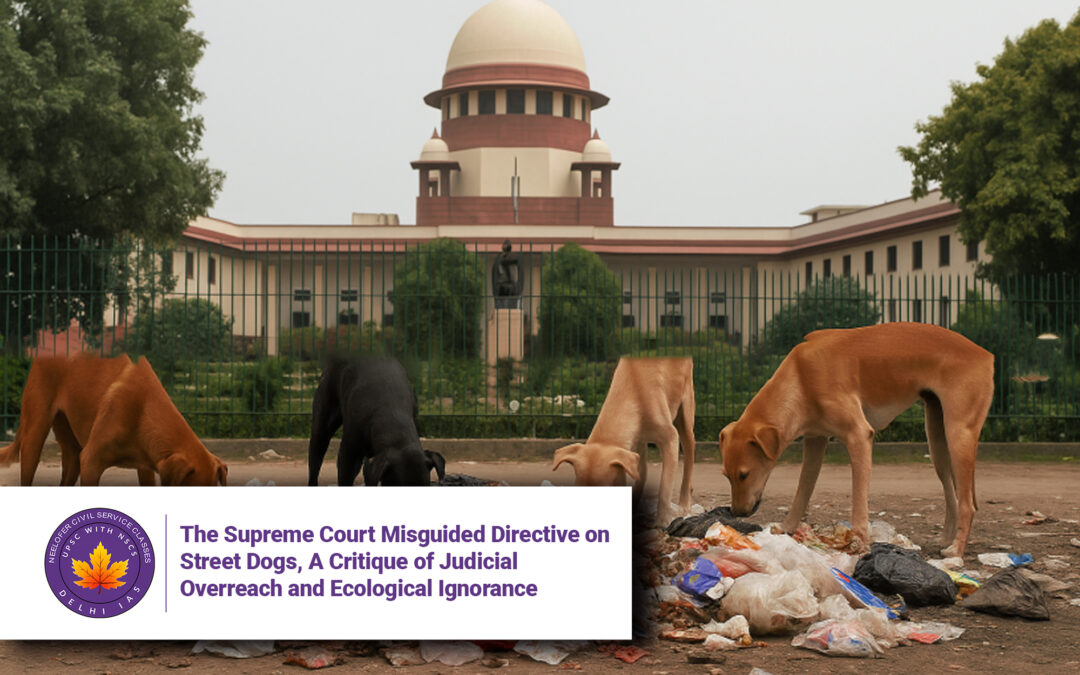
The Supreme Court Misguided Directive on Street Dogs, A Critique of Judicial Overreach and Ecological Ignorance
Why in News?
The Supreme Court of India’s interim order on August 11, 2025, mandating the mass incarceration of all street dogs in New Delhi in shelters, sparked widespread outrage and debate. While the order was temporarily stayed on August 22, 2025, its initial issuance exposed a profound disregard for scientific evidence, ecological balance, and constitutional morality. The directive, widely perceived as a knee-jerk reaction to public hysteria over dog bites, ignored proven humane solutions and risked exacerbating public health crises. With the final hearing pending, the episode underscores the need for evidence-based judicial interventions and accountable governance.
Introduction
India’s street dogs, estimated to number over 60 million nationwide, have long been a contentious issue in urban governance. The Supreme Court’s order to round up and incarcerate Delhi’s stray dogs in mass shelters was touted as a solution to the “stray dog menace.” However, the order was met with fierce criticism from animal rights activists, public health experts, and legal scholars who decried it as scientifically unsound, ethically indefensible, and practically unworkable. The stay granted on August 22 offered a reprieve, but the initial directive revealed a troubling tendency to prioritize political convenience over empirical evidence and compassion.
Key Issues
1. Scientific and Ecological Imprudence
-
Shelter Catastrophe: The idea of mass shelters is ecologically and logistically flawed. Studies from developed nations, such as the U.S., show that overcrowded shelters become breeding grounds for diseases (e.g., rabies, leptospirosis) and exacerbate behavioral issues in animals due to confinement stress.
-
Vacuum Effect: Ecological research demonstrates that removing dogs from an area creates a population vacuum, inviting migration from neighboring regions (e.g., Haryana, Uttar Pradesh) to occupy the vacant niche. This nullifies any temporary reduction in dog numbers.
-
Rodent and Monkey Proliferation: Street dogs act as natural scavengers, controlling populations of rodents and monkeys. Their removal could lead to an explosion in these species, introducing new public health threats such as leptospirosis and simian viruses.
2. Public Health Risks
-
Zoonotic Disease Spread: Concentrating thousands of dogs in shelters would facilitate the rapid spread of zoonotic diseases, endangering both animals and poorly protected shelter staff.
-
Carcass Disposal Crisis: In the event of a disease outbreak, the disposal of thousands of carcasses would pose an environmental and public health hazard of monumental proportions.
3. Failure of Governance and Diversionary Tactics
-
MCD’s Dereliction of Duty: The Municipal Corporation of Delhi (MCD) has consistently failed to implement the Animal Birth Control (ABC) program effectively. Data from the Animal Welfare Board of India (AWBI) reveals chronic underfunding, unmet sterilization targets, and zero accountability.
-
Political Smokescreen: The street dog issue diverts attention from pressing governance failures, including allegations of institutional voter fraud, crumbling infrastructure, monsoon flooding, corruption, and inflation.
4. Legal and Constitutional Flaws
-
Judicial Inconsistency: The order by Justice J.B. Pardiwala’s bench contradicted the 2024 judgment by Justice J.K. Maheshwari’s bench, which upheld the Animal Birth Control Rules, 2023, as a scientifically sound and compassionate approach.
-
Violation of Constitutional Duty: Article 51A(g) of the Constitution imposes a fundamental duty on citizens to have compassion for living creatures. State-sanctioned cruelty violates this principle and undermines India’s moral fabric.
5. Socio-Economic Impact
-
Marginalized Communities: For homeless populations, street dogs serve as companions and protectors. Removing them inflicts additional trauma on already vulnerable groups.
-
Elite vs. Poor Narrative: The framing of the issue as a conflict between “dog-loving elites” and bite-affected poor is a misrepresentation. Research shows that street dogs coexist symbiotically with marginalized communities.
Alternative Approaches
-
Implement ABC Programs Rigorously:
-
Sterilization and vaccination, as endorsed by the WHO and India’s National Action Plan for Dog Mediated Rabies Elimination (NAPRE), are the only sustainable solutions. Cities like Jaipur and Jodhpur have demonstrated success with ABC, achieving stable declines in dog populations and high vaccination coverage.
-
-
Hold MCD Accountable:
-
The Supreme Court should direct the MCD to execute its statutory duties, allocate sufficient budgets, and meet annual sterilization targets.
-
-
Public Awareness and Community Engagement:
-
Educate citizens on responsible feeding, reporting aggressive dogs, and participating in vaccination drives.
-
-
Targeted Measures for Aggressive Dogs:
-
Instead of mass incarceration, identify and humanely manage genuinely aggressive dogs through professional observation and rehabilitation.
-
-
Judicial Prudence:
-
Courts should rely on expert opinions from veterinarians, ecologists, and public health specialists before issuing orders on complex ecological issues.
-
Challenges and the Way Forward
-
Political Will: The MCD and state governments have historically neglected ABC programs due to apathy and corruption.
-
Resource Allocation: Building and maintaining shelters would cost thousands of crores, funds that could be better spent on sterilization and vaccination.
-
Behavioral Change: Overcoming public hysteria and misinformation about street dogs requires sustained awareness campaigns.
The Way Forward:
-
The Supreme Court must permanently reject mass incarceration and direct the government to implement ABC programs effectively.
-
Civil society must leverage Public Interest Litigation (PIL) to enforce accountability.
-
The media should highlight successful ABC models and expose governance failures.
Conclusion
The Supreme Court’s initial order to incarcerate street dogs was a regressive step that ignored science, ecology, and compassion. The stay granted on August 22 provides an opportunity to correct this error and embrace evidence-based solutions. The real issue is not street dogs but decades of governance failure. India must choose between cruel, ineffective shortcuts and humane, sustainable solutions. The path forward lies in strengthening ABC programs, holding authorities accountable, and upholding constitutional values of compassion and justice.
5 MCQs Based on the Article
Q1. What was the primary flaw in the Supreme Court’s initial order regarding street dogs?
A) It focused only on vaccination
B) It ignored scientific and ecological evidence
C) It mandated killing of all aggressive dogs
D) It allocated insufficient funds for shelters
Answer: B) It ignored scientific and ecological evidence
Q2. Which constitutional article imposes a duty on citizens to show compassion to living creatures?
A) Article 21
B) Article 51A(g)
C) Article 14
D) Article 19
Answer: B) Article 51A(g)
Q3. What ecological phenomenon occurs when dogs are removed from an area?
A) Natural selection
B) Vacuum effect
C) Genetic drift
D) Trophic cascade
Answer: B) Vacuum effect
Q4. Which program is endorsed by the WHO for managing street dog populations?
A) Mass incarceration
B) Animal Birth Control (ABC)
C) Relocation to forests
D) Euthanasia of aggressive dogs
Answer: B) Animal Birth Control (ABC)
Q5. Why did the author argue the street dog issue is a “smokescreen”?
A) It hides governance failures like corruption and infrastructure collapse
B) It diverts attention from climate change
C) It promotes elite interests over public health
D) It encourages illegal pet trade
Answer: A) It hides governance failures like corruption and infrastructure collapse

