
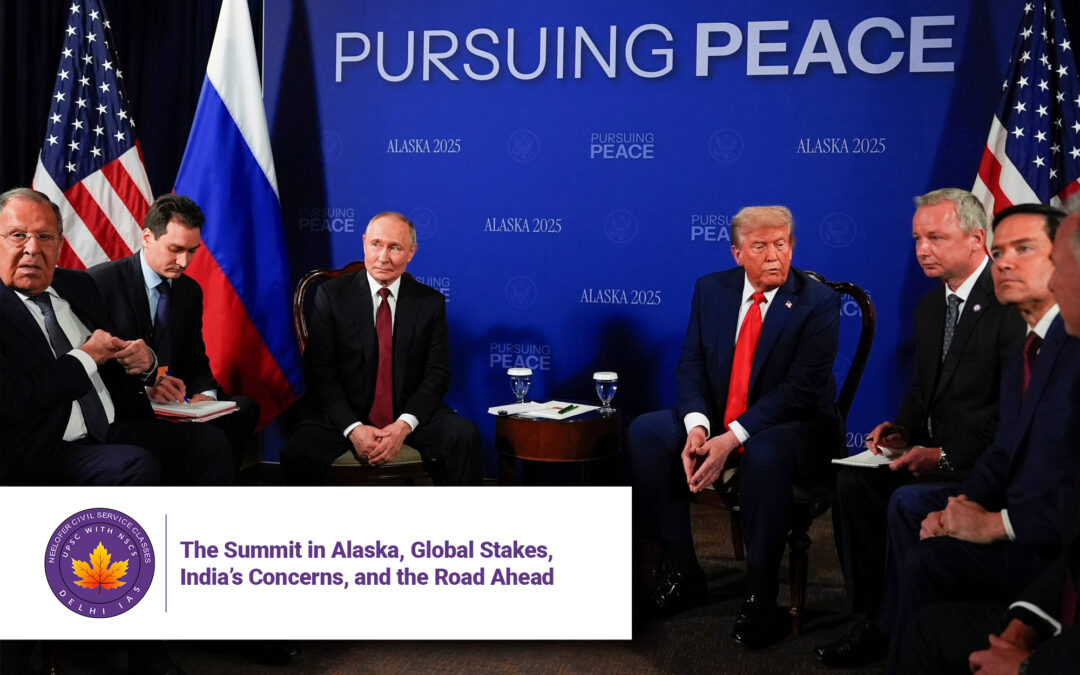
The Summit in Alaska, Global Stakes, India’s Concerns, and the Road Ahead
Why in News?
The international community is closely watching the high-profile summit in Anchorage, Alaska, where U.S. President Donald Trump is set to meet Russian President Vladimir Putin and Ukrainian President Volodymyr Zelensky. This summit comes at a time when Europe faces an existential threat from Russia, Ukraine’s future is uncertain, and the balance of power between East and West is under strain. For India, the outcomes of this meeting could have significant economic, energy, and geopolitical consequences.
Introduction
Summits between world leaders often become defining moments in history. The Alaska summit is one such event that evokes memories of Yalta 1945, when leaders of the U.S., the U.K., and the Soviet Union discussed the post-World War II order. Today, the stakes are equally high. Russia’s invasion of Ukraine has disrupted European security, NATO is attempting to reassert itself, and the U.S. is under pressure to reclaim its leadership role.
For India, the implications are layered. While the U.S. pushes India to reduce oil imports from Russia, New Delhi must balance its energy security needs, strategic partnership with Washington, and its traditional defense ties with Moscow. The summit’s outcome could decide not only the trajectory of the Russia-Ukraine war but also India’s geopolitical space in a rapidly polarizing world.
The Meeting and Venue
The Alaska summit marks the first in-person meeting between Trump and Putin since June 2021, when Putin met U.S. President Joe Biden in Geneva—a meeting that ended in disagreements. Within months, Russia escalated its military actions in Ukraine, leading to a full-scale invasion in February 2022.
Putin’s visit to Alaska is historically significant. The U.S. had purchased Alaska from Russia in 1867, and Putin’s presence there is symbolically powerful. The meeting takes place at Joint Base Elmendorf-Richardson, where Trump hopes to showcase American resolve.
Trump and Putin had previously met at multiple summits:
-
Hamburg G20 (2017)
-
Helsinki Summit (2018)
-
Osaka G20 (2019)
Those meetings oscillated between cautious engagement and outright disagreements. The Alaska summit is expected to be even more contentious given the ongoing war in Ukraine.
What Trump Wants
President Trump enters the summit with clear objectives:
-
Ceasefire in Ukraine – Trump wants to push Putin toward halting military action. He argues that continued war weakens Russia’s global image and damages the world economy.
-
Show of Strength at Home – With the 2024 U.S. elections in the backdrop, Trump wants to project himself as a dealmaker capable of achieving what Biden could not.
-
Global Security Guarantees – Trump is pressing for a security arrangement that prevents further Russian advances in Europe while also ensuring NATO solidarity.
-
Economic Stability – By calming the war in Ukraine, Trump hopes to stabilize global markets, especially energy prices that have hurt American consumers.
However, Trump also faces challenges: his past friendliness toward Putin has drawn criticism, and any concession to Russia could be seen as “appeasement.” Hence, Trump is walking a fine line—appearing tough while also pushing for negotiations.
Putin’s Goals and Dilemmas
For Vladimir Putin, the Alaska meeting is both an opportunity and a risk. His key goals include:
-
Recognition of Russian Influence: Putin wants the U.S. and its allies to acknowledge Russia’s control over parts of Ukraine, especially Crimea and eastern territories.
-
Relief from Sanctions: Western sanctions have hurt Russia’s economy and isolated it financially. Putin sees the summit as a chance to push for some easing.
-
Strategic Positioning: By appearing on equal footing with Trump, Putin reinforces his domestic narrative of Russia as a global superpower.
But Putin also faces serious dilemmas. The war has dragged on longer than expected, Russian forces have suffered heavy losses, and domestic dissent is growing. Moreover, NATO’s military and economic pressure is intensifying. If Putin concedes too much, he risks appearing weak at home.
Zelensky’s Demands
Ukrainian President Volodymyr Zelensky is in a precarious position. His country is under direct invasion, yet he must rely heavily on U.S. and NATO support. At the Alaska summit, his main demands are:
-
Full Ceasefire and Withdrawal of Russian Troops – Zelensky insists that any peace deal must begin with a complete Russian withdrawal from occupied territories.
-
Security Guarantees – Ukraine wants binding NATO and U.S. security commitments to deter future Russian aggression.
-
Military and Economic Support – Continued flow of Western arms and financial aid remains crucial for Ukraine’s survival.
-
Clear Path to NATO Membership – Although contentious, Zelensky stresses that Ukraine cannot remain in a “gray zone” indefinitely.
For Zelensky, compromise is politically difficult. Any settlement that legitimizes Russian occupation could be viewed as betrayal by Ukrainians who have endured immense sacrifices.
The European Angle
Europe’s response is divided yet resolute. Leaders like Emmanuel Macron and Friedrich Merz (Germany) have expressed cautious optimism but insist that Russia must show genuine willingness to stop targeting civilians. The European Union remains aligned with NATO in supporting Ukraine while also bracing for economic fallout.
Europe fears two things:
-
A weak U.S. stance that emboldens Russia.
-
A prolonged war that destabilizes energy supplies, trade, and internal politics.
India’s Stakes and Concerns
For India, the Alaska summit carries immense importance:
-
Energy Security – The U.S. has criticized India for purchasing Russian oil, despite the fact that discounted crude has helped India contain inflation. Washington has imposed a “25% penalty” on India’s purchases, making trade more difficult.
-
Strategic Autonomy – India cannot afford to alienate either Russia (its long-term defense partner) or the U.S. (a key strategic ally in the Indo-Pacific).
-
Geopolitical Balancing – India wants peace in Ukraine to avoid being caught between conflicting camps.
-
China Factor – A prolonged U.S.-Russia standoff pushes Moscow closer to Beijing, which is strategically disadvantageous for India.
India’s National Security Advisor Ajit Doval has engaged with both U.S. and Russian leaders, emphasizing de-escalation. New Delhi hopes Trump will come out of the summit with at least a partial “win,” reducing tensions and stabilizing energy markets.
The Endgame Scenarios
Several possible outcomes could emerge from the Alaska summit:
-
Breakthrough Agreement: Putin agrees to a ceasefire, Ukraine secures partial guarantees, and the U.S. projects victory. This would be ideal but is considered unlikely.
-
Partial Compromise: Temporary ceasefire zones, humanitarian corridors, or limited agreements on prisoner swaps and aid access.
-
Stalemate: Talks fail, and the war continues with escalated tensions.
-
Symbolic Victory: Trump uses the summit to showcase leadership even if no major deal is reached.
Conclusion
The Alaska summit is more than just another diplomatic meeting. It is a high-stakes negotiation that could redefine global security, economic stability, and power alignments. For Trump, it is about reclaiming American leadership. For Putin, it is about survival and recognition. For Zelensky, it is about national existence. And for India, it is about safeguarding strategic autonomy while navigating energy and geopolitical challenges.
Whether the summit delivers a breakthrough or becomes another missed opportunity, its impact will be felt far beyond Anchorage—shaping the future of Europe, Asia, and the global order.
5 Q&A
Q1. Why is the Alaska summit being compared to Yalta 1945?
The Yalta Conference shaped the post-World War II order. Similarly, the Alaska summit could influence the post-Ukraine-war global order, with U.S., Russia, and Ukraine determining the balance of power.
Q2. What does India want from the Alaska summit?
India hopes for de-escalation in Ukraine, which would stabilize energy markets, reduce U.S. pressure on oil imports, and prevent closer ties between Russia and China.
Q3. What are the main differences in Trump’s and Putin’s objectives?
Trump seeks a ceasefire and global leadership recognition, while Putin wants sanctions relief and recognition of territorial control. Their goals overlap only partially, making compromise difficult.
Q4. Why is Zelensky’s position the most difficult?
Zelensky cannot concede territory without losing domestic legitimacy. Yet, without compromise, a ceasefire becomes harder to achieve. His demands for NATO membership further complicate talks.
Q5. How does the summit affect Asia and the Indo-Pacific?
If U.S.-Russia tensions persist, Russia will lean more on China, strengthening Beijing’s hand in the Indo-Pacific. This directly impacts India, which seeks to counterbalance China’s influence in the region.
