
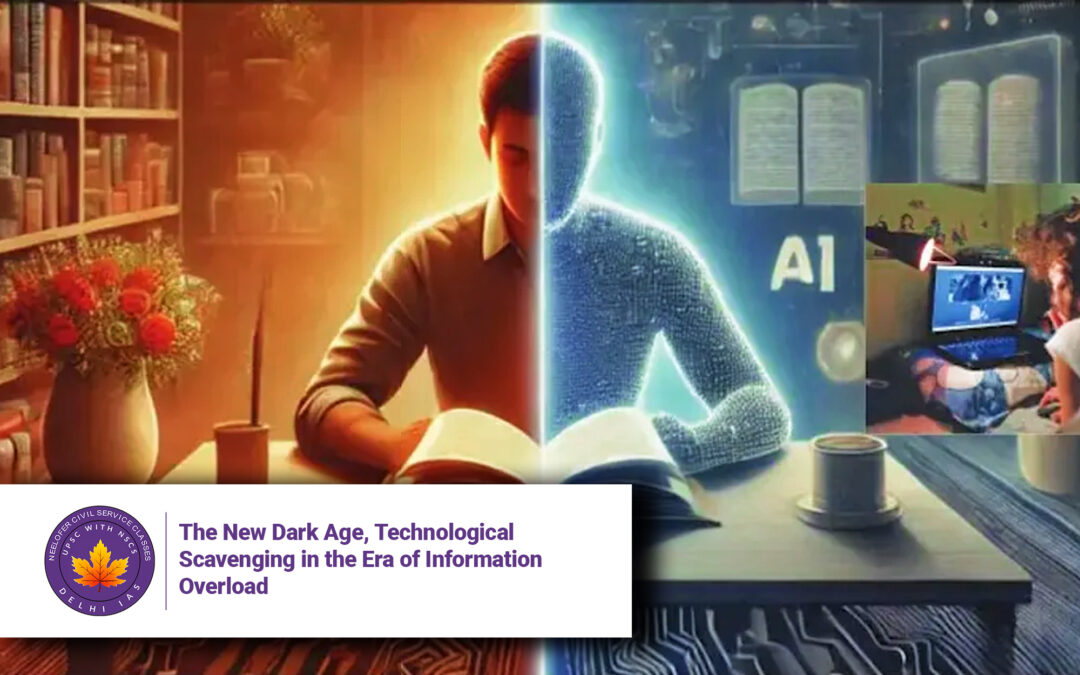
The New Dark Age, Technological Scavenging in the Era of Information Overload
Why in News?
In the 21st century, humanity stands at the intersection of dazzling innovation and deepening intellectual malaise. While technology has delivered unprecedented access to knowledge, it has also ushered in a wave of distractions, misinformation, and superficial engagement. The promise of progress is now being questioned, as democracies weaken, narcissism grows, and science is increasingly distrusted. As we inch further into what many intellectuals warn is a “New Dark Age,” concerns mount over the health of our institutions, the quality of our public discourse, and the future of rational thought.

The Digital Paradox: More Information, Less Wisdom
We live in a world saturated with data. From smartphones to AI algorithms, every tool claims to empower us. But the deluge of information has paradoxically made us less informed, less reflective, and more reactionary.
British writer James Bridle describes the internet era as an age of “technological barbarism”—a time when our minds are inundated with disconnected facts, fake news, conspiracy theories, and superficial entertainment. As attention spans shrink and deep thinking wanes, we risk becoming a species of technological scavengers—consuming without comprehension, scrolling without meaning.
This is not merely a crisis of intellect. It’s a civilisational turning point. The very tools that promised to democratise knowledge are now contributing to what analysts call “information poverty.” The result is widespread apathy, mistrust, and disengagement—conditions ripe for authoritarianism, disinformation, and societal fragmentation.
The Decline of Reason and the Rise of Anti-Science Sentiments
At the heart of the crisis is the erosion of reason. Nobel Laureate Venki Ramakrishnan laments the rise of “anti-science movements” which reject empirical evidence in favour of belief-based ideologies. In the digital age, every opinion seems to carry equal weight—regardless of its truth. Doubt, once the foundation of scientific inquiry, is now exploited to spread denialism and conspiracy.
In this “post-theory” society, as Ash Narain Roy writes, we are no longer moved by logic or proof. The Enlightenment ideals of skepticism, inquiry, and reasoned debate are losing ground. We have more data than ever, but less understanding. What Tagore once warned—the domination of fear over thought—is becoming reality.
Even democracies, once seen as bastions of rational public discourse, are faltering. Across nations, elected governments suppress dissent, manipulate media, and undermine institutional checks. When democracy becomes a mere ritual and the citizen a glorified employee, we edge closer to a dystopian future where thinking itself becomes suspect.
Digital Distractions and the Collapse of Public Debate
Today, information is abundant, but attention is scarce. In an attention economy, platforms compete not to inform but to provoke. Outrage, sensationalism, and viral gimmicks dominate the landscape. The result is a fractured society where public debate has collapsed under the weight of digital distraction.
Ash Roy observes that instead of emulating René Descartes’ maxim, “I think, therefore I am,” modern society seems to follow, “I am seen, therefore I am.” Social media and 24/7 news cycles demand constant engagement, eroding our capacity for solitude, reflection, and nuanced understanding. Truth becomes relative, and performance takes precedence over substance.
The younger generation, particularly Gen-Z, are caught in this vortex. Sociologists warn of declining mental health, growing alienation, and an epidemic of validation-seeking behavior. As David Brooks notes, many suffer from “rejection after rejection” in a world where self-worth is tied to likes, shares, and online visibility.
The Commodification of Attention and the New Political Economy
In this brave new world, attention has become the most coveted commodity. As Roy writes, “Attention, not money, is the fuel of politics.” Political actors, like corporations, now compete for our gaze—not our votes, not our ideas, but our time and outrage.
This transformation has profound consequences. When political discourse is reduced to viral moments, policies are crafted not for long-term good but for immediate applause. Serious issues such as climate change, inequality, and education reform are sidelined in favor of populist theatrics and polarizing narratives.
The new economy doesn’t produce ideas; it manufactures echo chambers. Algorithms feed us what we want to hear, confirming our biases and isolating us from alternative viewpoints. This accelerates political tribalism and the erosion of shared truths—making democratic consensus nearly impossible.
Surveillance Capitalism and the Politics of Technology
One of the gravest consequences of this new age is the rise of surveillance capitalism. Big Tech firms—once celebrated as innovation hubs—now behave like unregulated empires. As Roy warns, the new “plutocrats of Silicon Valley” are not just tech innovators; they are the new rulers of the digital age.
Companies harvest user data, manipulate behavior, and influence elections—often without consent or accountability. With governments either complicit or clueless, citizens are left vulnerable to manipulation, surveillance, and exploitation.
Moreover, the geopolitics of technology is intensifying. The U.S. and China are locked in a battle for AI supremacy, while smaller nations become arenas for digital experimentation and cyber warfare. As technological advancement becomes a proxy for power, its ethical and human costs are being overlooked.
Roy reminds us that innovation is not always progressive. Often, it serves the interests of the elite. When AI, automation, and biotechnology are guided by profit rather than principle, they widen inequality and deepen societal divides.
The Crisis in Academia and the Retreat of Knowledge
Universities, once temples of truth and reason, are also under siege. Funding cuts, ideological interference, and market pressures have eroded their autonomy. The romance with books and libraries has faded, replaced by a culture of instant gratification and shallow consumption.
This retreat from deep learning is dangerous. As Roy notes, science is becoming suspect, and universities are viewed as elitist ivory towers. The very institutions designed to question power are now struggling to protect their own intellectual freedom.
In many countries, academic freedom is being curtailed, critical thought is discouraged, and dissenting voices are silenced. This threatens the future of innovation, policy, and informed citizenship. Without robust institutions of learning, democracy itself becomes hollow.
Can We Reclaim the Age of Reason?
Despite the grim prognosis, hope is not lost. There is still a growing movement to reclaim reason, restore balance, and resist the tide of mindless consumption. Critical media literacy, civic education, and grassroots activism offer pathways to resistance.
Writers like Yuval Noah Harari have emphasized the urgency of preparing for technological disruption with humility and wisdom. The world needs a renewed commitment to truth, empathy, and shared values. We must rebuild institutions, reform algorithms, and empower citizens—not as users, but as thinking participants in democracy.
A new social contract is needed—one that protects digital rights, promotes ethical innovation, and places human dignity above profit. Citizens must demand transparency, accountability, and ethical leadership in both politics and technology.
As Roy points out, humanity’s future depends not just on the tools we invent, but on the values we choose. We must remember that while we cannot undo technological progress, we can choose how to use it—wisely or foolishly, for the common good or for private gain.
Conclusion
The “New Dark Age” is not a prophecy—it is a warning. A warning that unless we confront the crises of distraction, misinformation, and unreason, we risk losing the very essence of what it means to be human. As we marvel at artificial intelligence, we must not abandon human intelligence.
We need to defend truth in an era of lies, preserve reason in a time of chaos, and rebuild trust in a society torn by division. Only then can we emerge from the shadows of technological scavenging into a future of informed, reflective, and compassionate citizenship.
Quick Q&A
Q1: What is meant by a “New Dark Age”?
It refers to the current period where, despite technological advancements, society is becoming less rational, more distracted, and increasingly anti-science.
Q2: Why is democracy seen as being in decline?
In many nations, democratic institutions are being weakened by authoritarianism, surveillance, and the erosion of public trust.
Q3: What role does technology play in this decline?
While technology has increased access to information, it has also fostered misinformation, distracted engagement, and the commodification of human attention.
Q4: How are universities affected?
Academic institutions are under attack through funding cuts, ideological control, and public mistrust, reducing their ability to produce independent, critical thought.
Q5: Is there a way forward?
Yes. A renewed focus on media literacy, ethical innovation, institutional reform, and civic participation can help restore rational discourse and public trust.

