
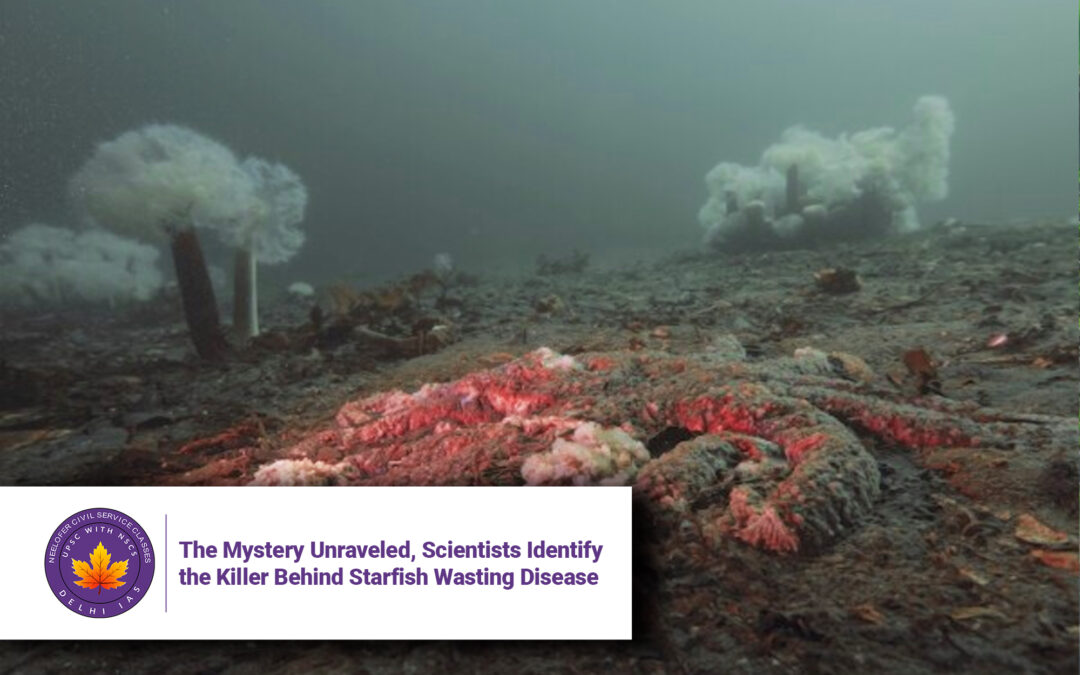
The Mystery Unraveled, Scientists Identify the Killer Behind Starfish Wasting Disease
Introduction
For over a decade, a mysterious and devastating epidemic has plagued starfish populations along the Pacific coast of North America. Known as Sea Star Wasting Disease (SSWD), this enigmatic illness caused sea stars to lose limbs and disintegrate into mush, baffling marine biologists and conservationists alike. Since its emergence in 2013, it has wiped out an estimated 5 billion starfish, altering marine ecosystems and triggering cascading ecological consequences.
Now, after twelve years, scientists have finally pinpointed the elusive killer: a bacterium named Vibrio pectenicida, a relative of the same microbial family that causes cholera in humans. The revelation, published on August 5 in the prestigious journal Nature, is a monumental step toward understanding—and eventually mitigating—this catastrophic marine disease.
This article dives deep into the journey of discovery, the science behind the breakthrough, and what this means for the future of starfish and ocean health.
A Decade-Long Marine Catastrophe
Since 2013, marine biologists have observed a horrifying phenomenon: sea stars (commonly known as starfish), once abundant and ecologically vital, were dying en masse. This wasn’t a quiet decline in population—it was a wasting epidemic.
Affected sea stars exhibited gruesome symptoms:
-
Limbs fell off spontaneously
-
Bodies melted into sludge
-
Death occurred rapidly, often within days
The disease didn’t discriminate—it hit multiple species of sea stars, from common varieties to rarer ones. The impact was especially devastating for the Sunflower Starfish (Pycnopodia helianthoides), once a dominant predator in kelp forest ecosystems.
The scope of destruction was staggering: over five billion sea stars perished along the Pacific coast of North America, from California to Alaska. This loss didn’t just spell trouble for starfish populations—it sent shockwaves through the entire marine ecosystem.
The Culprit: Vibrio pectenicida
After years of speculation and research dead ends, a team of scientists, led by marine biologists in Canada, made a groundbreaking discovery. The bacterium Vibrio pectenicida was identified as the true cause behind the disease.
This bacterium is part of the Vibrio family, infamous for including Vibrio cholerae, the microbe that causes cholera in humans. Though not identical, Vibrio pectenicida shares enough genetic and pathogenic similarities to raise alarm bells in the scientific community.
How was the bacterium discovered?
The journey to this discovery was long and complex. In the early years of the epidemic, scientists suspected a virus, particularly a densovirus, to be responsible. The densovirus was indeed found in some starfish but was later proven to be naturally present in healthy populations as well, thus casting doubt on its role in the disease.
Meanwhile, researchers studying tissue samples from dead starfish stumbled upon something intriguing: a bacterium present in the coelomic fluid, which is the equivalent of blood in starfish. This led them to suspect a bacterial cause.
The breakthrough came at the Hakai Institute in British Columbia, Canada, where scientists conducted controlled experiments on sunflower sea stars raised in laboratories. These sea stars were exposed to infected tissue and coelomic fluid from diseased individuals.
The findings were conclusive:
-
Physical contact with infected material caused healthy sea stars to develop wasting disease.
-
However, if the infected tissues were boiled before exposure, the disease did not spread, confirming the presence of a heat-sensitive, living organism—a bacterium, not a virus.
Further analysis confirmed that Vibrio pectenicida was the bacterium present in all diseased samples but absent in healthy ones.
Dr. Alyssa Gehman, co-author of the study, described the moment of discovery:
“When we compared the coelomic fluid of exposed and healthy sea stars, there was basically one thing different: Vibrio. We all had chills. We thought, ‘That’s it. We have it. That’s what causes wasting.’”
Why This Discovery Matters
1. Science can now fight back
Identifying the pathogen is the first and most critical step in combating any disease. With Vibrio pectenicida identified, scientists can now:
-
Develop diagnostics to detect the bacterium early
-
Study probiotics or antimicrobial agents to fight the infection in marine environments
-
Breed or genetically select Vibrio-resistant starfish in laboratories for potential rewilding
2. Ecosystem balance can be restored
The collapse of sea star populations didn’t happen in isolation. Sea stars, especially the Sunflower Star, are keystone predators in many marine ecosystems. They play a pivotal role in:
-
Controlling sea urchin populations, which feed on kelp
-
Maintaining kelp forests, essential underwater habitats that support biodiversity and sequester carbon
When starfish vanished, sea urchins exploded in number, decimating kelp forests. This led to a chain reaction:
-
Loss of habitat for fish, shellfish, and invertebrates
-
Decreased carbon sequestration, impacting climate regulation
-
Reduced food resources for marine mammals and seabirds
With the pathogen identified, there’s hope for rebuilding these damaged ecosystems.
Challenges Ahead
Environmental Factors and Climate Change
The Vibrio genus thrives in warm, nutrient-rich waters—conditions increasingly common due to climate change and coastal pollution. Rising sea temperatures may exacerbate outbreaks, making it harder to contain or eliminate the bacterium.
Ethical and Practical Limits of Intervention
Deploying antimicrobials or probiotics in open marine systems is complex and carries unintended consequences. Scientists must carefully balance intervention with ecological preservation.
Additionally, genetically engineering resistance in starfish could trigger ethical debates and regulatory challenges.
The Road Forward
Despite the hurdles, this discovery provides a roadmap for future conservation:
-
Monitoring and Early Warning Systems
Routine testing for Vibrio pectenicida in vulnerable regions could help detect outbreaks early. -
Protective Marine Zones
Creating safe havens for resistant starfish species could aid natural population recovery. -
Public Awareness and Funding
Greater visibility into the crisis could generate public support and research funding to accelerate solutions. -
Global Collaboration
As ocean currents are transboundary, tackling marine pandemics requires international scientific cooperation.
Conclusion
The identification of Vibrio pectenicida as the culprit behind Sea Star Wasting Disease is a landmark moment in marine biology. It ends years of uncertainty and opens a door to potential solutions. As humanity grapples with the broader effects of climate change, this discovery underscores the importance of scientific persistence and the intricate web of life that connects even the smallest creatures to the health of our planet.
The stakes are high—not just for starfish, but for the entire marine ecosystem and the future of oceanic biodiversity.
5 Key Questions and Answers
Q1: What is Sea Star Wasting Disease (SSWD)?
Answer: SSWD is a fatal condition affecting sea stars (starfish) characterized by loss of limbs, body disintegration, and death. It has caused the death of over 5 billion starfish along the Pacific coast since 2013 and was previously a mystery in terms of its cause.
Q2: What organism was identified as the cause of the disease?
Answer: The bacterium Vibrio pectenicida, a relative of the cholera-causing bacterium Vibrio cholerae, was found to be the cause of SSWD. It infects the coelomic fluid of starfish and leads to tissue degeneration and death.
Q3: How did scientists confirm Vibrio pectenicida as the culprit?
Answer: Scientists at the Hakai Institute exposed healthy sunflower sea stars to tissue and fluids from infected individuals. When the infected material was not heat-treated, the healthy stars developed the disease. Heat-treated material did not transmit the illness, confirming a bacterial cause. Further analysis consistently found Vibrio pectenicida in all diseased samples.
Q4: Why is this discovery important?
Answer: Understanding the cause of the disease allows scientists to begin developing prevention and treatment strategies. It also enables efforts to restore sea star populations, which are vital for controlling sea urchins and maintaining healthy kelp forest ecosystems that support marine biodiversity and carbon capture.
Q5: What are the broader ecological implications of starfish die-offs?
Answer: The disappearance of sea stars led to a massive increase in sea urchin populations, which in turn devoured kelp forests. These kelp forests are essential for supporting marine life, protecting coastlines, and sequestering carbon. Hence, the die-off has not only affected biodiversity but may also have contributed to climate instability.

