
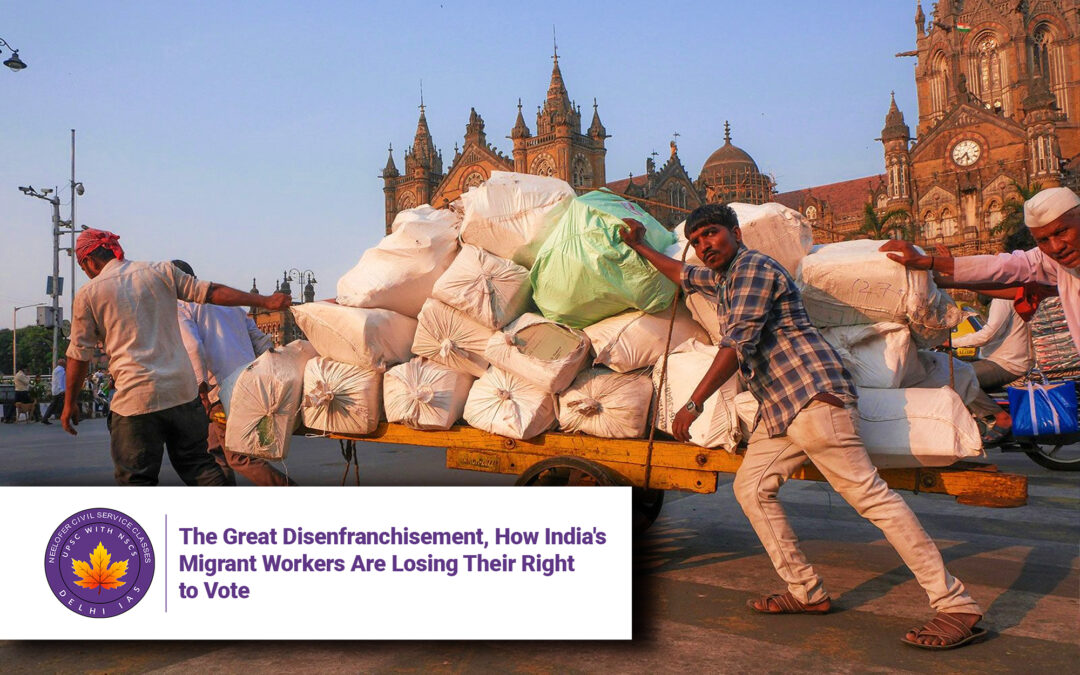
The Great Disenfranchisement, How India’s Migrant Workers Are Losing Their Right to Vote
Introduction
In Greek mythology, Odysseus faced an impossible choice—navigate between Scylla, a six-headed monster, and Charybdis, a deadly whirlpool. Today, India’s 150 million migrant workers confront a similar dilemma in Bihar’s electoral roll revision:
-
Stay registered in home constituencies (where they rarely reside) OR
-
Attempt re-registration in work states (where they lack documents).
The result? Mass disenfranchisement under the guise of technicalities. This crisis exposes how India’s electoral system fails its most vulnerable citizens—the construction laborers, security guards, and domestic workers who power urban economies but remain political ghosts.
Why in News?
-
Bihar’s “Special Intensive Revision” (SIR) of electoral rolls has dropped lakhs of migrant workers.
-
Reason: Classified as “permanently shifted/not found” due to absence during door-to-door verification.
-
Legal Catch-22:
-
Section 19, RP Act 1950: Requires “ordinary residence” to vote.
-
Migrants oscillate between native villages (where families live) and worksites (where they lack permanent address proof).
-
-
Political Backlash: States like Maharashtra, Tamil Nadu resist enrolling migrants, fearing “outsider influence.”
Key Issues and Analysis
1. The Legal Labyrinth: “Ordinary Residence” vs. Ground Reality
A. What the Law Says
-
Section 20, RP Act: A person is “ordinarily resident” where they habitually live, even if temporarily absent.
-
Gauhati HC Ruling (1999): Migrants can vote in native constituencies if they maintain family/property ties.
B. Why It Fails Migrants
-
ECI’s SIR Process: Drops voters if “not found” during verification—no consideration for seasonal migration.
-
Documentation Gap: Migrants lack rental agreements/Aadhaar-linked addresses at worksites.
-
Example: A Bihari construction worker in Mumbai lives in a makeshift hut (no “proof of residence”), but his family/home remains in Bihar.
2. The Political Calculus: Why States Fear Migrant Votes
| State | Migrant Population | Political Resistance |
|---|---|---|
| Maharashtra | ~8 million | Shiv Sena fears “North Indian voter sway.” |
| Tamil Nadu | ~3 million | DMK opposes “Hindi-belt influence.” |
| Kerala | ~2.5 million | Left govt. supports inclusion but lacks mechanism. |
Case Study: Bihar’s Migrant Muscle
-
60% of Delhi’s construction workers are Bihari migrants.
-
But in 2020 Delhi riots, many couldn’t vote—registered in Bihar, absent during elections.
3. Technological Solutions: Remote Voting Pilot & Why It Stalled
-
ECI’s Multi-Constituency RVM (Remote Voting Machine):
-
Allowed voting for 72 constituencies from one booth.
-
Pilot scrapped in 2023 after parties cried “fraud risk.”
-
-
Alternative Ideas:
-
Postal ballots for migrants (like NRIs).
-
Blockchain-based e-voting (Estonia model).
-
Why Resistance?
-
Regional parties fear losing control over “vote banks.”
-
Administrative hurdles: No bipartisan trust in tech.
5-Point Roadmap for Inclusive Elections
1. Amend RP Act
-
Define “ordinary residence” flexibly for migrants (e.g., 6+ months work = eligibility).
2. Portable Voter IDs
-
Aadhaar-linked temporary registration at worksites.
3. Mandatory Paid Voting Leave
-
2-day paid leave for migrants to return home.
4. National Migrant Registry
-
Track movement via welfare schemes (e.g., e-Shram data).
5. All-Party Consensus on Remote Voting
-
Revive RVM with opposition input to ensure transparency.
Conclusion: Democracy Cannot Have Ghost Citizens
India’s “economic backbone”—its migrants—are being reduced to political non-entities. The Supreme Court must intervene to:
✔ Halt arbitrary voter deletions in Bihar.
✔ Direct ECI to adopt migrant-friendly registration.
As Rangarajan R. (former IAS) notes:
“When 15 crore Indians lose voting rights, democracy becomes a farce.”
The choice is clear: Reform or accept electoral apartheid.
5 Key Questions & Answers
Q1: How many migrants risk losing voting rights?
A1: ~15 crore (PLFS 2021)—equivalent to Japan’s population.
Q2: Can migrants register in work states?
A2: Technically yes, but most lack documents to prove “ordinary residence.”
Q3: Why did remote voting fail?
A3: Opposition parties feared misuse; tech needed more testing.
Q4: Which countries allow migrant voting?
A4: USA (absentee ballots), Philippines (postal votes for OFWs).
Q5: What’s the #1 reform needed?
A5: Legal recognition of seasonal migration in voter registration.

