
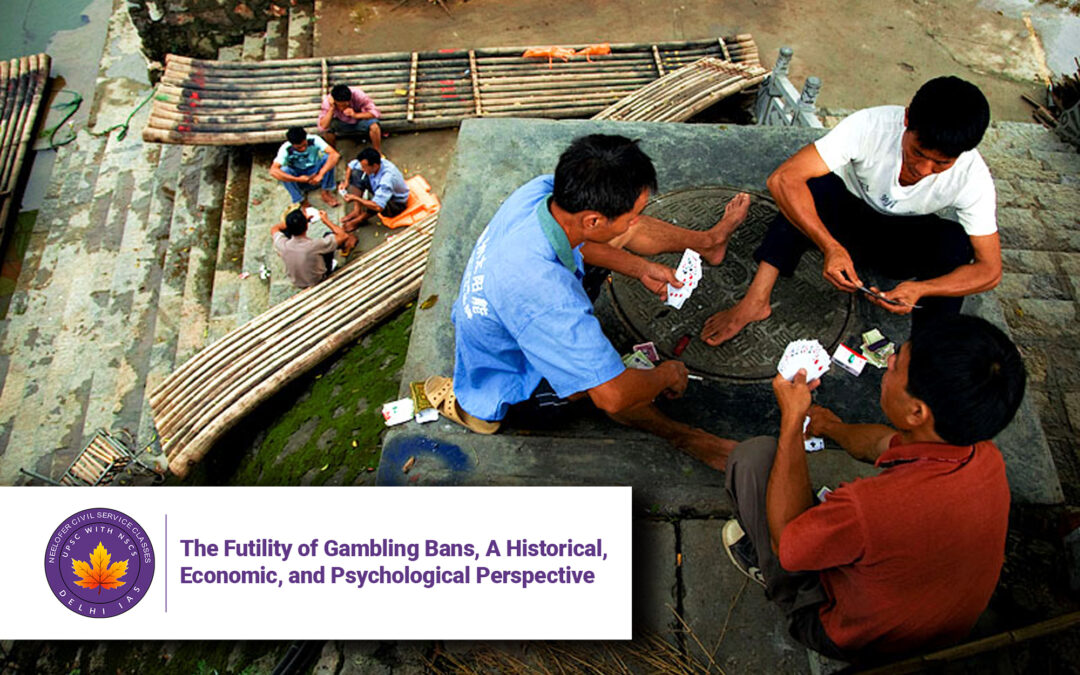
The Futility of Gambling Bans, A Historical, Economic, and Psychological Perspective
Why in News?
The Indian government’s recent introduction of stringent online gaming rules, aimed at curbing gambling, has sparked significant debate. Drawing historical parallels from Stalin’s Soviet Union and Khomeini’s Iran, where bans on card games failed to eradicate gambling, this analysis argues that prohibitive measures are inherently ineffective. Instead, they drive activities underground, foster illegal markets, and stifle innovation. The new regulations have already led to billions of dollars in losses for gaming platforms and threatened thousands of jobs. This examination delves into the evolutionary roots of gambling, its economic implications, and the unintended consequences of blanket bans, advocating for a regulated approach that balances consumer protection with entrepreneurial freedom.
Introduction
Gambling, in various forms, has been a part of human civilization for millennia. From ancient dice games to modern online platforms, the urge to take risks is deeply embedded in human psychology. Recent attempts by the Indian government to clamp down on online gambling through harsh regulations echo historical failures, such as Stalin’s efforts to eliminate card games in the Soviet Union and Iran’s ban under Islamic rule. These examples demonstrate that prohibitions often exacerbate the very problems they seek to solve. This analysis explores the multifaceted nature of gambling, its role in innovation and economic activity, and the pitfalls of regulatory overreach. By examining the broader context, we can better understand why bans are counterproductive and how a more nuanced approach might yield better outcomes.
Key Issues
1. Historical Precedents of Failed Bans
-
Soviet Union under Stalin: In the 1930s, Stalin attempted to eradicate gambling by reducing card production. However, Russians resorted to smuggled Swedish cards, and the state eventually continued production while using harsh measures like Gulags for “re-education.” Despite these efforts, card games persisted, and the USSR produced skilled bridge and poker players long after its collapse.
-
Iran’s Islamic Regime: Iran’s ban on card games due to their association with gambling proved unenforceable. Iranians continued playing discreetly with smuggled cards, highlighting the resilience of gambling practices against state repression.
-
Lesson: These cases show that gambling cannot be eliminated through prohibition; it simply goes underground, often with worse consequences.
2. The Evolutionary and Psychological Basis of Gambling
-
Risk-Taking as Survival: Evolutionary psychology suggests that risk-taking is hardwired into humans. Early humans had to gamble on hunting, foraging, and social interactions to survive and reproduce.
-
Modern Manifestations: Today, this instinct manifests in entrepreneurship, investment, and innovation. Figures like Bill Gates, Steve Jobs, and Elon Musk took significant risks (e.g., dropping out of college, overstaying visas) to achieve success.
-
Gambling in Finance and Insurance: Activities like stock trading, venture capital, and even paying life insurance premiums involve calculated risks, underscoring gambling’s foundational role in modern economies.
3. Economic Impact of Online Gaming Regulations
-
Job Losses and Valuation Drops: The new rules have led to an estimated loss of over 20,000 jobs in India’s online gaming industry and wiped out billions of dollars in platform valuations.
-
Stifling Innovation: By outlawing broad categories of games, the regulations deter programmers and digital artists from developing new games, crushing creativity and legitimate livelihood opportunities.
-
Comparative Penalties: The penalties under India’s new rules are less severe than those in historical cases (e.g., Gulags in the USSR), but they still pose significant threats to the digital economy.
4. The Rise of Underground Markets
-
Dark Web and Cryptocurrencies: Bans push gamblers towards anonymous platforms on the Dark Web, where transactions occur in cryptocurrencies, making regulation and monitoring nearly impossible.
-
Increased Risks: Underground markets lack consumer protections, leading to higher risks of fraud, addiction, and financial loss for participants.
-
Accelerated Adoption of Illicit Systems: Just as Soviets used smuggled cards, Indians may increasingly turn to offshore platforms, accelerating the adoption of unregulated systems.
5. The Educational Value of Gaming Platforms
-
Learning Risk Management: Online gaming platforms serve as test beds where individuals can learn probability, statistics, and risk management in an engaging manner. Games involving Markov Chains, Monte Carlo simulations, and probability theory offer practical education that classrooms often fail to provide.
-
Pathways for Talent: Aspiring game developers use these platforms to monetize innovations. Bans block these pathways, forcing talent to seek opportunities abroad or in illicit markets.
6. Psychological and Social Considerations
-
Addiction and Harm Reduction: While gambling addiction is a serious issue, bans do not address root causes. Regulated environments can implement safeguards like spending limits, self-exclusion options, and awareness campaigns.
-
Cultural Context: Gambling is embedded in many cultural practices, from festival games to stock market participation. Blanket bans ignore these nuances and criminalize ordinary behaviors.
Alternative Approaches
-
Regulation Instead of Prohibition:
-
Implement a licensing system for online gaming platforms, ensuring compliance with consumer protection standards.
-
Use technology like AI to monitor for addictive behaviors and intervene proactively.
-
-
Taxation and Revenue Generation:
-
Legalize and tax online gambling to generate government revenue, which can fund addiction treatment programs and public services.
-
-
Education and Awareness:
-
Integrate financial literacy and risk management education into school curricula, using gaming simulations as teaching tools.
-
Launch public campaigns on responsible gambling, similar to those for alcohol and tobacco.
-
-
Support for Innovation:
-
Create sandbox environments where game developers can test new ideas without immediate regulatory burdens.
-
Offer grants and incentives for developing educational games that teach probability and statistics.
-
-
International Collaboration:
-
Work with global regulators to track and shut down illicit offshore platforms while promoting legal alternatives.
-
Challenges and the Way Forward
-
Cultural Resistance: Deep-seated moral objections to gambling may hinder rational discourse on regulation.
-
Enforcement Difficulties: Detecting and penalizing underground activities requires significant resources and technical expertise.
-
Balancing Freedom and Protection: Policies must protect vulnerable individuals without stifling economic activity and personal freedoms.
The Way Forward:
-
Evidence-Based Policy: Conduct studies to understand the impacts of gambling and the effectiveness of different regulatory approaches.
-
Stakeholder Engagement: Involve gamers, developers, psychologists, and economists in crafting regulations.
-
Phased Implementation: Start with pilot programs in regulated environments to assess outcomes before nationwide rollout.
Conclusion
The instinct to gamble is an indelible part of human nature, intertwined with our evolutionary history and modern economic systems. Historical attempts to ban gambling, from Stalin’s USSR to Khomeini’s Iran, have consistently failed, driving activities underground and creating worse problems. India’s new online gaming rules risk repeating these mistakes, jeopardizing jobs, innovation, and economic growth. Instead of prohibition, a regulated approach that acknowledges the realities of human behavior and leverages technology for harm reduction offers a more pragmatic path forward. By embracing regulation, education, and innovation, India can harness the positive aspects of risk-taking while mitigating its dangers, turning a potential vice into a vehicle for learning and progress.
5 MCQs Based on the Article
Q1. Why did Stalin’s attempt to eradicate gambling in the Soviet Union fail?
A) Russians switched to digital games
B) Russians used smuggled cards from Sweden
C) Stalin died before implementation
D) Gambling was not popular in the USSR
Answer: B) Russians used smuggled cards from Sweden
Q2. What is a major immediate impact of India’s new online gaming rules?
A) Increase in foreign investment
B) Loss of jobs and devaluation of gaming platforms
C) Rise in cryptocurrency usage
D) Elimination of all gambling
Answer: B) Loss of jobs and devaluation of gaming platforms
Q3. How does the article describe the evolutionary basis of gambling?
A) As a modern phenomenon
B) As a hardwired instinct for risk-taking
C) As a result of capitalist societies
D) As unrelated to human survival
Answer: B) As a hardwired instinct for risk-taking
Q4. What alternative approach does the article suggest instead of banning gambling?
A) Strict enforcement with harsher penalties
B) Regulation, taxation, and education
C) Complete elimination of online platforms
D) Promoting only physical gambling
Answer: B) Regulation, taxation, and education
Q5. What is a potential consequence of driving gambling underground?
A) Improved consumer protections
B) Increased use of Dark Web and cryptocurrencies
C) Higher tax revenue for the government
D) Decreased addiction rates
Answer: B) Increased use of Dark Web and cryptocurrencies

