
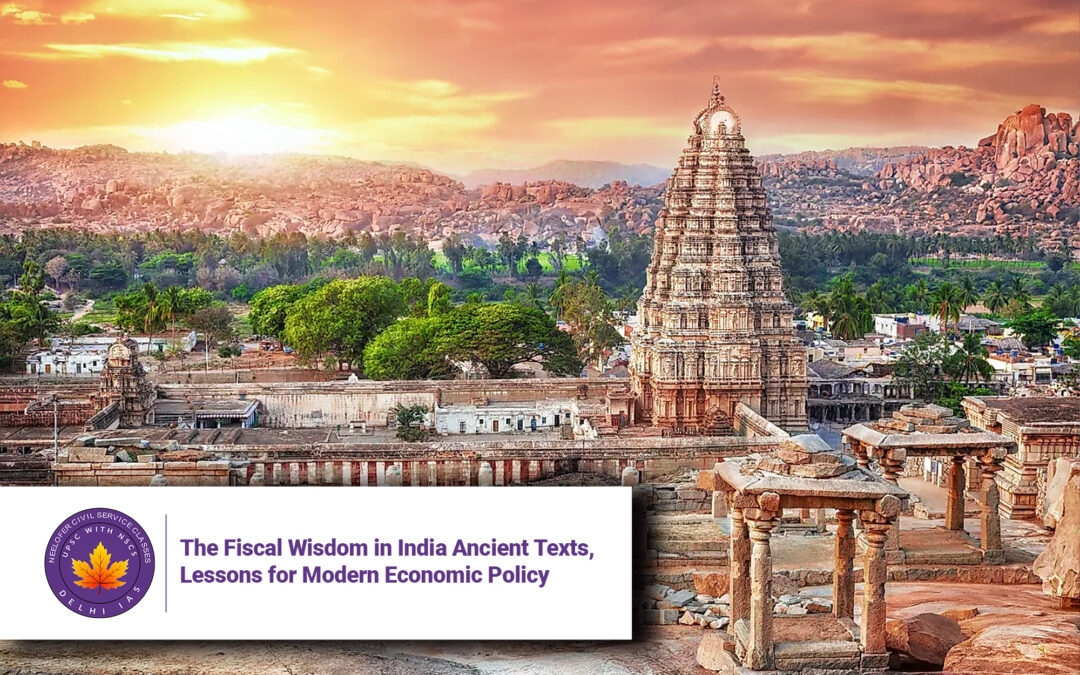
The Fiscal Wisdom in India Ancient Texts, Lessons for Modern Economic Policy
Why in News?
India’s sustainable economic model is under increasing scrutiny as the nation aims to expand its economy, improve governance, and address fiscal challenges. PC Jha, Advisor to the FICCI Committee Against Smuggling and Counterfeiting Activities Destroying Economy, has highlighted how ancient Indian texts such as the Arthashastra and Manusmriti offer timeless guidance for economic governance, taxation, and public finance. These principles, if integrated into modern fiscal policy, could provide India with a strong, resilient, and inclusive growth path.
Introduction
For centuries, India’s ancient knowledge has been revered for its spiritual, philosophical, and cultural richness. However, its contributions to practical governance, economics, and public finance are equally profound. Unlike modern approaches that often draw inspiration from Western economic models, India’s own intellectual tradition provides sustainable, people-centric solutions to nation-building.
Two of the most important works in this field are the Arthashastra by Kautilya (Chanakya) and the Manusmriti. These texts reflect governance models that prioritize welfare over mere revenue extraction, transparency over opacity, and sustainability over short-term gains. They emphasize creating economic systems that are fair, moderate, and resilient—values that resonate strongly with the needs of present-day India.
Ancient Foundations of Economic Governance
The Arthashastra and the Mauryan Empire
The Arthashastra was compiled during the reign of Chandragupta Maurya in the 4th century BCE, a time when the Indian subcontinent was fragmented into warring states. Under the guidance of Kautilya, Chandragupta established the Mauryan Empire, one of the largest and most organized states in ancient history.
Kautilya’s work was not merely a political treatise; it was an all-encompassing manual on governance, military strategy, diplomacy, taxation, economic management, and public administration. It recognized that sustainable governance required a careful balance between revenue generation and public welfare.
The Arthashastra’s vision can be summarized in the term yogakshema—a combination of yoga (resource acquisition) and kshema (resource utilization for welfare). This philosophy emphasized that state power should not come from extracting wealth from citizens, but from empowering them to be productive participants in the economy.
The Taxation Philosophy of the Arthashastra
One of the most notable aspects of the Arthashastra is its approach to taxation. It recommended a moderate tax rate of one-sixth of a citizen’s income (approximately 16.67%), designed to encourage compliance while still funding state responsibilities.
The system had several distinctive features:
-
Fairness and Proportionality: Taxes were to be fair, moderate, and proportionate to income.
-
Transparency: Taxpayers were entitled to know how their money was being spent.
-
Strict Oversight: Tax officials were monitored to prevent corruption.
-
Revenue Reinvestment: Taxes were reinvested into agriculture, infrastructure, education, and public services.
-
Relief During Crisis: The state was to provide tax relief during natural calamities.
Modern economic theory, including the Laffer curve, supports Kautilya’s view that moderate taxation improves compliance and strengthens revenue collection.
Manusmriti and Social Responsibility
While the Arthashastra focused on statecraft, the Manusmriti dealt with the moral and ethical dimensions of governance. It underscored the importance of rulers acting with fairness, integrity, and a sense of duty toward their citizens. Together, these texts created a holistic model of governance that linked economic policy with social justice.
Relevance to India’s Modern Economic Challenges
Current Fiscal Objectives
India is working to:
-
Increase its tax-to-GDP ratio
-
Expand the formal economy
-
Achieve the $5-trillion economy target by 2027
-
Realize the Viksit Bharat 2047 vision
However, these goals face hurdles such as tax evasion, narrow tax bases, complex GST structures, and informal market dominance.
Learning from Ancient Wisdom
Ancient principles can guide modern reforms:
-
Moderate, Fair Taxation: Avoid excessive rates that deter compliance.
-
Transparency in Public Spending: Citizens should see tangible returns—better infrastructure, public services, and security.
-
Redistribution for Equity: As in Kautilya’s time, redistribute wealth to ensure inclusive growth.
-
Crisis-Responsive Policies: Provide relief in times of hardship, ensuring economic resilience.
Comparing Colonial and Indigenous Approaches
India’s fiscal system inherited many traits from colonial taxation models, which prioritized revenue extraction over welfare. The Arthashastra, in contrast, emphasized empowerment, productivity, and redistribution. Moving toward the latter model could enhance both compliance and public trust.
Challenges Ahead
-
Broadening the Tax Base: Bringing informal workers and businesses into the tax net.
-
Simplifying GST: Reducing the number of slabs to encourage ease of compliance.
-
Curbing Evasion: Strengthening enforcement and using technology for monitoring.
-
Reducing Inequality: Ensuring that growth benefits reach all citizens, not just a few.
-
Aligning with Ability to Pay: Taxes should be proportionate to economic capacity.
The Way Forward
India’s fiscal transformation must draw from both ancient insights and modern innovations:
-
Implementing moderate, predictable tax rates
-
Using technology for efficient collection and transparency
-
Encouraging voluntary compliance through trust-based governance
-
Prioritizing public welfare spending over administrative expansion
-
Ensuring sustainability in growth by balancing economic expansion with social stability
In this process, India must avoid blindly replicating the growth models of developed nations, which often focus on short-term GDP spikes without ensuring equitable distribution.
Conclusion
India’s ancient economic wisdom offers a powerful template for creating a fair, efficient, and resilient fiscal system. The Arthashastra’s principles—moderate taxation, reinvestment in public welfare, and transparency—are not relics of the past; they are practical tools for navigating the complex fiscal realities of today. As India moves toward becoming a developed nation by 2047, blending this timeless wisdom with contemporary policy frameworks can help ensure that economic growth is both sustainable and inclusive.
Q&A Section
1. What is the central economic philosophy of the Arthashastra?
The Arthashastra emphasizes yogakshema, meaning resource acquisition (yoga) and their effective use for welfare (kshema), promoting moderate taxation, transparency, and reinvestment in public welfare.
2. How did the Mauryan Empire implement economic governance?
Under Chandragupta Maurya, guided by Kautilya, the empire adopted structured administration, fair taxation, public spending in welfare sectors, and strong military and diplomatic policies.
3. What was the tax rate suggested in the Arthashastra?
The text prescribed a tax rate of one-sixth of a citizen’s income (around 16.67%), designed to be low enough to encourage compliance yet sufficient to fund governance.
4. How can ancient fiscal principles help modern India?
By adopting moderate tax rates, improving transparency in spending, providing crisis relief, and redistributing wealth, India can build a more inclusive and compliant economy.
5. What fiscal challenges does India face today?
Challenges include a narrow tax base, high GST complexity, tax evasion, informal market dominance, and ensuring tax rates align with citizens’ ability to pay.

