
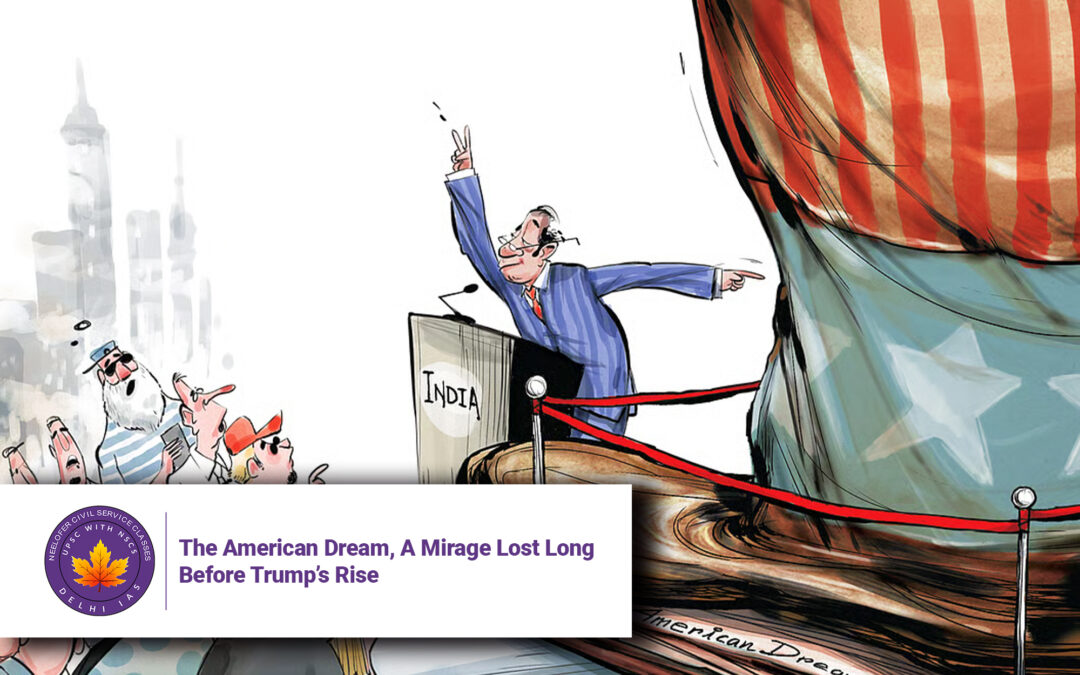
The American Dream, A Mirage Lost Long Before Trump’s Rise
Why in News?
As global socio-political dynamics evolve, the idea of the “American Dream”—once a symbol of hope and prosperity—has come under intense scrutiny. The article by Sugata Srinivasaraju revisits the historical and ideological shifts that led to the erosion of this dream long before former US President Donald Trump entered the political arena. 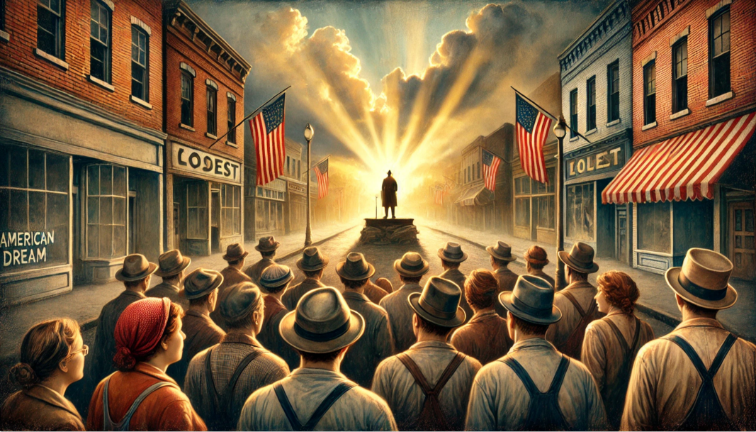
Introduction
The American Dream once inspired millions globally with its promises of freedom, upward mobility, and prosperity. But the rise of neoliberalism, economic inequality, and cultural conservatism have corroded that dream over decades. This has not only reshaped American society but also impacted global perceptions of the U.S., including India’s middle class, which borrowed from this dream during its own rise in the 1980s and 1990s.
Core Ideas from the Article
1. The Fall of the “Free World” Ideal
-
Critics argue the idea of “freedom” in the U.S. is increasingly rhetorical, often contradicted by domestic policies and global military strategies.
-
The American identity has shifted from liberal optimism to protectionism, materialism, and exclusivity, undermining its once universal appeal.
2. Neoliberalism and the Shift in Values
-
The 1970s rise of neoliberalism turned the US into a land of share-the-wealth cynicism, focused on deregulation and profit.
-
This shift empowered Wall Street over welfare, creating an economy of winners and losers, where vast sections of society were left behind.
3. India’s Relationship with the American Dream
-
In India, the post-1991 liberalisation era mimicked the American ethos, emphasizing individualism and material success.
-
The “brain drain” symbolized this chase for a better life abroad, though many later saw through the illusion as inequality widened even in the U.S.
4. Who Was the Dream Meant For?
-
Though idealized as universal, the American Dream excluded the poor, minorities, elderly, and disabled, offering comfort only to the economically privileged.
-
Economic insecurity, health care inequities, and racial segregation were swept under the rug for decades.
5. New Voices, New Critiques
-
Thinkers like Hendrik Smith and Michael Sandel have challenged the structural flaws of the American dream, including its dependence on meritocratic competition and systemic exclusion.
Five Key Takeaways
-
Neoliberal economic reforms in the 1970s reshaped the U.S., prioritizing profit over equity, and undermining the original ideals of the American Dream.
-
The middle-class expansion in India during the 1980s-90s was heavily influenced by this American narrative, especially during the IT boom and globalisation.
-
Despite its glamour, the American dream excluded vulnerable populations, creating a false ideal of prosperity.
-
The dream’s erosion began long before Trump, who merely amplified existing fault lines.
-
Intellectuals worldwide have begun to question the validity and ethics of the dream, calling for deeper systemic reform.
Q&A Section
1. What does the term “American Dream” originally signify?
It signifies the belief that anyone, regardless of background, can achieve success, prosperity, and upward mobility through hard work in America.
2. When did the erosion of this dream begin, according to the article?
The erosion began during the 1970s, with the rise of neoliberal economic policies and a shift in focus from welfare to corporate profits.
3. How did India adopt the idea of the American Dream?
India borrowed the dream during the post-liberalization phase in the 1980s and 1990s, especially among the urban middle class, who associated it with opportunity, success, and Westernization.
4. Why do many now view the American Dream as a ‘myth’?
Because it excluded marginalized groups, failed to address inequalities, and became tied to exploitative economic systems favoring the rich.
5. What is the global significance of rethinking the American Dream?
As the U.S. influence shapes many emerging economies, rethinking the dream allows countries like India to develop their own inclusive growth models, free from outdated neoliberal blueprints.

