
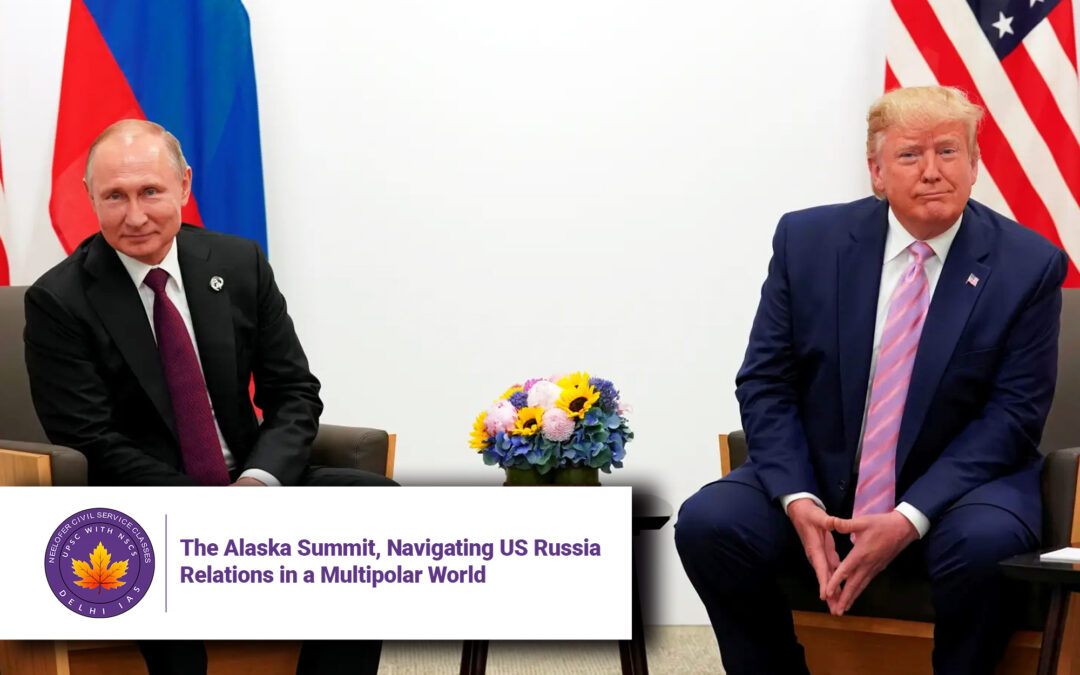
The Alaska Summit, Navigating US-Russia Relations in a Multipolar World
Why in News?
The recent high-stakes summit between the United States and Russia in Alaska has captured global attention as a critical diplomatic engagement amid escalating geopolitical tensions. Against the backdrop of the Ukraine conflict, nuclear arms control uncertainties, and shifting energy dynamics, the meeting aimed to address contentious issues such as sanctions, territorial disputes, and strategic stability. Notably, the summit also highlighted the evolving role of middle powers like India, whose energy purchases from Russia have become a focal point in global politics. While the talks yielded no groundbreaking agreements, they underscored the enduring importance of dialogue in managing great-power competition and preventing catastrophic conflict.
Introduction
Diplomacy in the 21st century is increasingly characterized by complexity, multipolarity, and the interplay of competing interests. The Alaska summit, set against the stark and symbolic backdrop of a former Russian territory now owned by the U.S., epitomized these dynamics. Bringing together seasoned diplomats from both nations, the meeting sought to navigate a range of issues—from the war in Ukraine to nuclear arms control and energy security. This analysis delves into the key outcomes, implications, and broader significance of the summit, situating it within the context of a rapidly changing world order where traditional alliances are being recalibrated and new power centers are emerging.
Key Issues
1. The Ukraine Conflict and Territorial Sovereignty
-
Land Swap Discussions: The summit quietly broached the idea of a Russia-Ukraine land swap, though it was not formally proposed. This concept, which has circulated in policy circles, suggests a potential compromise involving contested regions like Donbas and Crimea. However, both Moscow and Kyiv maintain rigid positions on territorial integrity, making any such agreement highly improbable in the near term.
-
Humanitarian Corridors: The parties agreed to maintain humanitarian corridors in select Ukrainian regions, a small but meaningful step toward alleviating the human cost of the conflict.
-
Sanctions and Security: The U.S. linked sanctions relief to verifiable Russian de-escalation, including troop withdrawals and an end to cyber operations against Western networks. For Russia, sanctions relief is not only economically vital but also a matter of national prestige.
2. Nuclear Arms Control and Strategic Stability
-
New START and Beyond: With the New START treaty hanging by a thread and Russia’s withdrawal from key nuclear inspection protocols, the summit aimed to prevent a new arms race. Both sides expressed guarded optimism about maintaining strategic stability but acknowledged deep-seated mistrust.
-
Mid-Level Diplomatic Contacts: The commitment to resume mid-level diplomatic talks on arms control represents a modest but important confidence-building measure.
3. Energy Politics and Climate Change
-
India’s Role: India’s increased purchases of discounted Russian crude oil emerged as a significant discussion point. This pragmatic approach to energy security has drawn Western criticism but reflects India’s strategy of balancing ties with the U.S. while securing vital resources from Russia.
-
Arctic Interests: The melting Arctic ice due to climate change has opened new opportunities and tensions in commercial navigation, energy exploration, and military presence. Both nations recognize the need for cooperation in this fragile region, even as they compete for influence.
-
Energy Working Group: The creation of an energy working group, which will include consultations with major consumers like India, signals a willingness to engage on global energy challenges.
4. The Role of Middle Powers
-
India’s Balancing Act: India’s presence in the dialogue underscores the decline of Cold War-era binaries. Middle powers like India, Brazil, and Indonesia are pursuing hybrid strategies, engaging with multiple blocs to serve their national interests.
-
Diplomatic Signaling: For Russia, India’s energy purchases are both an economic lifeline and a diplomatic statement that Moscow is not isolated. For the U.S., engaging with these powers is essential to maintaining global influence.
5. Symbolism and Substance
-
The Alaska Setting: The choice of Alaska—a former Russian territory—as the venue was rich with historical irony and symbolism. It represented both geographical and ideological middle ground.
-
The Limits of Dialogue: While the summit did not produce major breakthroughs, it demonstrated that even adversaries can engage in difficult conversations. This in itself is a victory in an era of escalating tensions.
Alternative Perspectives
-
Optimistic View:
-
The summit reaffirmed the importance of diplomacy in preventing conflict and managing competition. Small steps, such as agreeing on humanitarian corridors and resuming arms talks, can build momentum for larger agreements.
-
-
Pessimistic View:
-
The meeting risked normalizing Russian aggression in Ukraine and sending mixed signals to allies. Without concrete concessions, diplomacy may serve as a cover for continued hostility.
-
-
Realist View:
-
The summit reflected the pragmatic recognition that great powers must coexist despite differences. The involvement of middle powers like India highlights the shifting dynamics of global politics.
-
Challenges and the Way Forward
-
Implementation: The real test of the summit will be in the follow-through. Commitments on humanitarian corridors and arms control must be translated into action.
-
Ukraine’ Future: Any lasting solution will require addressing the legitimate security concerns of both Ukraine and Russia, likely through a negotiated settlement that involves international guarantees.
-
Energy Diversification: For nations like India, balancing energy imports from Russia with relationships with Western partners will remain a delicate task.
-
Climate Cooperation: The Arctic represents both a zone of competition and a potential area for U.S.-Russia collaboration on climate change and resource management.
The Way Forward:
-
Strengthening Diplomacy: Regular high-level engagements should be institutionalized to prevent misunderstandings and manage crises.
-
Involving Middle Powers: Forums like the G20 and BRICS can provide platforms for mediating great-power disputes and addressing global challenges.
-
Promoting Multilateralism: The U.S. and Russia should work within international institutions to uphold norms on sovereignty, human rights, and environmental protection.
Conclusion
The Alaska summit may not have ended the Ukraine war or lifted sanctions, but it served as a reminder that diplomacy remains an indispensable tool in international relations. In a world where power is increasingly diffuse, and challenges like climate change and nuclear proliferation demand collective action, even adversaries must find ways to cooperate. The involvement of middle powers like India underscores the emergence of a more complex and multipolar world order. As the ice melts in Alaska and the Arctic, so too must the frostiness in U.S.-Russia relations thaw—if only gradually—through dialogue, pragmatism, and a shared recognition of common interests.
5 MCQs Based on the Article
Q1. What was a key symbolic aspect of the Alaska summit venue?
A) It was the site of a previous U.S.-Russia conflict
B) It was a former Russian territory purchased by the U.S.
C) It is the geographical midpoint between Washington and Moscow
D) It is neutral ground under UN jurisdiction
Answer: B) It was a former Russian territory purchased by the U.S.
Q2. Which country was highlighted for its role in energy politics during the summit?
A) China
B) India
C) Saudi Arabia
D) Germany
Answer: B) India
Q3. What was one of the modest deliverables achieved at the summit?
A) A permanent ceasefire in Ukraine
B) Lifting of all sanctions on Russia
C) Creation of an energy working group
D) A new nuclear arms treaty
Answer: C) Creation of an energy working group
Q4. What did the U.S. link to sanctions relief for Russia?
A) Increased oil exports to Europe
B) Verifiable progress on troop withdrawals and cyber operations
C) Recognition of Crimea as Russian territory
D) Payment of war reparations to Ukraine
Answer: B) Verifiable progress on troop withdrawals and cyber operations
Q5. How does the article characterize the role of middle powers like India?
A) As passive bystanders in great-power competition
B) As allies of Russia against the West
C) As pursuing hybrid strategies and engaging with multiple blocs
D) As irrelevant to diplomatic discussions
Answer: C) As pursuing hybrid strategies and engaging with multiple blocs

