
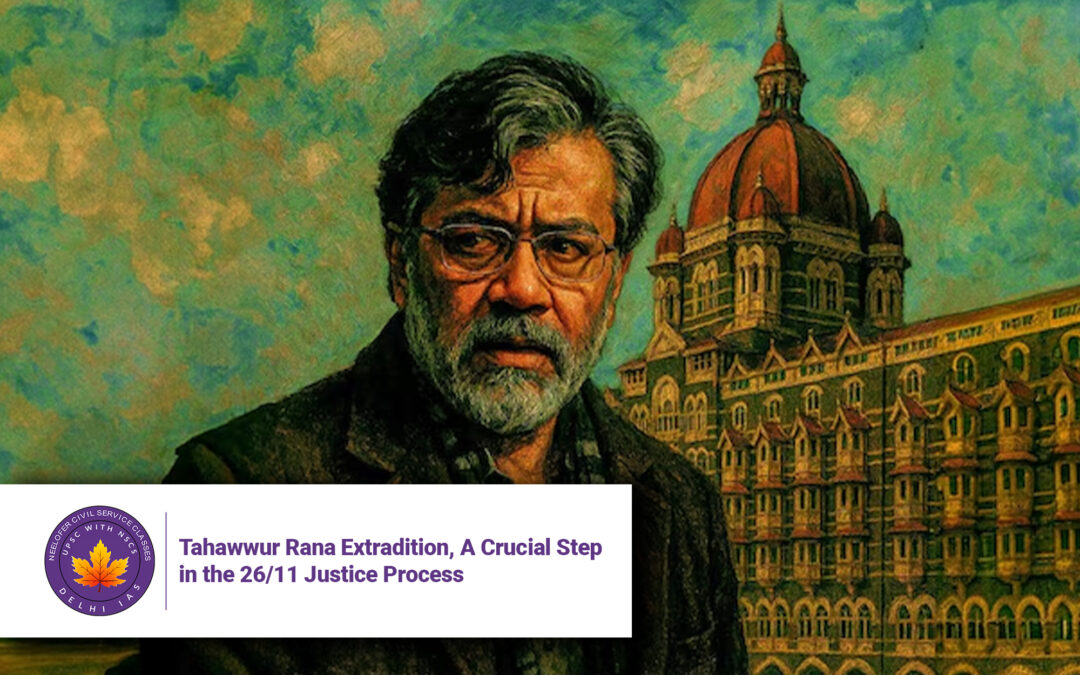
Tahawwur Rana Extradition, A Crucial Step in the 26/11 Justice Process
Why in News?
Seventeen years after the horrific 26/11 Mumbai terror attacks, India has taken a major step forward with the extradition of Tahawwur Hussain Rana from the United States. Rana, an alleged co-conspirator in the attacks, will now face trial in India. 
Introduction
The 2008 Mumbai attacks, which left 166 people dead, stand as one of the most brutal terror incidents in India’s history. Tahawwur Rana’s extradition is seen as a diplomatic and investigative success for India, offering hope for deeper justice and accountability. Rana, a Canadian-American citizen and former Pakistan military doctor, was involved in assisting David Headley — the Lashkar-e-Taiba (LeT) operative who conducted reconnaissance for the attacks.
Key Issues and Background
-
Who is Tahawwur Rana?
Rana was arrested in the U.S. in 2009 for aiding David Headley in planning the 26/11 attacks and another terror conspiracy in Copenhagen. Though he wasn’t convicted for the Mumbai attacks in the U.S., he was sentenced for his involvement in the Copenhagen plot and served part of a 14-year sentence. -
His Connection to David Headley
Rana was Headley’s childhood friend and helped facilitate his travel to India for reconnaissance. Headley later turned approver in the U.S., receiving immunity from extradition under a plea deal, a decision that remains controversial in India. -
Purpose of the Extradition
The extradition will allow Indian prosecutors to try Rana for his alleged role in the 26/11 attacks and investigate his links to Pakistan’s military and intelligence agencies. He was one of the men charge-sheeted in absentia in India. -
Implications for Counter-Terror Diplomacy
Rana’s extradition highlights the strength of U.S.-India counter-terror cooperation. It is expected to add pressure on Pakistan to act against key LeT commanders, including Hafiz Saeed, who masterminded the attack. -
Unanswered Questions
The trial could uncover new evidence about Pakistan’s involvement, the U.S. decision to shield Headley, and whether more could have been done to prevent the attacks or track key operatives.
Key Takeaways
-
Diplomatic Breakthrough: The extradition is a major win for India’s counter-terror diplomacy with the U.S.
-
New Trial Prospects: Rana will now be tried in India, offering closure to the families of 26/11 victims.
-
Focus on Pakistan Links: Investigators aim to extract more information on Rana’s and Headley’s ties to Pakistan’s military establishment.
-
Spotlight on U.S. Decisions: India may scrutinize the plea deal given to Headley and lack of prior alerts.
-
Increased Pressure on Pakistan: The trial could intensify demands on Pakistan to prosecute high-level LeT figures.
Challenges and the Way Forward
The challenge lies in conducting a fair, transparent, and time-bound trial. The National Investigation Agency (NIA) must also ensure that no diplomatic complications arise during the process. Additionally, the trial should serve as a platform to push for international accountability for terror operatives sheltered across borders.
Conclusion
Tahawwur Rana’s extradition marks a crucial moment in India’s long-standing pursuit of justice for the 26/11 attacks. It strengthens India’s position globally against terrorism and revives attention on cross-border terror networks and state complicity. With a fair trial and diplomatic pressure, India hopes to secure justice not just for the nation, but also for the families of the 166 victims.
Q&A Section
Q1. Who is Tahawwur Rana and why is he significant to the 26/11 case?
Tahawwur Rana is a Canadian-American and a former Pakistan military doctor who allegedly helped David Headley plan the 26/11 attacks. He facilitated Headley’s movements and was charge-sheeted in absentia by Indian investigators.
Q2. Why was Rana not earlier tried for the Mumbai attacks?
He was arrested and convicted in the U.S. for a different plot (Copenhagen) and served part of a 14-year sentence. The U.S. had not previously extradited him for the Mumbai attacks until now.
Q3. What are the expectations from Rana’s trial in India?
The trial is expected to uncover his Pakistan connections, shed light on LeT’s international network, and provide justice for victims. It may also reveal the extent of state-sponsored terrorism from across the border.
Q4. Why is David Headley not being extradited to India?
Headley entered a plea bargain with U.S. prosecutors, which granted him immunity from extradition under their treaty with India, despite his critical role in the 26/11 planning.
Q5. What could be the broader diplomatic impact of Rana’s extradition?
The trial could turn global attention back to Pakistan’s role in harboring and supporting LeT commanders, potentially pressuring international bodies to act more decisively against state-backed terror.
