
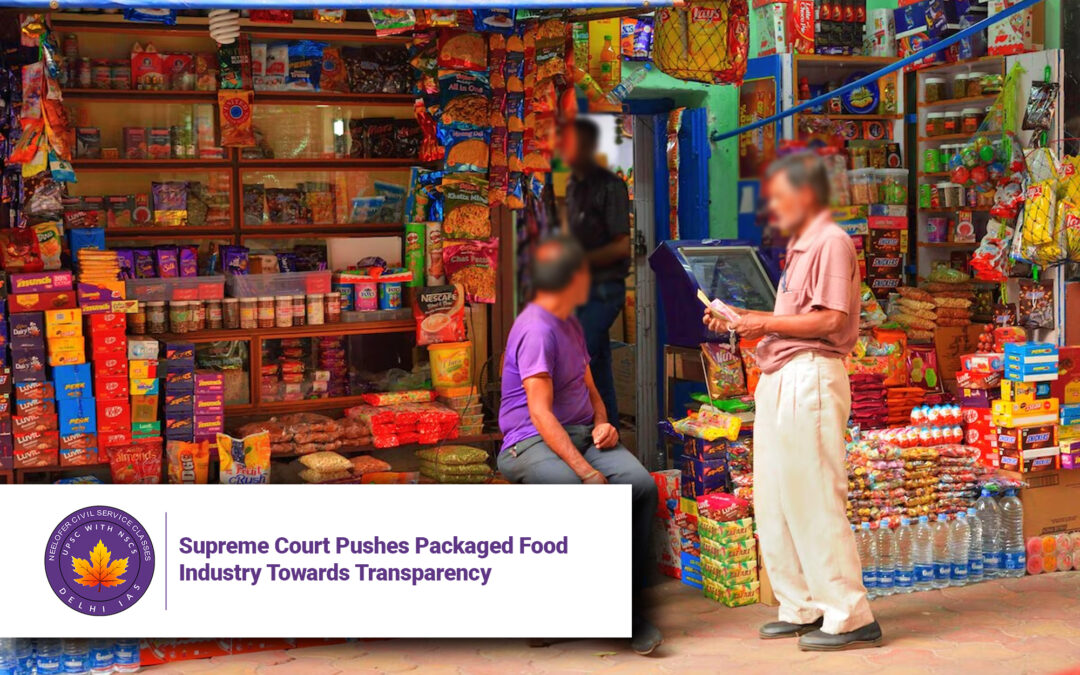
Supreme Court Pushes Packaged Food Industry Towards Transparency
Why in News?
In a landmark move, the Supreme Court of India has directed packaged food companies to display vital nutritional information on the front of packs within three months, bringing a major shift in how consumers understand what they eat. This ruling challenges the food industry’s longstanding resistance to clear front-of-pack labeling. 
Introduction
For years, nutrition experts, public health advocates, and policy makers have been calling for visible and comprehensible nutrition labels on food products to help consumers make informed choices. The recent Supreme Court order, hailed as a win for public health, mandates companies to finally act.
Key Issues
1. Industry Pushback
Food companies argue that the move could hit an already “depressed” industry. Many claim it will increase costs and disrupt business, particularly if amendments aren’t aligned with existing pack sizes.
2. Health Crisis at Hand
Experts have pointed out that many packaged foods that appear “healthy” are loaded with hidden sugars, salts, and fats. Without clear, easy-to-understand labeling, consumers are unknowingly making unhealthy choices.
3. Lagging Regulations
The Food Safety and Standards (Labeling and Display) Regulations were notified in 2020, but have not yet been enforced due to delays and industry pressure. The Supreme Court now demands action within three months.
4. Consumer First Approach
The court stressed the urgency by stating: “What about the children? Let the order run with the compliance.” The aim is to protect public health, particularly that of children, from misleading packaging and unhealthy products.
5. Future of the Industry
While companies worry about costs and market slowdown, public interest must prevail. Industry bodies and nutrition experts agree this step could push companies to reduce harmful ingredients and introduce healthier alternatives.
Challenges and the Way Forward
-
Quick Implementation: Food Safety and Standards Authority of India (FSSAI) must finalize labeling rules by July 2025 and ensure compliance begins sooner.
-
Transparency over Profit: Companies must place consumer health over cost and adjust their packaging accordingly.
-
Public Awareness: The government and NGOs should run awareness campaigns to educate consumers on reading and understanding labels.
-
Product Reformulation: Companies should consider reducing salt, sugar, and fat content in their products to align with public health interests.
-
Monitoring and Penalty: Regular checks must be conducted to ensure companies follow the new labeling norms, with penalties for non-compliance.
Conclusion
The Supreme Court’s ruling is a wake-up call for both companies and consumers. As the packaged food market continues to grow, so does the responsibility of making it safer and more transparent. This decision could mark a new era where the health of consumers is prioritized over profit margins.
5 Q&A on Packaged Food Labelling
Q1: What exactly did the Supreme Court rule?
The Court ordered packaged food companies to display vital nutritional information such as sugar, salt, and fat levels on the front of the packaging within three months.
Q2: Why is this ruling important?
Many packaged foods are misleading. They appear healthy but contain high levels of hidden sugars, salts, and fats. Front-of-pack labels will help consumers make informed choices.
Q3: How has the industry reacted?
Many companies argue that the move will increase operational costs and affect market dynamics, especially in urban areas.
Q4: What kind of labels are expected?
Labels must clearly highlight key information like total sugar, saturated fat, sodium, and calorie content in a simple, readable format on the front side of the packaging.
Q5: What happens if companies don’t comply?
The FSSAI is expected to enforce penalties and ensure compliance through regular monitoring. The Supreme Court has signaled no tolerance for delay.
