
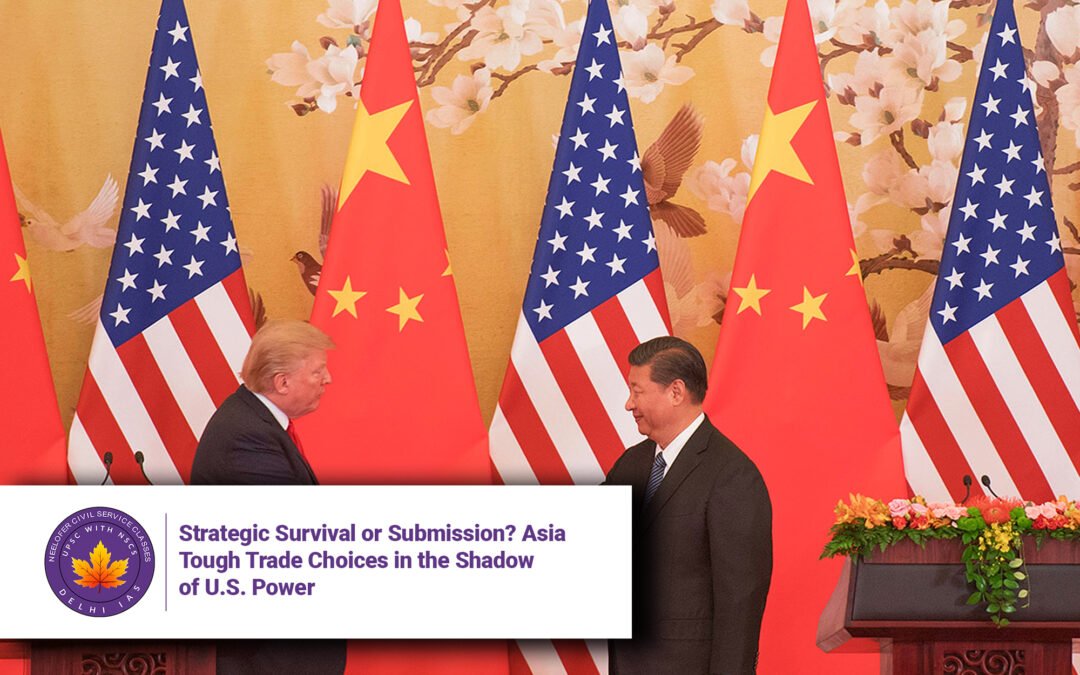
Strategic Survival or Submission? Asia Tough Trade Choices in the Shadow of U.S. Power
Why in News?
In a shifting global economic environment marked by rising protectionism and economic nationalism, particularly from the United States under the leadership of Donald Trump, Asian economies are grappling with a tough choice: either accept unfavorable trade terms or risk losing access to the powerful U.S. market. A recent Bloomberg Opinion article by Daniel Moss sheds light on how nations like the Philippines, Vietnam, Indonesia, India, and South Korea are navigating this precarious landscape of “predatory trade.” With rising tariffs, trade coercion, and America’s hegemonic economic policies, Asia’s response is a case study in survival economics.
Introduction
The global trade environment is witnessing a dramatic shift. Once hailed as the engines of the future global economy, many Asian nations are now finding themselves cornered into accepting lopsided trade deals with the United States—deals that are often far from equitable, but seen as necessary for retaining market access. The Trump administration’s aggressive trade tactics, marked by higher tariffs and tough negotiations, have forced Asian leaders to reassess their long-term strategies for growth, sovereignty, and survival.
For Asian economies, which for decades based their development strategies on seamless access to the American consumer market, the ongoing trade wars feel like a rude awakening. The new reality brings back echoes of a more protectionist and inward-looking era, one where survival often means bowing to superpowers rather than building equal partnerships.
Key Issues and Institutional Concerns
1. A Revival of 1930s-Style Tariffs
According to Bloomberg Economics, the overall U.S. tariff levels are now the highest they’ve been since the 1930s. This regression to earlier protectionist norms has undermined decades of progress in global trade liberalization. For Asia, which thrived under more open trade regimes, the return to high-tariff economics signals a systemic threat.
2. Strategic Trade Concessions
Asian leaders have been cornered into signing deals with terms worse than previously anticipated. Countries like Japan, Indonesia, and Vietnam have agreed to new trade pacts with higher-than-hoped tariffs. For example, Japan’s former Prime Minister Shigeru Ishiba, who once refused to accept tariffs on cars, ultimately agreed to a 15% penalty just to preserve some access. Similarly, the Philippines agreed to levies barely lower than what had already been imposed unilaterally by the U.S.
3. Power Imbalance and Obedience
Trump’s demands are less about economic logic and more about theatrical demonstrations of power. Countries eager to avoid further sanctions or trade disruptions often choose to concede—not because the terms are fair, but because the alternative is worse. As Daniel Moss explains, countries are offering Trump a “theatre he craves,” even if it means swallowing national pride.
4. The Apex Predator Analogy
Former Australian trade negotiator Dmitry Grozoubinski describes the U.S. as an apex predator in global trade—devouring smaller or weaker economies that cannot resist its demands. These nations are “large extent paying protection money” in the form of tariffs or concessions just to keep doing business with America.
5. Military and Political Overtones
Trade is no longer just about economics. In the Philippines, the stakes are also geopolitical. The country continues to balance U.S. influence with increasing Chinese aggression in the South China Sea. President Ferdinand Marcos Jr.’s strategy involves using historical U.S.-Philippine ties and occasional resistance as negotiation tactics, though with limited success. Pentagon Chief Pete Hegseth hinted at potential military components in future trade arrangements.
Challenges and the Way Forward
1. Tariff Benchmarking
A new “normal” seems to be settling in across Southeast Asia: a 20% tariff benchmark. Countries like Indonesia and Vietnam, though initially promised relief, still ended up with these high import taxes. Yet, they continue to view even these as victories because they are lower than what was previously threatened.
2. Humiliation vs. Continuity
The Philippines’ experience exemplifies the difficult position smaller economies are in. Facing what appeared to be a trade humiliation, the country still opted for the lesser of two evils. Tariffs were slightly below Trump’s initial announcement, which Manila took as a win, even though it came with no significant gains in return.
3. Escape Through Competitiveness
Vietnam demonstrates a different survival strategy. Despite facing 20% tariffs, the country remains relatively competitive. Instead of resisting U.S. demands head-on, Vietnam’s goal is to absorb the losses and continue selling to American customers. This, as Stephen Miran, a former Trump economic adviser, notes, is the “only choice” some countries have.
4. India and South Korea: The Next Dominoes?
Both nations have not yet finalized trade deals, but they face immense pressure to do so. India, for instance, has been offered a shipbuilding partnership as a trade-off. Talks with China have slowed, indicating a possible strategic pivot towards the U.S. However, the risk is that these countries might end up with even worse deals than those who’ve already signed.
5. China and Global Multipolarity
A larger question looms: how will China respond to this renewed American aggression? President Xi Jinping faces a double challenge—managing domestic economic resistance and countering U.S. trade policies that aim to isolate or weaken Chinese influence globally. As the article suggests, this could turn into a broader struggle of ideologies and economic systems.
Conclusion
Asia’s strategy under predatory trade conditions isn’t necessarily surrender—it’s survival. Faced with the loss of access to the U.S. market, many countries are choosing to accept bad deals in the hope of better outcomes in the future. These nations are not just conceding out of weakness, but recalibrating their economic strategies amid great power competition and geopolitical coercion.
What emerges from this new trade era is a grim but realistic recognition that fairness may no longer be guaranteed in international agreements. Instead, maintaining market access, minimizing economic damage, and preparing for a post-Trump or post-hegemony world has become the short-term strategy.
For policymakers in India, South Korea, the Philippines, and beyond, the key lesson is this: navigate with caution, concede where needed, but plan strategically for a world where economic partnerships are transactional, political, and often, predatory.
Q&A Section (5 Questions & Answers)
Q1. Why are Asian countries agreeing to unfavorable trade deals with the U.S.?
A1. Asian countries are accepting less-than-ideal deals to maintain access to the powerful U.S. market. With increasing U.S. tariffs and a hostile trade environment under Trump’s leadership, these countries believe that accepting some losses now is better than losing their biggest export destination altogether.
Q2. What is the role of tariffs in the current U.S.-Asia trade dynamic?
A2. Tariffs are being used as a coercive tool by the U.S. to pressure Asian economies into submission. Current U.S. tariffs are at their highest levels since the 1930s, and Southeast Asian nations are being forced to accept tariffs around 20%, which severely impacts their export competitiveness.
Q3. How is the Philippines balancing trade and geopolitics?
A3. The Philippines is trying to leverage its historical ties with the U.S., while also managing tensions with China over the South China Sea. Despite facing trade humiliation, it continues negotiations with the hope of retaining U.S. favor and possibly securing military or strategic advantages.
Q4. What are the implications for India and South Korea in this scenario?
A4. Both India and South Korea are in difficult positions. They haven’t finalized deals with the U.S. and are under pressure to conform. India, in particular, is being lured with promises like a shipbuilding partnership, but risks ending up with worse terms if it delays too long.
Q5. What does this mean for the global economic order?
A5. This scenario highlights a shift from cooperative globalization to transactional trade. The U.S. is behaving like an apex predator, demanding tribute from smaller economies. This challenges the rules-based global order and raises questions about long-term economic fairness and stability.

