
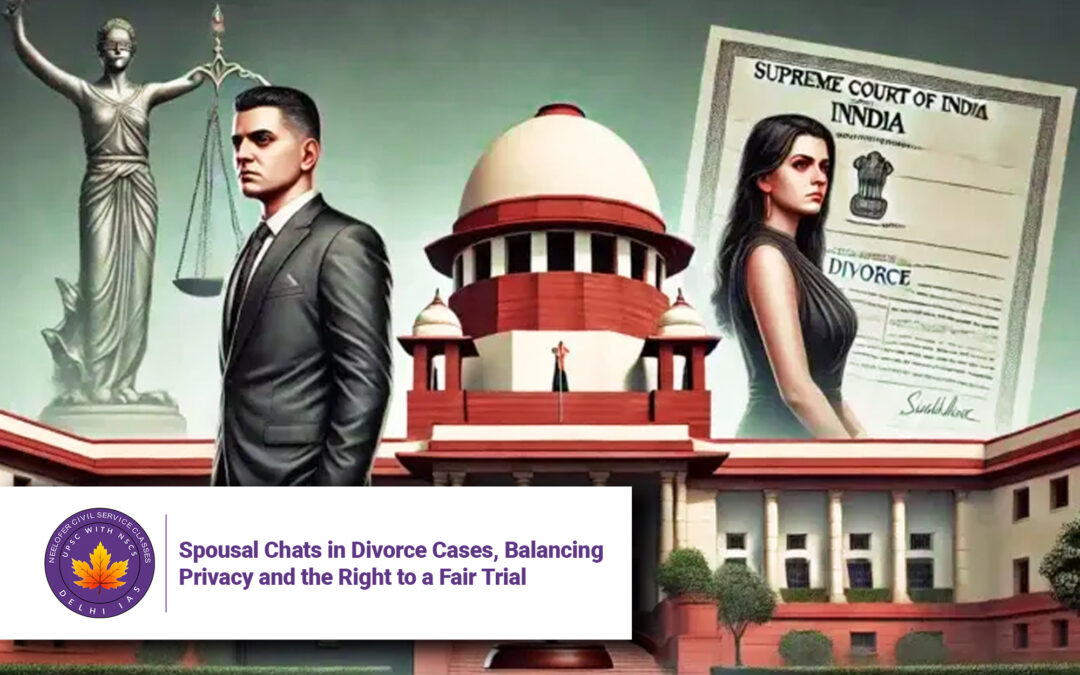
Spousal Chats in Divorce Cases, Balancing Privacy and the Right to a Fair Trial
Introduction
The advent of digital technology has revolutionized communication in both personal and public spheres. From social media to encrypted messaging platforms, private conversations now leave permanent digital trails. These developments, while convenient, have also created new legal dilemmas—especially in matrimonial and family disputes.
A recent Supreme Court ruling in India has reignited the debate surrounding digital privacy, the admissibility of spousal communications, and the fundamental right to a fair trial. The court held that even secretly recorded conversations between spouses can be admissible as evidence in divorce proceedings, raising critical constitutional and ethical questions. Does this signify a judicial endorsement of covert surveillance in private relationships? Can the right to privacy be overridden in pursuit of justice?
This article explores the background of the judgment, the legal principles involved, key constitutional provisions, and the broader implications of such a precedent in family law and criminal jurisprudence.
The Case That Sparked the Debate
The case revolved around a husband from Bathinda, Punjab, who filed a divorce petition citing cruelty by his wife. He submitted a variety of digital materials as evidence, including audio recordings, compact discs, mobile phone chips, and transcripts of telephonic conversations between him and his wife, which he claimed occurred between 2010 and 2016. These materials were covertly obtained—recorded without his wife’s knowledge or consent.
A family court allowed the use of this material as admissible evidence. Aggrieved, the wife challenged this order before the Punjab and Haryana High Court, which also upheld the family court’s decision. Finally, the matter reached the Supreme Court, which had to decide whether the covertly recorded conversations could be legally accepted as evidence without violating the right to privacy.
The Supreme Court bench, led by Justice B. V. Nagarathna, ruled that privacy rights do not offer blanket protection against judicial scrutiny, especially in matrimonial disputes. The right to a fair trial, a core component of Article 21 of the Indian Constitution, was held to be of equal—if not greater—importance than the right to privacy.
Key Legal Questions
This ruling brings into sharp focus several interlinked legal and constitutional issues:
-
Is the covert recording of a spouse’s conversation a breach of privacy?
-
Does the Indian Evidence Act allow such material to be admissible in court?
-
Can the right to privacy be curtailed by the need for a fair trial?
-
What protections exist for individuals whose private lives are exposed in court?
-
Where do courts draw the line between fair evidence and unethical intrusion?
Each of these questions requires a careful exploration of both statutory and constitutional law.
The Right to Privacy: Not Absolute
The right to privacy was recognized as a fundamental right under Article 21 in the landmark Puttaswamy v. Union of India (2017) judgment. However, the ruling also stated that this right is not absolute and is subject to reasonable restrictions.
In this context, the Supreme Court made it clear that while the privacy of marital communication is important, no one can claim absolute immunity from judicial scrutiny. Especially when one party produces evidence to prove cruelty or other matrimonial faults, the court must strike a balance between privacy and justice.
This is a crucial principle because courts cannot allow legitimate evidence to be barred merely due to the manner of its collection, unless it involves gross deception or criminal illegality.
The Indian Evidence Act: Admissibility and Exceptions
Section 122 of the Indian Evidence Act, 1872 normally bars the disclosure of spousal communications made during marriage. It recognizes marital communications as privileged, meaning neither spouse can be compelled to disclose these in court. However, the provision includes exceptions, especially when the spouses are litigating against each other, such as in a divorce case.
The court reiterated this exception in its ruling. It further observed that Section 128 of the Bharatiya Sakshya Adhiniyam, 2023—India’s newly enacted evidence law—also retains this exception. Thus, marital disputes are not exempt from legal scrutiny when evidence, even privately obtained, is directly relevant to the case.
Privacy vs. Fair Trial: Article 21’s Dual Edges
Article 21 of the Constitution guarantees both:
-
The right to life and personal liberty (which includes privacy), and
-
The right to a fair trial, which includes presenting relevant evidence and confronting the other party with all available facts.
The current ruling underscores that one right cannot override the other. Privacy cannot be used as a shield against the presentation of truth in court, particularly when that truth directly affects justice outcomes.
Courts have, in past cases too, taken a pragmatic view. For example, in Yusufalli Esmail Nagree v. State of Maharashtra (1968), a secretly recorded conversation was admitted in a bribery case, laying the foundation for legal acceptance of covert audio recordings under certain conditions.
Morality of the Method vs. Legitimacy of the Evidence
The court also delved into the morality of the method—whether deception, surveillance, or secret recording could invalidate otherwise relevant evidence. It observed that the legitimacy of the evidence lies not in how it was collected but in its material relevance and lack of prejudice to the other party.
Where the method used to gather evidence does not involve coercion or fabrication, the courts are empowered to accept it. This applies even in in-camera trials, where sensitive information is protected from public view, but not from judicial analysis.
Importantly, courts must evaluate if the element of deception is so severe that it would nullify the evidence’s probative value. If not, it can be used—albeit with caution.
Challenges in Real-Life Application
Though the legal reasoning seems sound, this precedent opens up new ethical and legal challenges:
-
Domestic Surveillance Culture: If spouses begin to record each other without consent, marital homes could become surveillance zones, fostering mistrust and toxicity.
-
Misuse of Technology: Easy access to spyware, hacking tools, and data theft software could lead to illegal surveillance under the guise of evidence collection.
-
Erosion of Emotional Bonds: The sanctity of marital communication, already under strain in modern relationships, could suffer a further blow if privacy is no longer assured.
-
Lack of Recourse for Victims: A partner subjected to secret surveillance may have no effective legal remedy if the evidence is deemed admissible.
Hence, courts must ensure that each case is evaluated individually, weighing both evidence value and privacy harm.
Comparative Jurisprudence
Globally, courts have wrestled with similar dilemmas. In the United States, spousal privilege laws offer protection but allow for exceptions in cases of abuse or crime. In the UK, courts have allowed secretly recorded conversations in civil and family cases, subject to relevance and legality.
India’s stance now aligns with moderate global standards, where relevance, fairness, and necessity take precedence, but with oversight to prevent misuse.
Reforms Required: Regulating Evidence in the Digital Age
To prevent blanket abuse of this legal allowance, regulatory safeguards are urgently needed:
-
Court-sanctioned protocols for handling and verifying digital evidence
-
Technical validation (timestamp, device authentication, encryption proof)
-
Privacy impact assessment before admission of personal content
-
Stronger punishment for illegal data theft or spyware use under IT laws
-
Counseling and mediation mechanisms to reduce adversarial divorce litigation
The law must evolve to recognize technological abuse as a form of psychological cruelty, just as much as it respects the right to truth.
Conclusion: A Delicate Judicial Balance
The Supreme Court’s ruling on spousal chats illustrates the inherent tension between two vital democratic values—privacy and justice. In an age where digital footprints dominate personal lives, courts cannot afford to ignore potentially crucial evidence. Yet, they must also guard against the normalization of surveillance and the erosion of personal dignity.
The judiciary must continue to evolve case-by-case jurisprudence, refining the limits of admissibility, and ensuring that legal flexibility does not become a weapon for oppression.
This verdict is not an open invitation to snoop on spouses. It is a judicial acknowledgment that in some exceptional cases, truth-seeking may warrant privacy compromise—but always with strict safeguards, moral scrutiny, and constitutional oversight.
The future of Indian jurisprudence, especially in family law, now depends on how well courts, lawyers, and litigants respect this delicate balance—one that shapes not just the outcomes of cases but also the social fabric of trust and liberty.

