
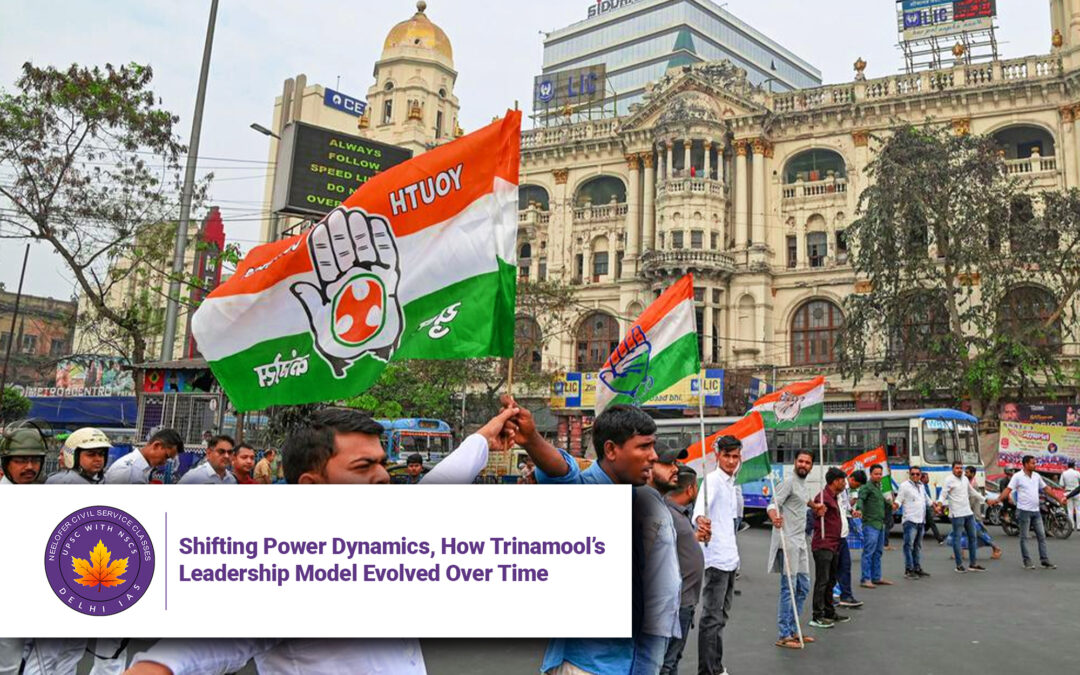
Shifting Power Dynamics, How Trinamool’s Leadership Model Evolved Over Time
Why in News?
A recent empirical study by researchers G. Sampath, Mahmood, Zaad, and Soham Bhattacharya titled “The Roots of a Populist Regime: Examining the Trinamool Congress in West Bengal” (Studies in Indian Politics, 2025) reveals how the leadership structure, electoral strategy, and socio-political composition of the Trinamool Congress (TMC) has transformed significantly since it replaced the Left Front regime in 2011. 
Introduction
The 2011 West Bengal Assembly Elections marked a watershed moment, ending the Left Front’s prolonged rule and propelling the Trinamool Congress to power. With successive wins in 2016 and 2021, TMC has dominated the state’s political landscape. This study evaluates the changing nature of TMC’s leadership and its transition from traditional political strategies to a welfare-centric, populist, and electorally effective model.
Key Trends and Issues
-
Welfare Politics Beyond Growth
The TMC governance model prioritises “desirable re-electable outcomes” through welfare delivery rather than economic growth. It departs from the “party-based patron” style to one that hinges on personalised delivery and emotional connect. -
Decline of the “Party Society”
Unlike the Left Front’s entrenched party-society structure, TMC’s rise indicates a decline in such structures, with a move towards a patronage-based welfare state driven by individual leadership. -
Changing Caste Dynamics
Between 2011 and 2021, there was a notable increase in the representation of SC/ST and “lower caste/dalit” candidates within TMC—from 19.4% in 2011 to 25% in 2021—indicating greater inclusion of non-forward castes and non-Brahmin groups. -
New Economic Elites in Politics
A shift is observed towards candidates who identify as “businesspersons” or from the “professional/services” class, replacing traditional political workers or union leaders. This reflects a growing confluence of wealth creation and political power. -
State Budget as a Tool for Populism
Analysis of state budgets (2016–2021) shows heavy emphasis on welfare and direct benefit transfers. Over 43% of new revenue expenditure goes to the social sector, showing a clear tilt towards a “schemed-led” model of governance.
Five Key Takeaways
-
TMC has shifted from cadre-based politics to charismatic and welfare-based populism, centered around Mamata Banerjee.
-
The party’s leadership and candidate pool now includes a higher share of SC/ST, OBC, and non-Brahmin Forward Castes, signifying broader social representation.
-
Candidates with business or wealth-linked occupations have increased, signaling a fusion of politics with economic capital.
-
Welfare spending dominates the budget, with capital expenditure shrinking, suggesting electoral strategy outweighs long-term infrastructure goals.
-
TMC’s model reveals the rise of a ‘non-party political formation’ where electoral success is achieved without deep institutional penetration.
Challenges and the Way Forward
-
Challenges:
-
Overdependence on welfare without addressing structural economic issues.
-
Shrinking capital expenditure could hurt long-term development.
-
Increasing role of wealth in politics may skew democratic representation.
-
-
Way Forward:
-
Balance welfare with sustainable economic policies.
-
Institutionalise leadership beyond charismatic personalities.
-
Ensure political inclusion remains socially equitable and economically productive.
-
Conclusion
The TMC’s evolving leadership is a reflection of broader changes in Indian state politics—where personal appeal, targeted welfare, and shifting caste compositions now shape electoral outcomes more than ideology or grassroots mobilisation. As the political landscape matures, this model offers both lessons and warnings on the future of representative governance.
Q&A Section
1. What is meant by “desirable re-electable outcomes” in the context of TMC’s governance?
It refers to the use of targeted welfare delivery and populist measures to ensure electoral success, even in the absence of significant economic growth.
2. How has TMC’s leadership composition changed from 2011 to 2021?
There has been a sharp rise in SC/ST and non-forward caste representation. The party also increasingly nominates candidates from business and service sectors.
3. What does the study reveal about TMC’s use of state budgets?
TMC’s budget priorities heavily favour welfare and direct beneficiary transfers. Nearly 43% of new revenue expenditures go to the social sector, showing a shift toward scheme-driven politics.
4. How does TMC’s model differ from the Left Front’s “party society”?
While the Left Front relied on deep organisational networks and ideological commitment, TMC’s approach is more centralised, personalistic, and based on populist outreach.
5. Why is the rise of “non-party political formations” significant?
It marks a transformation where political success does not require entrenched party structures or ideological mobilisation, but can be built through charisma, welfare delivery, and financial power.
