
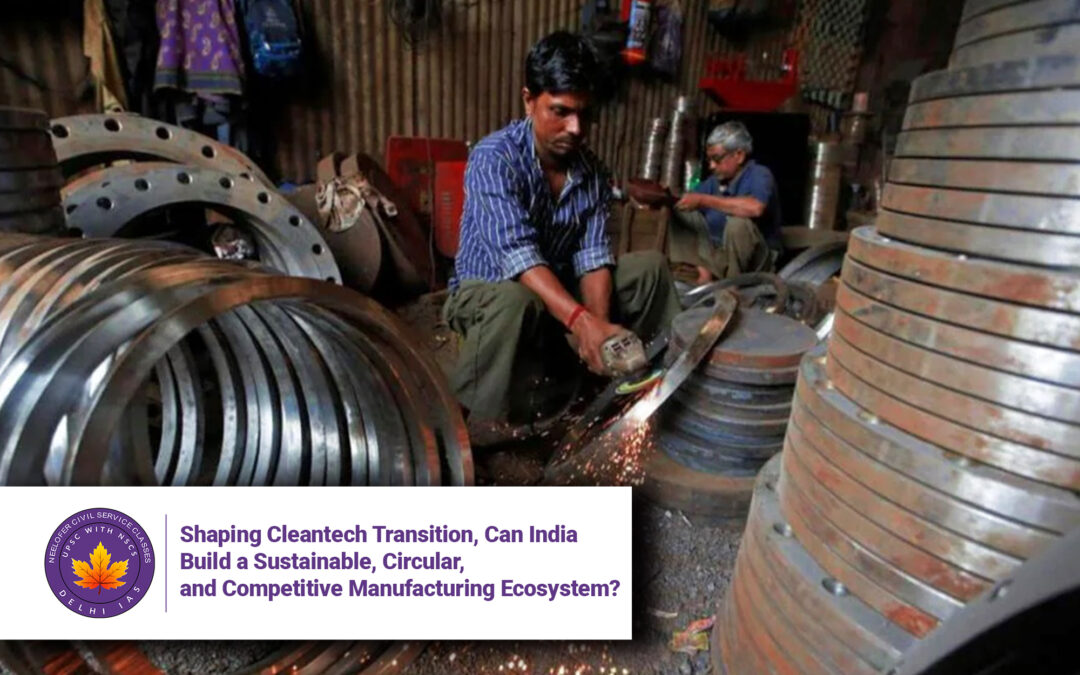
Shaping Cleantech Transition, Can India Build a Sustainable, Circular, and Competitive Manufacturing Ecosystem?
Why in News?
India is at a crucial juncture in its journey towards becoming Viksit Bharat (Developed India) by 2047. Two major pillars—economic resurgence through manufacturing and climate leadership—are emerging as the foundation of this transformation. However, the big question remains: can India achieve both economic growth and sustainability in manufacturing while transitioning to clean technologies?
Introduction
The transformation of India’s economy hinges on how well the country can balance industrial growth with environmental responsibility. With the global shift towards decarbonisation, cleantech (clean technology) has emerged as a strategic sector. The goal is not just to expand manufacturing but to make it sustainable, circular, and globally competitive.
Manufacturing’s contribution to India’s GDP stands at only 16–17%, much lower than China’s 27% and Vietnam’s 23%. To achieve developed nation status, India must raise this share while meeting its climate commitments.
Current Context and Challenges
India faces three simultaneous challenges:
-
Global Competition:
India lags behind regional manufacturing powerhouses like China and Vietnam. -
Climate Responsibility:
As a signatory to global climate agreements, India must reduce emissions and adopt clean technologies. -
Supply Chain Disruptions:
Post-pandemic volatility and geopolitical tensions have exposed vulnerabilities in global supply chains.
Technological Pathways for Cleantech
To succeed, India must embrace a mix of emerging and alternative technologies:
-
Battery storage solutions (lithium-ion, sodium-ion, and other chemistries).
-
Renewable energy sources like solar photovoltaics and solar thermal.
-
Sustainable materials for industrial applications.
-
Green hydrogen for energy-intensive sectors.
-
Circular economy innovations such as recycling, remanufacturing, and waste-to-resource systems.
These technologies require significant upfront investments, long-term policy support, and risk-sharing mechanisms.
The Role of Policy and Investment
The government’s production-linked incentive (PLI) schemes have been a start, but large-scale cleantech manufacturing will require:
-
Higher allocation of funds—an investment of ₹1 lakh crore has been proposed for next-gen cleantech infrastructure.
-
Stronger public-private partnerships to finance green innovations.
-
Alignment with international sustainability standards.
-
Addressing financing barriers—currently, India’s green finance largely flows to energy and transport, while manufacturing is excluded.
The Global Economic Imperative
Global markets are moving towards carbon border taxes—as seen in the European Union’s Carbon Border Adjustment Mechanism (CBAM)—which could penalise Indian exports if they are not produced sustainably. This makes cleantech adoption not just an environmental need, but also an economic survival strategy.
China currently dominates 80% of global solar module manufacturing, while India holds just 5% of planned and active module capacity. To compete, India must rapidly scale up capacity in solar, batteries, and other renewable technologies.
Infrastructure and Skills Gap
While India has strengths in IT and service sectors, manufacturing-focused skills are lacking:
-
Only 3.74% of India’s workforce has received formal vocational training.
-
In comparison, the figure is 59% in China, 75% in Germany, and over 90% in South Korea.
-
Without large-scale upskilling, the cleantech sector could face severe human resource shortages.
An integrated skills strategy is required—linking academic curricula with industry needs, promoting R&D in universities, and encouraging international collaborations.
Circular Economy and Sustainability
A successful cleantech transition must follow circular economy principles:
-
Redesigning production systems for material reuse.
-
Developing product passports to track components.
-
Implementing reverse logistics for product take-back and recycling.
-
Avoiding end-of-pipe fixes by integrating sustainability at the design stage.
Globally, countries are adopting traceability systems and secondary markets for components—India must do the same to remain competitive.
Financial Requirements
The green industrial transition in India will require investments exceeding $100 trillion by 2070. This covers:
-
Industrial clusters for sustainable manufacturing.
-
Research and innovation hubs.
-
Startups focusing on clean tech.
-
Infrastructure for renewable energy and recycling.
-
Workforce upskilling programs.
Conclusion
The cleantech transition is not optional—it is an essential requirement for India’s future competitiveness and environmental responsibility. Success will depend on:
-
Strong government policy.
-
Targeted financing for manufacturing.
-
Industry-government-academia collaboration.
-
Massive workforce skill development.
-
Adoption of circular economy practices.
If done right, India can become a global leader in sustainable manufacturing, creating jobs, boosting exports, and meeting climate targets simultaneously.
5 Key Questions & Answers
Q1. Why is cleantech manufacturing important for India’s economic future?
A: Cleantech manufacturing is critical because it allows India to grow its economy while meeting international climate commitments. It also protects Indian exports from potential trade barriers like carbon taxes, strengthens energy security, and creates high-quality jobs in advanced technology sectors.
Q2. What are the biggest challenges in India’s cleantech transition?
A: The main challenges include low manufacturing GDP share, heavy reliance on imports for critical technologies, skill shortages in manufacturing sectors, limited access to green finance for manufacturing, and insufficient infrastructure for a circular economy.
Q3. How can India attract investment in cleantech manufacturing?
A: India can attract investment by offering policy stability, expanding PLI schemes to include cleantech manufacturing, ensuring traceability in products, implementing international sustainability standards, and providing risk-sharing financial mechanisms for large-scale projects.
Q4. What role does skill development play in this transition?
A: Skill development is vital. Without trained technicians, engineers, and researchers, India cannot build or maintain advanced manufacturing systems. Large-scale vocational training, R&D collaboration, and curriculum reform are needed to prepare the workforce for cleantech jobs.
Q5. What are the potential benefits if India succeeds in this transition?
A: If India successfully transitions, it can become a global hub for sustainable manufacturing, significantly increase exports, reduce dependence on imports for critical technologies, create millions of green jobs, and play a leading role in global climate action.

