
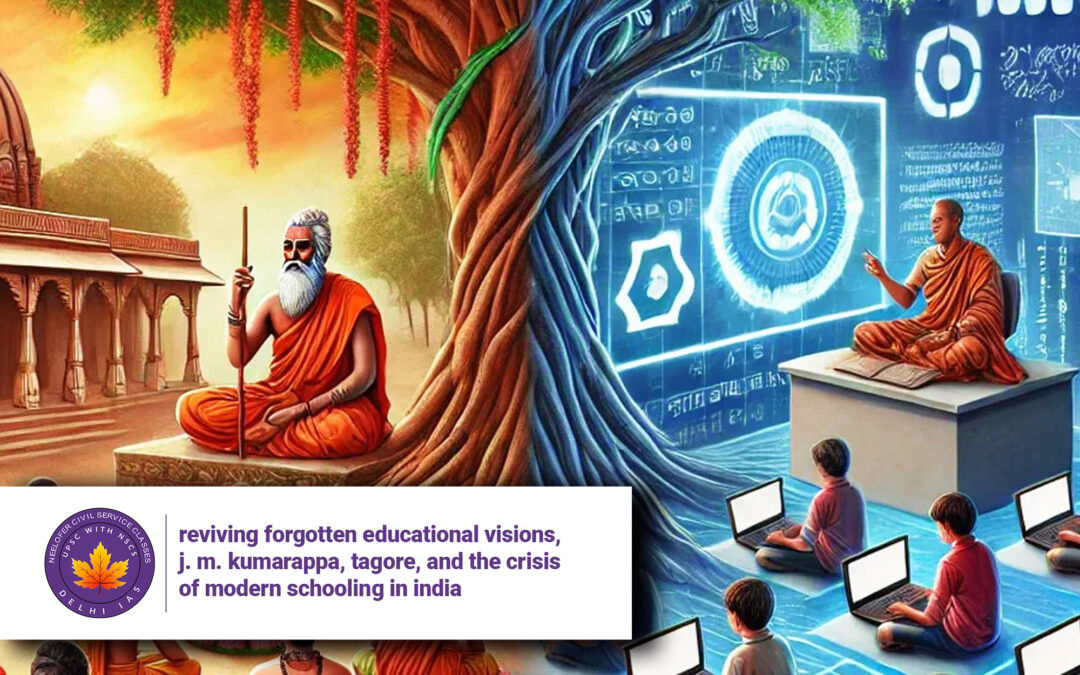
Reviving Forgotten Educational Visions, J. M. Kumarappa, Tagore, and the Crisis of Modern Schooling in India
Introduction
As India stands at a crossroads in education, policy, and public ethics, it becomes vital to revisit the contributions of thinkers whose visions still hold relevance—perhaps even more today than in their own time. The death anniversary of Rabindranath Tagore, one of India’s most revered intellectuals, poets, and educationists, offers such an opportunity. A deep and often overlooked connection between Tagore and J. M. Kumarappa—a Gandhian thinker, economist, and educationist—has been brought to light by environmental economist and writer Lawrence Surendra, whose recent article invites us to reclaim the lost essence of educational philosophy in India.
This article aims to delve into that legacy, situate it within today’s educational and social crises, and emphasize why rethinking education in India demands a return to the holistic and humanistic approaches advocated by both Tagore and Kumarappa.
J. M. Kumarappa: The Forgotten Scholar Inspired by Tagore
J. M. Kumarappa, the elder sibling in the famous Kumarappa family that included J. C. Kumarappa and Bharatan Kumarappa, was a scholar who went largely unacknowledged in mainstream education debates. His doctoral thesis at Columbia University, titled “Rabindranath Tagore—India’s School Master” (published in 1930), was a comprehensive examination of Tagore’s philosophy of education. It focused on Tagore’s insights into child-centered learning and the transformative potential of education for the individual and society.
Kumarappa’s thesis was not written in a vacuum. He was mentored by none other than John Dewey, a major figure in American educational thought and author of the seminal work “My Pedagogic Creed.” Dewey’s pragmatist philosophy deeply influenced Kumarappa, just as it had influenced Tagore in his own approach to education at Santiniketan, Tagore’s experimental school founded on the ideals of joy, creativity, and self-directed learning.
The Philosophical Triad: Dewey, Tagore, Kumarappa
It is no coincidence that J. M. Kumarappa’s educational work was grounded in both Indian tradition and Western progressivism. While Dewey provided the methodological framework, Tagore offered the spiritual and cultural foundation. Kumarappa’s interpretation of Tagore’s work presents a synthesis: education not as rote memorization or mechanical skill acquisition, but as a means of self-actualization and social transformation.
Kumarappa’s own academic background added to this philosophical depth. His brother Bharatan Kumarappa, a philosopher trained in Vedanta theology and an authority on Ramanuja’s conception of the Deity, had already laid an intellectual foundation for exploring the interplay between traditional Indian metaphysics and modern ethics. J. M. Kumarappa, by extension, used Tagore’s ideas to bridge Indian educational needs with global pedagogical insights.
Tagore’s Critique of Modern Schooling
Tagore’s views on education were not merely philosophical—they were deeply political and social. He warned against the fetishization of modern tools and methods, cautioning that excessive emphasis on technology and equipment, when detached from values and context, would render education soulless and elitist.
Kumarappa quoted Tagore in his thesis:
“The spread of education and the bringing of higher influences into human lives are of infinitely greater importance than following the modern fad of efficient and expensive equipment, which is raised to the rank of a fetish.”
This statement is particularly relevant today. In a time where expensive private schools dominate urban India, and government schools fall into disrepair, Tagore’s vision sounds like both a warning and a prophecy. Even poor families, struggling to meet basic nutritional needs, now aspire to send their children to private schools—not necessarily for better learning, but because of the collapse of the public education system and the perceived status associated with private institutions.
The Policy Muddle in Modern Indian Education
Surendra notes that despite decades of reform, Indian education policy remains directionless. Basic questions about the purpose of schooling, its affordability, and its social role remain unresolved. Education, once viewed as a public good, is now heavily commodified.
Government schools, underfunded and neglected, are not viewed as institutions of learning but as places of last resort. Elite private schools offer air-conditioned classrooms and smart boards, but often lack in community connection, ethical grounding, and inclusive pedagogy.
This commercialization of education aligns with Tagore’s worst fears: a system obsessed with form over substance, where “Saraswati’s seat owes any of its splendor to appearances borrowed from Lakshmi.”
Religion, Formalism, and the Fracturing of Public Ethics
Tagore was equally vocal about the dangers of formalism in religion and education. He saw a clear connection between sectarianism, nationalism, and the decline of ethical education. His critique was as relevant in 1925 as it is in 2025:
“Instead of expressing itself as love and service, religion has become a mere destructive formalism… It breeds sectarian arrogance, mutual misunderstanding, and a spirit of persecution.”
This critique reflects contemporary India’s challenges, where religious identity politics often overshadow public welfare, education, and social justice. Formalism in religious practice, according to Tagore, erodes the inner ethical compass, replacing spirituality with performative displays and bigotry.
He urged a move toward shared humanity and interreligious cooperation, arguing that Hindus and Muslims must not only unite but come together with equality in the social support at their back.
This vision remains critically relevant in the face of increasing communal polarization. Education, Tagore insisted, should not merely equip students with facts, but should foster human dignity, compassion, and a sense of collective responsibility.
Montessori, Tagore, and the Role of Child-Centered Education
A crucial but overlooked chapter in Tagore’s educational thought is his deep alignment with Maria Montessori, the Italian educational reformer. The two met at a Montessori International Conference in Denmark in 1929, and shared a common concern for the autonomy of the child in the learning process.
Tagore admired Montessori for her scientific yet humanistic approach. In 1940, when she fled fascist Italy and came to India, Tagore warmly welcomed her. Both viewed children not as passive recipients of knowledge, but as active participants in the creation of meaning.
Their shared vision positioned education as a liberatory act—not merely about test scores or employability, but about inner awakening and moral development.
Legacy in Crisis: Why Tagore Still Matters
Tagore’s educational legacy is not merely of historical interest. It provides the ethical framework and philosophical clarity desperately needed today. As India debates New Education Policies, curriculum overhauls, and AI integration, it must pause to ask: What kind of human beings are we trying to produce?
Tagore’s insistence on the unity of knowledge, morality, and aesthetics is a radical challenge to utilitarian and market-driven models. Education, in his view, should nurture joy, curiosity, empathy, and responsibility. Without these, technical knowledge becomes dangerous, even destructive.
The Shantiniketan model—though diminished today—was a beacon of this approach. It treated students as whole persons, embedded learning in nature and art, and prioritized emotional intelligence over rote learning.
Conclusion: Reclaiming Educational Sanity
Remembering Rabindranath Tagore and J. M. Kumarappa is not an exercise in nostalgia—it is a moral and strategic necessity. At a time when India’s school system is stratified, commodified, and directionless, the philosophical grounding offered by these thinkers can guide us toward a more equitable, meaningful, and humane education system.
Tagore’s vision was clear:
Education must serve human development, not state machinery or corporate profit. It must foster cooperation, not competition; wisdom, not just information; freedom, not conformity.
In the words of Lawrence Surendra, let us retrieve Tagore from the collective amnesia that has gripped our educational imagination. Let us re-engage with his questions about what it means to be human, to be educated, and to live meaningfully in a fractured world.
In doing so, we may find that the true solutions to India’s education crisis lie not in technological fixes or global rankings, but in a return to values, community, creativity, and care—the very ideals Tagore and Kumarappa spent their lives advancing.
