
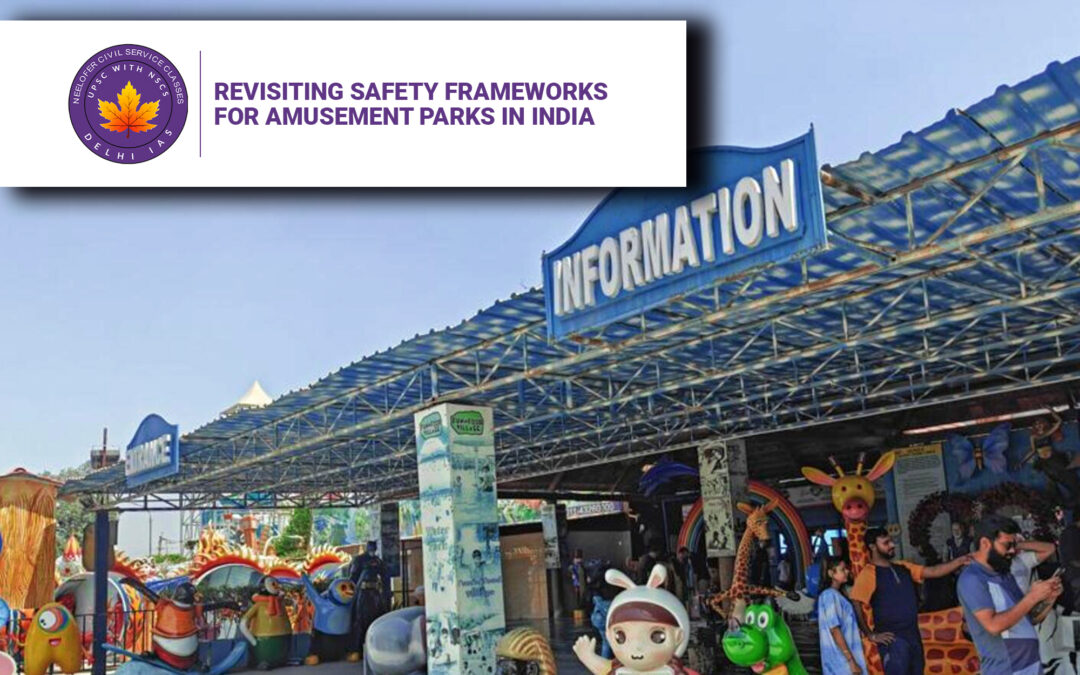
Revisiting Safety Frameworks for Amusement Parks in India
Why in News?
The recent tragic death of a woman who fell from a ride at an amusement park in Delhi has triggered urgent discussions around the safety regulations governing amusement parks and temporary fairs in India.
Introduction 
While amusement parks and fairgrounds are popular entertainment spaces, recent accidents highlight the pressing need to revisit the regulatory framework ensuring ride safety. A number of mishaps in recent years reflect systemic gaps that must be urgently addressed.
Key Issues and Background
1. Flawed Safety Oversight
-
The current safety model places the full burden of responsibility on park owners and ride operators.
-
Local police and civic authorities have minimal accountability in the existing system.
2. Licensing Process in Delhi
-
Operators apply to the Delhi Police, who forward the request to the Municipal Corporation of Delhi (MCD).
-
MCD engineers conduct a one-time visual inspection, often lacking depth and rigour.
-
Mandatory load tests using sandbags are often skipped, and even when done, they might not be enough due to increasing ride complexity.
Core of the Concern
1. No Periodic Scientific Assessment
-
There is no mandate for regular technical checks or performance audits of ride machinery or operator skill levels.
2. Maintenance Gaps
-
Issues like wear and tear of moving parts and malfunction risks are not proactively addressed.
3. Flawed Annual Inspection System
-
One-time inspections are not sufficient to prevent accidents throughout the year.
Challenges and the Way Forward
Challenges:
-
Inadequate inspection protocols.
-
Absence of periodic, science-based assessments.
-
Low accountability of civic and police authorities.
Steps Forward:
-
Introduce mandatory, periodic safety audits of rides and operations.
-
Ensure scientific load and safety testing.
-
Enforce regular technical inspections and assess operator skill levels.
-
Increase accountability of municipal bodies and police in safety enforcement.
-
Implement a national policy framework for amusement ride safety.
Conclusion
The current framework, by absolving municipal and police bodies of clear responsibility, creates a dangerous regulatory vacuum. To prevent further tragedies, India must reform its amusement park safety regulations with a focus on scientific inspections, accountability, and operator competency.
Q&A Section
Q1. What incident sparked the debate on amusement park safety in India?
A woman died after falling from a ride at an amusement park in Delhi, prompting scrutiny of the safety regulations.
Q2. Who is currently responsible for ensuring ride safety under the existing system?
The burden lies entirely on the ride operators and park owners.
Q3. How is the licensing system for rides handled in Delhi?
Operators apply through the police, and MCD engineers conduct a one-time visual inspection before granting licenses.
Q4. What are the major flaws in the current inspection process?
Load tests using sandbags are often skipped, and there is no system for regular or scientific inspection of ride safety or operator skills.
Q5. What reforms are suggested to improve safety?
Introducing periodic scientific inspections, strengthening civic and police accountability, and enforcing compliance more strictly.
