
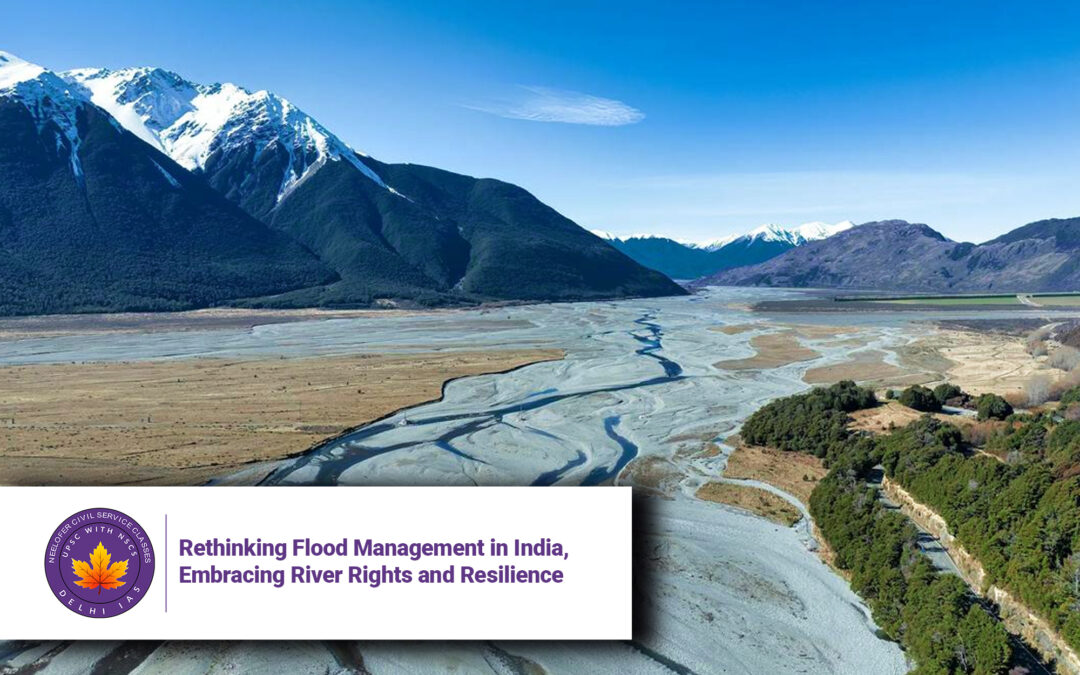
Rethinking Flood Management in India, Embracing River Rights and Resilience
Introduction
Floods have been an integral part of India’s natural ecosystem for centuries, replenishing soil fertility, recharging groundwater, and sustaining biodiversity. However, rapid urbanization, unregulated construction, and outdated flood management strategies have turned these natural events into catastrophic disasters. The increasing frequency and intensity of floods in recent years—such as the devastating deluges in Kerala (2018), Assam (2022), and Himachal Pradesh (2023)—highlight the urgent need for a paradigm shift in flood management.
Instead of attempting to control rivers through dams and embankments, experts now advocate for flood resilience—a strategy that respects rivers as living entities with their own rights. This approach emphasizes coexistence rather than conflict with nature, integrating ecological wisdom with modern technology.
This article explores:
-
The failures of traditional flood control methods.
-
The concept of river rights and ecological resilience.
-
The role of urban planning in mitigating floods.
-
Technological interventions for flood forecasting and management.
-
Policy initiatives like the River-City Alliance (RCA) and Urban River Management Plan (URMP).
By the end, we will understand why India must move from flood control to flood resilience—ensuring sustainable development while protecting both people and ecosystems.
The Failures of Traditional Flood Control Methods
1. Dams and Embankments: A False Sense of Security
Since Independence, India’s flood management policy has relied heavily on large dams, embankments, and canal systems. While these were initially seen as engineering marvels, decades of experience have exposed their shortcomings:
-
Disrupted Sediment Flow: Dams trap sediments, leading to erosion downstream and reduced soil fertility.
-
Embankment Breaches: During extreme floods (e.g., Bihar 2008, Kerala 2018), embankments often collapse, worsening inundation.
-
Upstream Waterlogging: Constricting rivers increases sedimentation upstream, raising riverbeds and exacerbating floods.
2. Encroachment on Floodplains: A Recipe for Disaster
Floodplains act as natural sponges, absorbing excess water. However, unchecked urbanization has led to:
-
Illegal constructions on riverbanks (e.g., Mumbai’s Mithi River, Chennai’s Adyar River).
-
Loss of wetlands and lakes, which traditionally stored floodwater (e.g., Bengaluru’s 79% lake loss since 1970).
-
Increased urban flooding due to concretization (e.g., Hyderabad 2020, Delhi 2023).
3. Outdated Zoning Laws and Poor Governance
Many Indian cities lack enforceable flood zoning regulations, allowing builders to exploit ecologically sensitive areas. The absence of integrated river basin management further aggravates flood risks.
A New Approach: River Rights and Flood Resilience
1. Recognizing Rivers as Living Entities
The concept of “river rights” is gaining global traction. In 2017, New Zealand’s Whanganui River was granted legal personhood, and India’s Ganga and Yamuna were similarly recognized by the Uttarakhand High Court (though later stayed by the Supreme Court).
Key principles of river rights include:
-
Right to Flow: Rivers must not be obstructed by excessive dams or diversions.
-
Right to Meander: Natural curves prevent erosion and maintain biodiversity.
-
Right to Meet the Sea: Estuaries are crucial for marine and freshwater ecosystems.
2. Ecological Flood Management Strategies
Instead of rigid concrete structures, flood resilience focuses on:
-
Restoring wetlands and floodplains (e.g., Chennai’s Pallikaranai marshland revival).
-
Promoting floating agriculture (as practiced in Bangladesh’s haor regions).
-
Using flood-resistant crops (e.g., deep-water paddy varieties in Assam).
3. Adaptive Infrastructure
-
Amphibious Housing: Buildings that float during floods (e.g., Netherlands’ water homes).
-
Blue-Green Infrastructure: Permeable pavements, urban wetlands, and rain gardens.
-
Early Warning Systems: AI-driven flood prediction models (e.g., IMD’s ‘SAMAR’ portal).
Urban Planning and Flood Mitigation
1. The Role of the River-City Alliance (RCA)
Launched by the National Mission for Clean Ganga (NMCG) and National Institute of Urban Affairs (NIUA), the RCA aims to:
-
Integrate river health into urban planning.
-
Prevent encroachments on floodplains.
-
Promote sustainable riverfront development (e.g., Sabarmati Riverfront).
2. Urban River Management Plan (URMP)
The URMP framework includes:
-
Ecological restoration of degraded rivers.
-
Strict zoning laws to prevent construction on floodplains.
-
Wastewater treatment to reduce pollution.
3. Case Studies of Success
-
Ahmedabad’s Sabarmati Riverfront: Reduced flooding while boosting tourism.
-
Kolkata’s East Kolkata Wetlands: Natural sewage treatment and flood buffer.
Technological Interventions for Flood Management
1. Advanced Forecasting Systems
-
Satellite Monitoring (ISRO’s Bhuvan Portal) tracks rainfall and river swelling.
-
AI and Machine Learning predict floods (e.g., Google’s Flood Forecasting Model).
-
Community Alerts via SMS, mobile apps (e.g., ‘Sachet’ by NDMA).
2. Smart Water Management
-
Real-time Reservoir Operations (RT-ROMS) adjust dam releases based on rainfall.
-
Hydrological Models (HEC-RAS, MIKE FLOOD) simulate flood scenarios.
3. GIS and Drone Mapping
-
Identifies flood-prone zones and illegal encroachments.
-
Post-flood damage assessment for faster relief.
4. Crowdsourced Data
-
Apps like “Jal Chitran” allow citizens to report waterlogging.
Policy Recommendations for a Flood-Resilient India
-
Strict Enforcement of Floodplain Zoning – No construction on riverbanks.
-
Revival of Traditional Water Bodies – Lakes, tanks, and stepwells.
-
Decentralized Flood Management – Empower local communities.
-
Climate-Adaptive Agriculture – Promote flood-resistant crops.
-
Public Awareness Campaigns – Educate citizens on flood preparedness.
Conclusion: Towards a Harmonious Future
Floods cannot be eliminated, but their impact can be minimized. India must transition from “flood control” to “flood resilience” by:
-
Respecting river rights.
-
Adopting ecological urban planning.
-
Leveraging technology for early warnings.
As climate change intensifies rainfall variability, sustainable river management is no longer optional—it is a necessity. By embracing this holistic approach, India can ensure that floods remain a natural phenomenon rather than a man-made disaster.
Authors
-
CIRLA K BHARAT, Managing Director, Mus Gamara Constantine, Gurugram.
-
S K SARKAR, Distinguished Fellow, TERI, and Former Secretary, Ministry of Water Resources, Govt. of India.

