
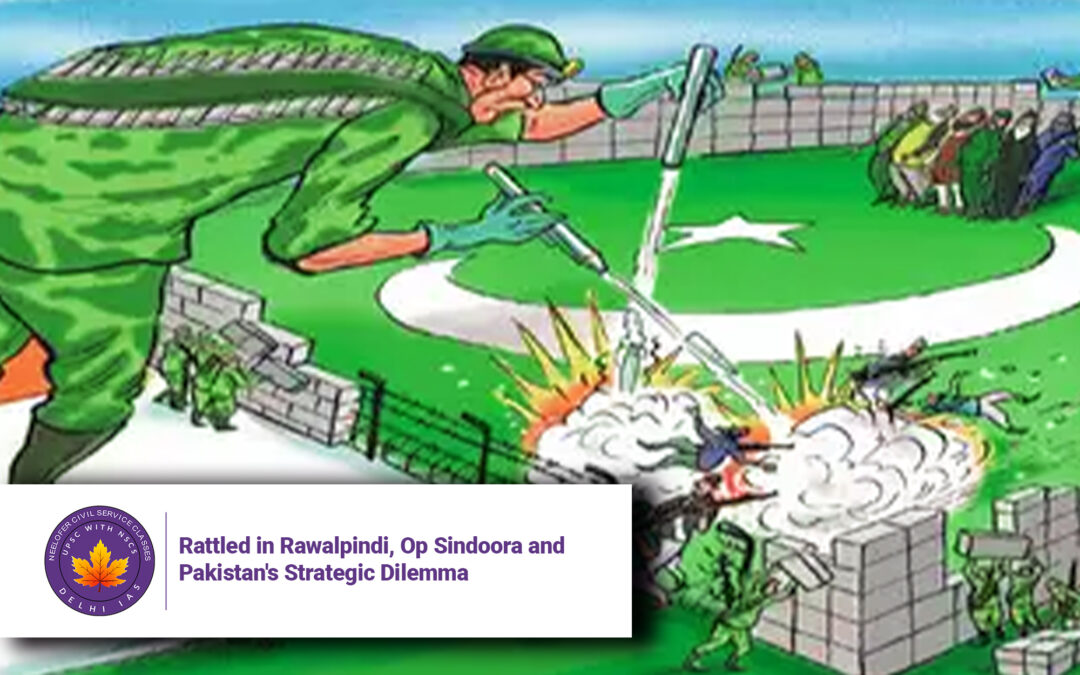
Rattled in Rawalpindi, Op Sindoora and Pakistan’s Strategic Dilemma
Why in News?
Operation Sindoora by the Indian military has raised serious questions about the core strategic doctrine of the Pakistan army. It exposed weaknesses in Pakistan’s long-standing three-part military doctrine and has shifted regional deterrence dynamics.
Introduction
Operation Sindoora, India’s limited but powerful military response, has not only inflicted tactical damage on Pakistan but has also shaken the very foundations of Pakistan’s military thinking. This shift is being felt deeply in Rawalpindi—the Pakistani military’s nerve center. With global and regional contexts evolving, Pakistan’s strategy of using low-intensity conflict as a shield under the cover of nuclear deterrence is now under pressure.
Key Issues and Institutional Concerns
1. Pakistan’s Three-Part Doctrine Under Stress
-
Pakistan’s doctrine has long relied on three pillars:
-
Strategic depth via Afghanistan,
-
Low-intensity conflict (LIC) and proxy warfare,
-
Nuclear deterrence.
-
-
Operation Sindoora tested all three—particularly the second, which assumes India cannot respond proportionally without escalating to full war.
2. The ‘Thousand Cuts’ Policy Weakens
-
Pakistan’s old reliance on bleeding India through terrorism and proxy attacks is failing.
-
India’s response via Op Sindoora has shown that it can now impose real costs without crossing the escalation threshold of full-scale war.
3. Technological and Tactical Evolution
-
Advances in drones, surveillance, precision missiles, and cyber capabilities have allowed India to deliver targeted strikes with high impact but low risk of nuclear retaliation.
-
LICs (low-intensity conflicts) are now more costly for Pakistan, as international opinion and domestic pressure restrict retaliation.
4. Strategic Depth in Afghanistan Is Lost
-
With the fall of the Ghani regime and Taliban’s focus on their internal priorities, Pakistan can no longer count on Afghanistan as a strategic fallback.
-
India now has no need to fear a two-front threat in the same way.
5. Erosion of Pakistan’s Nuclear Deterrent Posture
-
Operation Sindoora’s success shows India can undertake punitive actions even with nuclear weapons in the equation.
-
The psychological hold of nuclear blackmail is breaking down, as India’s calibrated strikes prove escalation is manageable.
Conclusion
Operation Sindoora has forced a strategic recalibration in Islamabad and Rawalpindi. It has disrupted the old belief that India will always be restrained by fear of war or nuclear escalation. With global and regional power dynamics shifting—and India’s technological edge growing—Pakistan’s options are narrowing. The ball is now in Islamabad’s court, but New Delhi has made its position clear: terrorism will not go unanswered.
Q&A Section
Q1. What is Pakistan’s military doctrine based on?
It is based on three pillars: strategic depth in Afghanistan, use of low-intensity conflict (LIC), and nuclear deterrence.
Q2. How did Operation Sindoora challenge this doctrine?
It exposed the weakness of Pakistan’s LIC strategy by delivering a strong Indian response without triggering full-scale war or nuclear retaliation.
Q3. Why is the ‘strategic depth’ doctrine failing now?
Because the Taliban in Afghanistan is no longer a reliable ally, and Afghanistan is focused on internal issues rather than offering Pakistan geopolitical leverage.
Q4. Has the fear of nuclear retaliation stopped India?
No. India has demonstrated that it can conduct limited military operations without crossing thresholds that would trigger nuclear response.
Q5. What does the future look like for India-Pakistan military dynamics?
India is likely to continue using its technological and strategic superiority for measured responses, while Pakistan is under pressure to rethink its outdated doctrine.

