
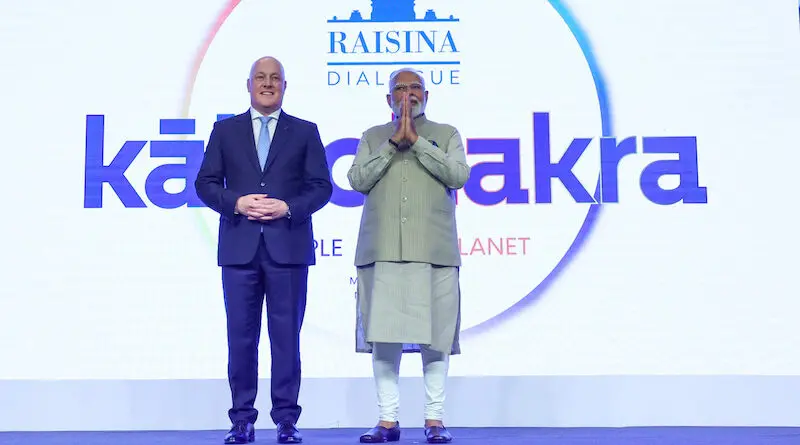
Raisina Dialogue 2025 Convenes Amid Global Uncertainty
Why in News?
The Raisina Dialogue 2025, India’s premier foreign policy conference, convened this week amid rising global tensions. With shifting geopolitical alliances, trade disputes, and conflicts in multiple regions, the discussions focused on the future of global governance and India’s role in an evolving world order.
Introduction
The Raisina Dialogue, hosted by the Ministry of External Affairs, serves as a platform for world leaders, policymakers, and analysts to discuss pressing international issues.
Recent global instability, including diplomatic disputes in Europe, ongoing conflicts in Ukraine and the Middle East, and emerging technological disruptions, has added urgency to this year’s discussions.
Key Themes of the Dialogue
Geopolitical Realignments
- U.S. Vice President JD Vance’s remarks on Ukraine and European policies sparked diplomatic friction.
- India’s External Affairs Minister S. Jaishankar highlighted the growing need for adaptive global governance structures.
- Prime Minister Narendra Modi reinforced India’s stance on global partnerships and self-reliance amid these geopolitical shifts.
Economic Competition and Trade Wars
- The rise of economic nationalism has led to increased trade disputes, impacting global supply chains.
- Discussions emphasized the need for strategic autonomy in economic policies, ensuring nations are not overly reliant on singular markets.
The Role of Emerging Technologies
- Artificial Intelligence (AI) and its impact on geopolitics became a central theme, with discussions on AI-driven conflicts, misinformation, and the future of digital economies.
- India aims to position itself as a leader in ethical AI governance and technological sovereignty.
India’s Position and Diplomatic Strategies
Strengthening Global Ties
- India emphasized deepening ties with like-minded nations to create a multipolar world order.
- PM Modi underscored the importance of partnerships while maintaining India’s strategic independence.
PM Modi’s Conversation with Lex Fridman
- In a first-of-its-kind podcast with AI researcher Lex Fridman, Modi discussed globalization, economic sovereignty, and the importance of self-reliance.
- He emphasized India’s commitment to ensuring global stability while prioritizing national interests.
Comparison with the Trump Administration’s Policies
- Modi spoke about his close relationship with U.S. President Trump, emphasizing shared nationalistic values.
- Trump’s ‘America First’ policy and Modi’s ‘India First’ approach were highlighted as complementary strategies.
Implications of Raisina Dialogue 2025
Shaping the Future of Global Governance
- Calls for reforming global institutions, including the United Nations, to make them more adaptable to modern geopolitical realities.
- India positioned itself as a champion of emerging economies in discussions on institutional restructuring.
Security and Strategic Cooperation
- The presence of U.S. intelligence officials in New Delhi indicated strengthened Indo-U.S. security cooperation.
- Rising concerns over extremist threats and regional security challenges, including the situation in Bangladesh, were discussed.
Conclusion
The Raisina Dialogue 2025 reaffirmed India’s role as a key global player. While discussions highlighted optimism about international cooperation, the overarching theme was cautious diplomacy amid a rapidly evolving world order. India aims to navigate these uncertainties by prioritizing strategic partnerships, technological advancement, and economic self-reliance.
Q&A Section
Q: Why is the Raisina Dialogue significant?
A: It serves as a platform for global leaders to discuss pressing international issues, helping shape India’s foreign policy strategy.
Q: What were the key themes of Raisina Dialogue 2025?
A: Geopolitical realignments, economic competition, trade wars, emerging technologies, and India’s diplomatic strategies.
Q: How did PM Modi emphasize India’s role in global affairs?
A: He stressed India’s commitment to strategic autonomy, global partnerships, and technological leadership, particularly in AI governance.
Q: What implications does the Dialogue have for India’s foreign policy?
A: It reinforces India’s push for a multipolar world, strengthens its security alliances, and highlights its vision for institutional reforms in global governance.
