
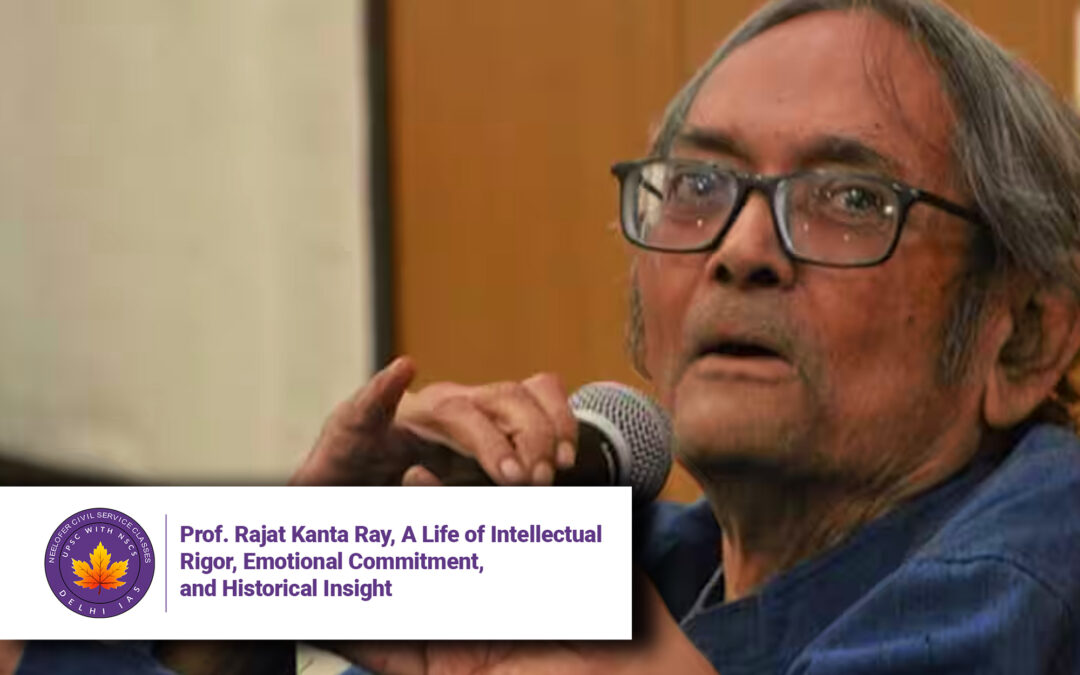
Prof. Rajat Kanta Ray, A Life of Intellectual Rigor, Emotional Commitment, and Historical Insight
By Benjamin Zachariah
Why in News?
On Wednesday afternoon, August 6, 2025—Hiroshima Day—news broke of the passing of eminent historian Professor Rajat Kanta Ray at the age of 79. A revered academic and an influential thinker, Professor Ray left behind a legacy of intellectual brilliance, emotional depth, and an unwavering commitment to secular education and historical truth. His death has left a deep void among students, colleagues, and the academic community worldwide.
Introduction
Rajat Kanta Ray’s passing is more than the loss of a historian; it marks the end of a chapter in the history of modern Indian scholarship. Known for his meticulous research, powerful teaching, and deep personal engagement with students, Ray’s work spanned critical themes in Indian and global history. From economic and agrarian studies to the nuanced politics of nationalism, his scholarship shaped generations of historians and thinkers.
Beyond his intellectual contributions, Ray was remembered for his kindness, generosity, and sharp political insight. His ability to combine emotional commitment with scholarly discipline set him apart in an academic world often divided between detached analysis and activist passion.
Key Biographical Facts
Rajat Kanta Ray was born in 1946 into a family with a background in public service—his father served as Bengal’s Home Secretary. After completing his schooling at Ballygunge Government High School, he studied history at Presidency College, Kolkata, and later at Trinity College, Cambridge. He returned to Calcutta and taught at the Indian Institute of Management before moving to Presidency College in 1975, where he served until 2006. Between 2006 and 2011, he was Vice-Chancellor of Visva-Bharati University.
His research career was shaped by collaborations, most notably with Ratnalekha Ray on agrarian studies. Together, they co-authored influential articles in the 1970s and worked on landmark studies like Change in Bengal Agrarian Society, 1760–1850. He was also known for his contributions to the study of Indian nationalism, capitalist transformation, and colonial economic structures.
Major Works and Contributions
Ray’s scholarship was vast, but certain works stand out as academic landmarks:
-
Urban Roots of Indian Nationalism: This examined press groups and political movements in late 19th-century Calcutta.
-
Industrialisation in India: Analysed industrial growth and corporate structures from 1914–47.
-
Social Conflict and Political Unrest in Bengal: A major contribution to understanding political violence and protest movements.
-
The Felt Community: Explored morality and mentality before the emergence of Indian nationalism.
-
Mindset and Mentality in the Indian Awakening: Critiqued the turn towards emotional and affective history in the early 21st century.
Ray’s work was informed by deep archival research and a determination to link historical scholarship with broader political and social understanding.
Philosophy and Approach to History
Ray belonged to a generation of historians influenced by Marxist traditions but unwilling to be bound by any single ideological framework. While he valued the explanatory power of class and economic structures, he resisted dogmatic thinking.
He firmly believed in the importance of secular education and was deeply critical of the rise of sectarian and nationalist ideologies in post-colonial India. In his view, historical truth was too often compromised by political agendas, and historians had a duty to resist such distortions.
Even as a “card-carrying Communist” in his early years, Ray understood that Marxist historiography had its limitations. He moved beyond rigid ideology to embrace a historically grounded humanism, one that recognised the interplay between material conditions and human agency.
Teaching and Mentorship
Professor Ray was as much a teacher as a researcher. Known for his generosity with time and ideas, he guided students not only academically but also personally. His office and home were open to discussions that ranged from historiographical debates to practical advice about life.
He read students’ work with meticulous care, often providing detailed feedback, and was never shy about expressing disagreement when he thought an argument lacked rigor. At the same time, he supported his students’ intellectual independence, encouraging them to challenge established narratives.
Political Engagement and Public Stance
Ray’s political positions were firmly grounded in a commitment to secularism, social justice, and rational thought. He stood firmly against the rise of communalism, warning against the dangers of using religion as a tool for political mobilisation.
During his career, Ray frequently addressed the ways in which history could be manipulated to serve contemporary agendas. He particularly criticised post-colonial nationalist histories that masked social and class divisions in the name of a unified past.
Personal Traits and Relationships
To those who knew him personally, Rajat Kanta Ray was a man of warmth, humor, and emotional depth. He maintained close friendships across political and academic divides. In his interactions, he combined intellectual seriousness with a wry sense of humor.
He was unafraid of confronting political untruths and could be sharply critical, yet he was equally capable of acts of great kindness. His colleagues recall how he would read drafts of their work and return them with thoughtful, handwritten notes—sometimes with gentle teasing, sometimes with pointed critique.
Later Years and Passing
In his later years, Ray continued to write, mentor, and engage in public debate, though at a slower pace. His final years were spent in New Town, Kolkata, surrounded by his books and memories. On Hiroshima Day, August 6, 2025, he passed away peacefully in his sleep.
His death prompted tributes from across the academic and political spectrum, with many highlighting his role in shaping their intellectual journeys and his unwavering commitment to truth.
Challenges and the Way Forward
Ray’s death leaves a significant gap in the intellectual landscape of Indian history. The challenge now is for younger scholars to carry forward his legacy: to approach history with rigor, resist ideological manipulation, and remain committed to the principles of secular education.
In an age where historical narratives are increasingly politicised, Ray’s example reminds us that history is not just about the past—it is also about how we understand and shape the present.
Conclusion
Professor Rajat Kanta Ray’s life was a testament to the belief that intellectual work and emotional commitment are not contradictory but complementary. His scholarship combined analytical depth with human warmth, and his public stance was guided by an unwavering dedication to truth and justice.
As the academic world mourns his loss, his writings, teachings, and example will continue to inspire future generations. His passing is not just the end of a career—it is the closing of a chapter in the story of Indian historiography.
Q&A Section
Q1. Who was Professor Rajat Kanta Ray, and why is he significant in Indian historiography?
A: Rajat Kanta Ray was a renowned Indian historian known for his work on nationalism, agrarian history, and the colonial economy. His scholarship combined meticulous research with a commitment to secular education and resistance to political distortion of history.
Q2. What were some of his most influential works?
A: His major works include Urban Roots of Indian Nationalism, Industrialisation in India, Social Conflict and Political Unrest in Bengal, The Felt Community, and Mindset and Mentality in the Indian Awakening.
Q3. What was his approach to history and politics?
A: While influenced by Marxist historiography, Ray resisted ideological rigidity. He emphasised secularism, rational thought, and historical truth, often challenging nationalist and communal distortions of history.
Q4. How did he influence students and younger scholars?
A: Ray was deeply committed to mentorship, offering intellectual guidance, personal advice, and critical feedback. His encouragement of independent thinking helped shape a generation of historians.
Q5. What is the lasting legacy of Professor Rajat Kanta Ray?
A: His legacy lies in his uncompromising scholarly rigor, his defense of secular and rational education, and his ability to combine intellectual work with emotional commitment. He remains a model for historians seeking to balance academic excellence with moral responsibility.

