
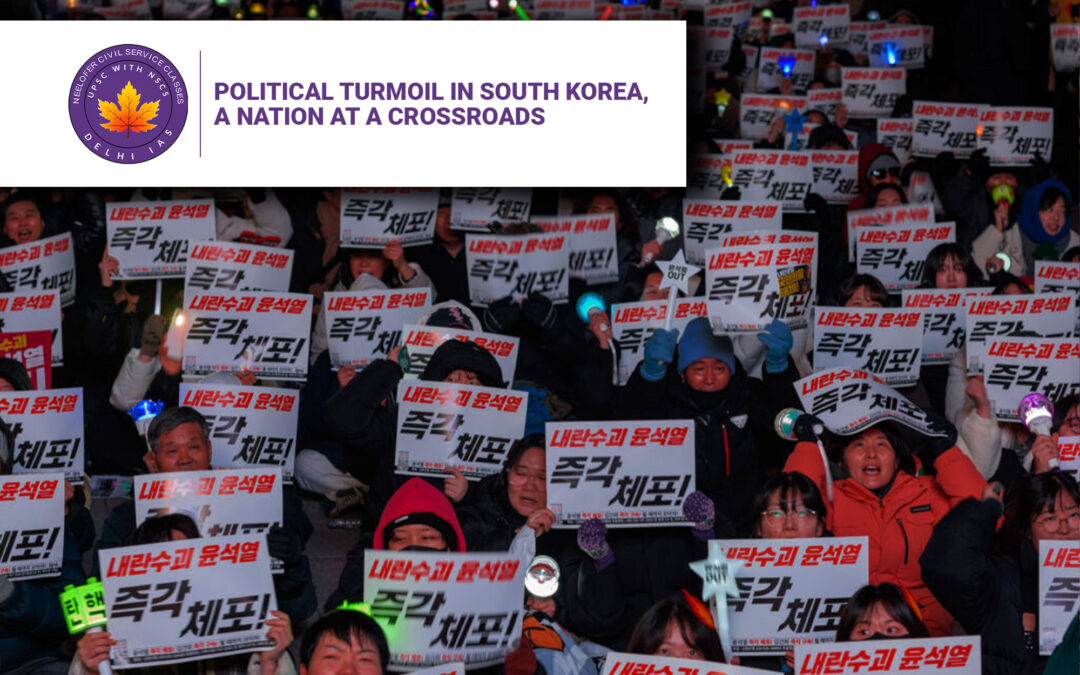
Political Turmoil in South Korea, A Nation at a Crossroads
Why in News?
South Korea is undergoing significant political turbulence following the impeachment of former President Yoon Suk Yeol in April. This major political development has led to widespread public unrest, legal debates, and questions about the future of the country’s democracy and governance. 
Introduction
On April 4, 2024, South Korea’s constitutional court unanimously upheld the impeachment of President Yoon Suk Yeol. With this verdict, Mr. Yoon became the second president in South Korea’s history to be removed from office. As per the Constitution, fresh presidential elections must be held within 60 days of such a verdict.
What Led to His Impeachment?
On December 3, 2023, Yoon declared a national emergency and martial law, reportedly in reaction to mass protests by “anti-state forces” and to eliminate threats from “pro-North Koreans.” He made this announcement from an army base near Jeonju.
Soon after, the National Assembly convened and 190 members voted in favour of impeaching him under Article 71. By December 14, the Assembly passed a motion to vote out President Yoon, with 204 of 300 members in favour. His opposition included the Democratic Party of Korea (DPK) and the People’s Power Party (PPP).
The Martial Law Controversy
Yoon’s declaration of martial law was highly controversial. Critics claimed it was an abuse of power to silence civil protests. The emergency rule included using military presence to suppress dissent, and 11 anti-state figures were arrested after a clash at the courthouse on February 25.
Yoon defended his decision by stating that the move was necessary to combat threats to democracy and national unity.
The Court’s Final Verdict
The constitutional court ruled against Mr. Yoon, emphasizing that his declaration of martial law violated the democratic process, and that his justifications were unfounded. It concluded that such extreme actions not only undermined legal order but also deepened public division.
Additionally, corruption charges from his tenure were also dismissed, although the court found his martial law move unconstitutional.
What Lies Ahead for South Korea?
South Korea is now in a fragile political state. A caretaker government is currently in power, with elections expected soon. Meanwhile, there are daily protests and heavy military presence on the streets.
The PPP is in disarray, and Yoon’s party lost credibility, especially among youth and moderates. South Korea also faces external pressures including strained relations with China and North Korea, and trade tensions with the U.S.
This political crisis presents an opportunity for South Korea to reaffirm its commitment to democratic values, rule of law, and transparency.
Conclusion
The ousting of President Yoon has pushed South Korea into one of its most significant constitutional and political challenges in recent history. The country now stands at a crossroads, with its upcoming elections playing a decisive role in restoring public trust and institutional integrity.
5 Q&A on the South Korean Political Crisis
Q1. Why was President Yoon Suk Yeol impeached?
He was impeached for declaring martial law without justification, attempting to silence public dissent, and violating constitutional and democratic norms.
Q2. What was the court’s verdict on his impeachment?
The constitutional court upheld his impeachment unanimously, stating that his actions lacked constitutional mandate and threatened democratic governance.
Q3. What were the events following martial law declaration?
Protests erupted across the country, military forces were deployed, and several arrests were made, leading to further unrest and eventual impeachment proceedings.
Q4. Who voted for the impeachment in the National Assembly?
204 out of 300 members, including major opposition parties like the Democratic Party of Korea (DPK), voted in favour of the motion.
Q5. What is the current political state of South Korea?
An interim caretaker government is in place, daily protests continue, and early presidential elections are expected within 60 days as per the constitution.
