
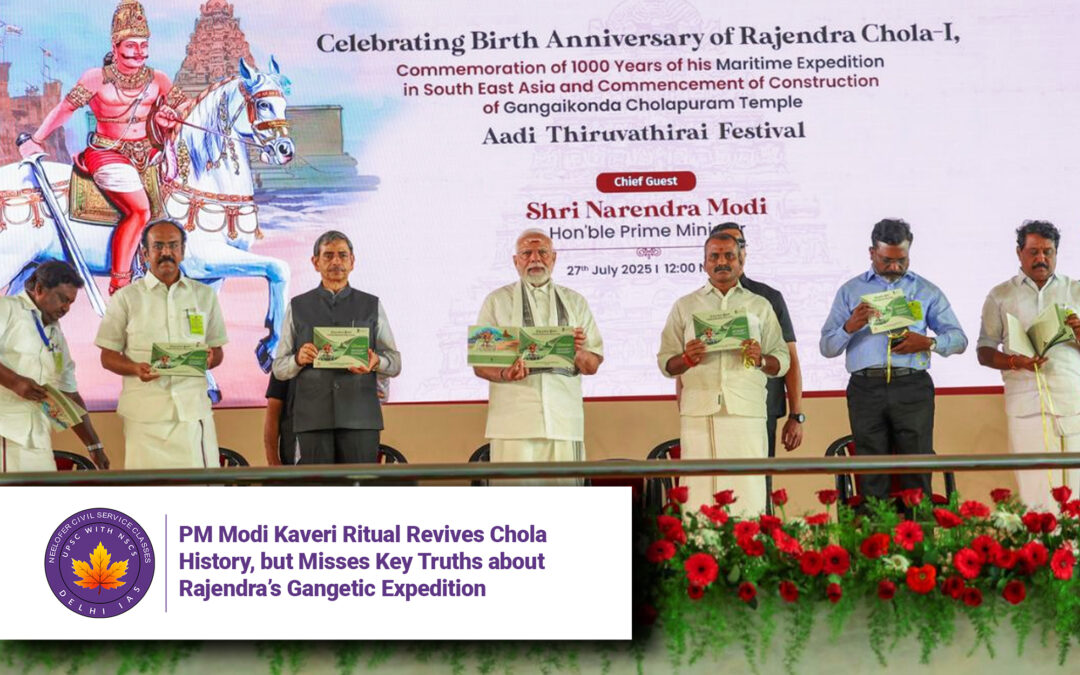
PM Modi Kaveri Ritual Revives Chola History, but Misses Key Truths about Rajendra’s Gangetic Expedition
Why in News:
Prime Minister Narendra Modi, during his visit to Tamil Nadu on July 27, paid tribute to the Chola emperor Rajendra Chola I by pouring water from the Ganga into a tank at the historic Gangaikonda Cholapuram. He linked this act to his government’s cultural initiative ‘Ek Bharat, Shreshtha Bharat’, symbolizing India’s unity. However, the event sparked academic and political discourse over the historical accuracy and selective memory around Rajendra’s northern campaign.
Introduction:
The PM’s gesture, while symbolic and politically strategic, has brought new attention to the Chola king Rajendra Chola I, who once launched an ambitious military expedition to the Ganga. While Modi portrayed it as a spiritual-cultural voyage akin to today’s Kashi Tamil Sangamam, historians argue that Rajendra’s journey was anything but peaceful. It was a violent conquest, full of loot, war, and temple destruction—a reality that stands in contrast to the unity and reverence the PM sought to highlight.
Key Issues and Background:
-
Who was Rajendra Chola I?
Known as Gangaikonda Cholan, he was the son of Rajaraja Chola and famed for extending Chola power to North India and Southeast Asia. He founded the new capital Gangaikonda Cholapuram, building a temple to rival the Brihadeeswarar Temple in Thanjavur. -
The Expedition to the Ganga:
Around 1023 CE, Rajendra sent an army northwards, defeating rulers and kingdoms along the way. He brought back water from the Ganga and established a tank in his capital to commemorate the feat.
Unlike spiritual or diplomatic missions, this was a military campaign marked by aggression and imperial ambitions. -
Political Symbolism by PM Modi:
The PM referenced the historic act of bringing Ganga water as a way to unite Kashi and Tamil Nadu, similar to his government’s efforts to promote cultural integration. He linked it to Tamil pride, Ek Bharat, and preparations for 2024 elections in the state.
Specific Impacts or Effects:
-
Misinterpretation of History:
The Chola expedition was not a “pilgrimage” or peaceful integration as portrayed—it involved warfare, destruction of temples, and military dominance. According to historians, such sanitization of historical campaigns ignores the brutal realities of medieval politics. -
Communal Harmony Narrative Undermined:
The BJP’s framing of history, as seen here, unintentionally undermines the centuries of peaceful co-existence among different communities, especially during Chola reign, which included Hindu, Jain, and Buddhist patrons. -
Sri Lanka and Southeast Asia Context:
The Cholas also ravaged parts of Sri Lanka and Southeast Asia. Rajendra’s troops sacked Polonnaruwa, captured the Lankan king, and destroyed Buddhist monasteries. This part of Chola legacy rarely makes it to public discourse.
Challenges and the Way Forward:
-
Selective History for Political Gain:
There’s growing concern about cherry-picking historical events to suit modern political narratives. While celebrating ancient rulers is important, it should not come at the cost of historical accuracy. -
Need for Nuanced Education:
The Cholas were undoubtedly advanced rulers, particularly in art, administration, and naval power. But educational and political discourse must present their legacy in full—both glory and gore. -
Public Memory vs Historical Truth:
Using temple architecture, water rituals, and spiritual symbolism without historical context can distort public understanding. Political leaders should avoid romanticizing violent campaigns for ideological positioning.
Conclusion:
PM Modi’s symbolic act at Gangaikonda Cholapuram may have brought national attention to a lesser-known Tamil king, but in doing so, it oversimplified a complex chapter of Indian history. Rajendra Chola’s northern campaign was a military expansion, not a sacred unification. As India embraces its past under the lens of cultural pride, it’s equally essential to remember the realities of power, conquest, and conflict that shaped it. Only then can true unity, as envisioned by ‘Ek Bharat, Shreshtha Bharat,’ be meaningfully achieved.
5 Key Questions and Answers:
-
Who was Rajendra Chola I?
He was a powerful Chola emperor known for expanding his empire northward and bringing Ganga water to Tamil Nadu. -
What did PM Modi do during his July 27 visit?
He performed a ritual by pouring Ganga water into a tank at Gangaikonda Cholapuram, symbolizing unity between Tamil Nadu and Kashi. -
Was Rajendra’s expedition peaceful?
No. It was a military conquest involving destruction of temples and subjugation of kingdoms. -
Why is the event politically significant?
It connects with BJP’s cultural narrative and Tamil pride ahead of upcoming elections. -
What is the criticism around this event?
Historians argue that it misrepresents historical facts, portraying a violent campaign as a unifying pilgrimage.

