
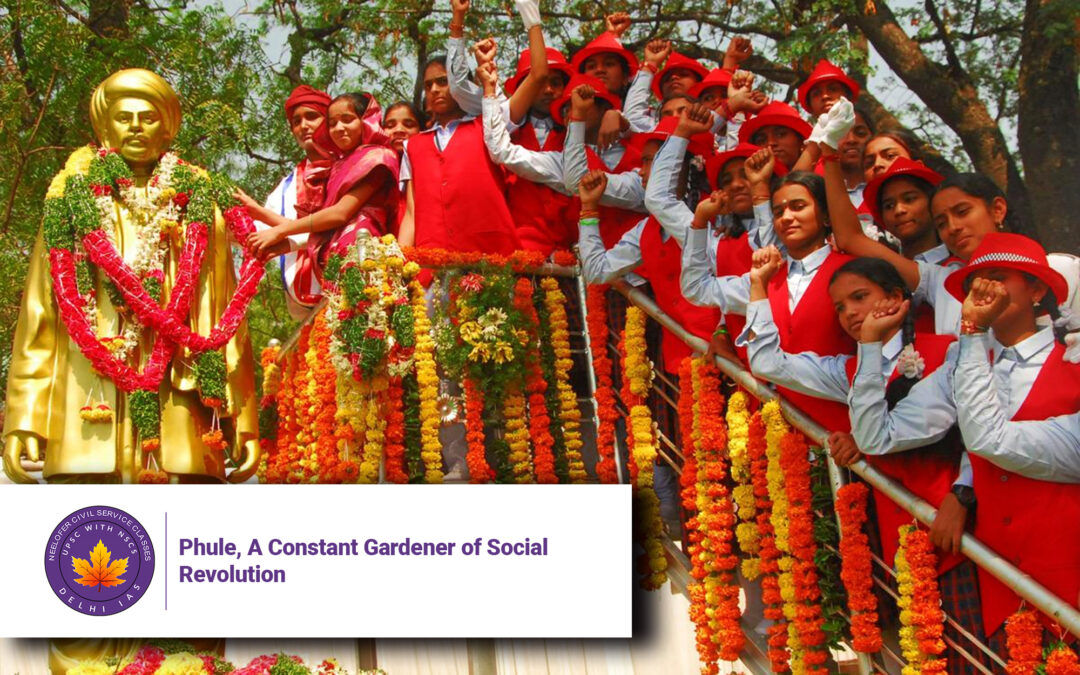
Phule, A Constant Gardener of Social Revolution
Why in News?
April 11 marks the birth anniversary of Mahatma Jyotiba Phule (1827–1890), a pioneer of social reform in India. This day is commemorated for his lifelong fight against caste oppression, patriarchy, and Brahminical orthodoxy. His actions and writings remain profoundly relevant in today’s discourse on equality, education, and justice. 
Introduction
Jyotiba Phule, born in the Mali caste, a community traditionally involved in gardening, rose to become one of India’s most influential social reformers. Insulted at a Brahmin wedding for attending despite his lower-caste status, Phule resolved to challenge the caste system and champion the rights of the oppressed.
He, along with his wife Savitribai Phule, founded India’s first school for girls in 1848. The couple went on to open 18 schools for women, Shudras, and working-class people by 1855. His work spanned education, anti-caste activism, women’s rights, religious reform, and secularism.
Key Issues and Institutional Concerns
1. Educational Reforms and Women’s Empowerment
Phule and Savitribai were pioneers in girls’ education at a time when it was condemned. Their schools served not just as learning centers but also as hubs for social empowerment of the lower castes and women.
2. Rejection of Brahminical Orthodoxy
Influenced by thinkers like Thomas Paine and missionary Cynthia Farrar, Phule was critical of the Brahminical order. He saw it as a system designed to enslave Shudras and uphold upper-caste hegemony. He criticized Hindu scriptures for justifying inequality and urged people to reject blind faith.
3. Rationalism and Religious Plurality
Phule’s rationalist beliefs were evident in his interpretation of religion. In Gulamgiri (Slavery) and Shetkaryacha Asud (Farmer’s Whipcord), he argued against superstition and promoted ethical, rational thought. He also appreciated the moral teachings of Islam and Christianity.
4. Advocacy for Farmers and the Poor
In Shetkaryacha Asud, Phule spoke against exploitation of farmers and argued for their empowerment through land reform, irrigation, education, and technological support. He criticized unjust taxation and the influence of upper-caste landlords.
5. Vision of an Egalitarian Society
Phule envisioned a society free from caste, patriarchy, and religious bigotry. He proposed a secular government that supported farming communities, scientific agriculture, and animal rights. He strongly believed in collective ownership of resources and communal harmony.
Challenges and the Way Forward
-
Revive Phule’s Principles in Modern Policy: His focus on education, land rights, and equality must guide today’s inclusive governance.
-
Expand Access to Rationalist Thought: Encourage youth to question discriminatory traditions through Phule-inspired curriculum.
-
Support for Rural and Agrarian Sectors: Echoing Phule’s ideas, governments should promote sustainable agriculture and rural development.
-
Gender and Caste Equity Programs: His legacy must influence current schemes targeting caste and gender-based discrimination.
-
Combating Religious Dogma: Institutions should uphold constitutional secularism over orthodoxy, as envisioned by Phule.
Conclusion
Mahatma Jyotiba Phule was not just a reformer of his time, but a visionary whose ideals are eternally relevant. From promoting girls’ education to confronting caste tyranny and critiquing religious dogma, he planted the seeds of a just society. Today, his legacy continues to inspire progressive thought and action — a reminder that true revolution begins with education, equality, and courage.
Q&A Section
Q1. Who was Jyotiba Phule and why is he important?
He was a 19th-century social reformer who fought against caste oppression, promoted education for girls and lower castes, and challenged Brahminical orthodoxy.
Q2. What was Phule’s major contribution to education?
Phule and his wife Savitribai opened the first school for girls in India and later expanded access to Shudras and working-class communities.
Q3. How did Phule view religion and scriptures?
He criticized religious texts that supported inequality, appreciated humanistic elements in Christianity and Islam, and promoted rational thought.
Q4. What are Phule’s thoughts on agriculture and farmers?
He advocated land reforms, scientific farming, and better treatment for farmers. He believed that empowering peasants was key to societal progress.
Q5. How can Phule’s vision help India today?
His emphasis on equality, education, and justice can guide modern policies addressing casteism, gender inequality, rural poverty, and religious extremism.
