
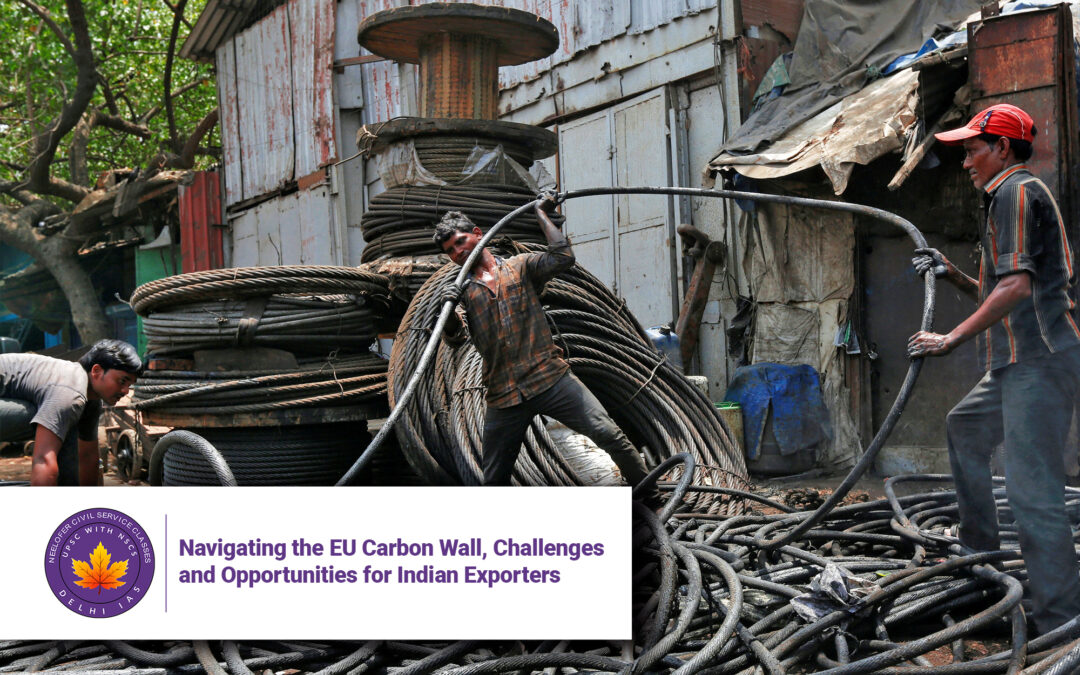
Navigating the EU Carbon Wall, Challenges and Opportunities for Indian Exporters
Why in News:
The European Union (EU) is set to operationalize its Carbon Border Adjustment Mechanism (CBAM) from January 2026, a move that will significantly impact countries exporting carbon-intensive goods to the EU—including India. With iron, steel, and aluminium being key Indian exports, the implications of CBAM are economically critical.
Introduction:
The Carbon Border Adjustment Mechanism (CBAM) aims to prevent “carbon leakage” and create a level playing field for EU producers. Initially covering energy-intensive sectors like iron, steel, aluminium, cement, electricity, and hydrogen, CBAM will eventually extend to other sectors. India, the EU’s second-largest export partner, exported $70 billion worth of goods to the EU in 2023, with $7.3 billion (10.5%) covered under CBAM.
A recent Centre for Science and Environment study indicates that if the carbon price is €100 per tonne, India may incur an additional 25% cost on exports of CBAM-covered products, translating to a $1.7 billion impact—0.05% of its GDP.
Key Issues and Background:
-
Emission Intensity of Indian Industries:
-
India’s iron and steel sectors primarily use the blast furnace–basic oxygen furnace (BF–BOF) route, with an emission intensity of 3 tonnes of CO₂ per tonne of steel, well above the global average of 2 tonnes.
-
Secondary routes (DRI-EAF and DRI-induction) are gaining ground but are still not dominant.
-
-
Price Competitiveness:
-
India’s competitiveness comes from lower energy costs and labor costs, but the lack of internalized carbon pricing makes Indian products vulnerable to CBAM tariffs.
-
The aluminium sector faces similar threats due to its high emission intensity.
-
-
Market Structure in the EU:
-
An estimated 20,000 authorized EU importers will be active under CBAM.
-
A competitive importer base may soften the impact by creating price-sharing pressures between importers and exporters.
-
Specific Impacts or Effects:
-
Small and Medium Enterprises (SMEs):
-
Most vulnerable due to lack of financing, expertise, and infrastructure to meet the MRV (Measuring, Reporting, Verification) requirements.
-
Risk of being priced out of the EU market.
-
-
Larger Exporters:
-
Better prepared due to investments in low-carbon technologies.
-
Likely to adopt a dual-market strategy, sending low-carbon goods to the EU and higher-carbon goods to domestic or less-regulated markets.
-
-
Trade and Diplomacy:
-
Ongoing India-EU FTA negotiations are being affected.
-
Special concessions for SMEs and facilitation mechanisms are under discussion.
-
Challenges and the Way Forward:
-
Technological Modernization:
-
Shift to DRI–EAF or other cleaner steel production methods.
-
Reduce reliance on BF–BOF by promoting low-emission alternatives.
-
-
Policy and Support Mechanisms:
-
Establish facilitation offices in the EU to help Indian exporters navigate compliance.
-
Push for de minimis exemptions for small exporters in FTA negotiations.
-
-
SME Support:
-
Provide financial incentives and technical assistance to help SMEs comply with CBAM requirements.
-
Government and industry associations must create compliance-readiness programs.
-
-
Long-term Strategy:
-
Promote carbon pricing or trading mechanisms in India to align with global carbon cost structures.
-
Encourage green finance and innovation funds for industrial transformation.
-
Conclusion:
The implementation of the EU’s CBAM represents a significant trade and climate policy shift with serious consequences for Indian exporters, especially in iron, steel, and aluminium. While large exporters are relatively prepared, SMEs require urgent policy and institutional support. India must strategically engage with the EU, enhance technological adoption, and create internal carbon cost frameworks to sustain its competitiveness.
5 Questions and Answers:
1. What is CBAM and why has the EU introduced it?
CBAM is the Carbon Border Adjustment Mechanism introduced to prevent carbon leakage and ensure fair competition by taxing imports based on their carbon content.
2. How will CBAM affect Indian exports?
It could add 25% cost to CBAM-covered exports, impacting India’s competitiveness—especially in iron, steel, and aluminium.
3. Which Indian industries are most vulnerable to CBAM?
Iron and steel (BF–BOF route users), aluminium, and SMEs lacking decarbonization capabilities are most at risk.
4. What steps can India take to mitigate CBAM impacts?
Technological upgrades, government facilitation in the EU, negotiating FTA exemptions, and internal carbon regulation reforms.
5. How can Indian exporters remain competitive under CBAM?
By shifting to cleaner technologies, partnering with competitive importers, and adopting dual-market strategies to separate high and low-carbon products.

