
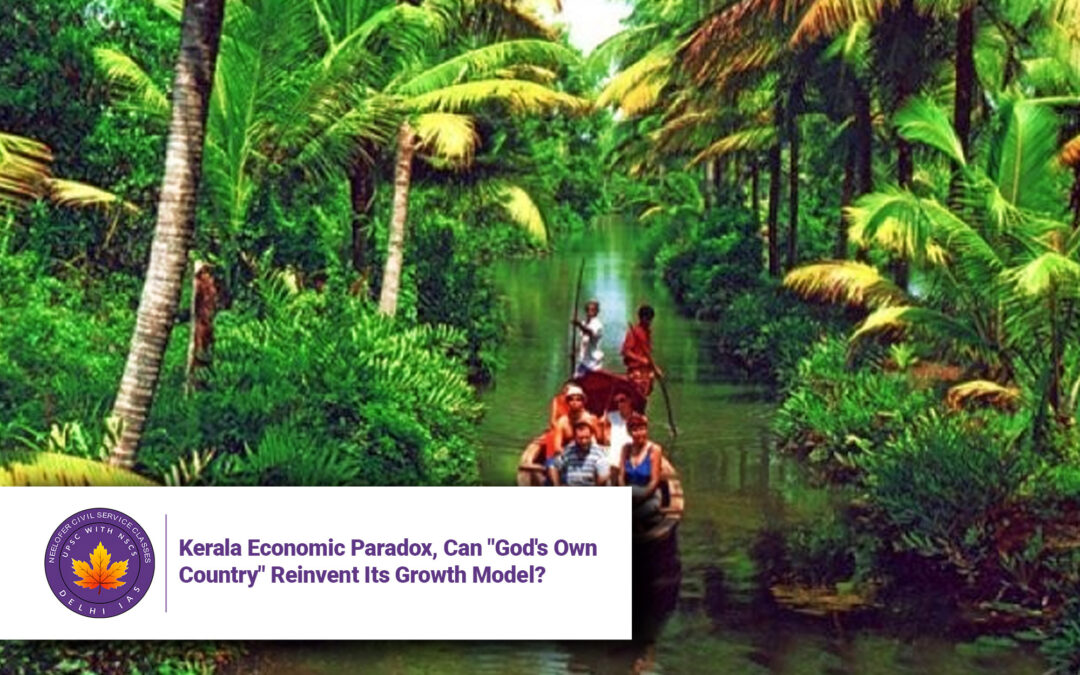
Kerala Economic Paradox, Can “God’s Own Country” Reinvent Its Growth Model?
Introduction
Kerala, often hailed as “God’s Own Country” for its natural beauty and human development achievements, faces a deepening economic crisis that threatens its celebrated social model. Despite boasting India’s highest literacy rate (94%), lowest infant mortality, and robust healthcare, the state struggles with stagnant industries, soaring unemployment (9.6% vs. national 4.1%), and a crushing public debt of ₹3.57 lakh crore. This article examines Kerala’s economic contradictions, the risks of its remittance-dependent model, and the urgent reforms needed to revive growth.
The Kerala Paradox: Social Progress vs. Economic Stagnation
1. Human Development vs. Economic Indicators
| Metric | Kerala | National Average |
|---|---|---|
| Literacy Rate | 94% | 77.7% |
| Unemployment (2023) | 9.6% | 4.1% |
| Industrial Contribution | 23% of GSDP | 29% of GDP |
| Public Debt | ₹3.57 lakh crore | – |
2. The Remittance Trap
-
Diaspora Dependence: NRKs (Non-Resident Keralites) send ~₹1.5 lakh crore annually, once forming 30% of state GDP.
-
Pandemic Shock: Remittances dropped 20% in 2020-21, exposing economic fragility.
-
Limited Local Jobs: Despite high education, youth flock to Gulf nations for work.
3. Fiscal Crisis
-
Debt Spiral: 25% of Kerala’s budget goes to debt servicing (higher than education + healthcare spending).
-
Declining Central Funds: Post-2017, GST compensation cuts and reduced devolution hurt revenue.
Root Causes of Kerala’s Economic Decline
1. Anti-Business Ecosystem
-
Rigid Labor Laws:
-
Example: The Kerala Shops Act (1960) mandates 5-woman teams for night shifts, deterring IT/BPO firms.
-
45-hour workweek rules lack flexibility compared to Karnataka/Tamil Nadu.
-
-
Bureaucratic Hurdles:
-
Average 118 days to start a business (vs. 16 days in Gujarat).
-
“Investor suicides” due to permit delays and political interference.
-
2. Industrial Stagnation
-
No Major Private Investments: Only 3% of India’s FDI flows to Kerala (vs. 35% to Maharashtra).
-
Agricultural Decline:
-
Rubber & spices hit by climate change and cheaper imports.
-
Farm incomes dropped 40% since 2015.
-
3. Political Resistance to Reform
-
Historic Leftist Opposition to privatization (e.g., protests against SilverLine semi-high-speed rail).
-
Populist Spending: Freebies like pension schemes strain finances.
5 Key Reforms for Kerala’s Revival
1. Ease of Doing Business Overhaul
-
Single-Window Clearances: Digitize approvals (like Tamil Nadu’s “Business First” portal).
-
Amend Labor Laws: Allow flexible shifts for women in IT/hospitality.
2. Investor Protection Laws
-
Shield Projects from Political Flip-Flops (e.g., cancelled Aranmula Airport after ₹100cr spent).
-
Fast-Track Courts for contract disputes.
3. Leverage Human Capital
-
Knowledge Economy Push:
-
Biotech/AI hubs in Kochi/Thiruvananthapuram.
-
PPP models for research (e.g., Kerala’s Digital University).
-
4. Tourism 2.0
-
Eco-Tourism: Expand Responsible Tourism Mission (e.g., bamboo rafting in Wayanad).
-
Medical Tourism: Capitalize on Ayurveda and low-cost healthcare.
5. Debt Restructuring
-
Negotiate with Centre for long-term moratorium on loans.
-
Asset Monetization: Lease out KSRTC depots/ports for revenue.
5 Key Q&A on Kerala’s Economy
Q1: Why is Kerala’s unemployment so high despite high literacy?
A: Jobs mismatch—youth seek white-collar roles, but the state lacks industries beyond tourism/remittances.
Q2: How does remittance dependence hurt Kerala?
A: It creates a consumption-driven economy with low productivity. Global shocks (like Gulf recessions) trigger crises.
Q3: What’s stopping industries from investing in Kerala?
A: Bureaucratic delays, militant unions, and fear of policy U-turns (e.g., cancelled SmartCity Kochi deals).
Q4: Can tourism alone revive Kerala’s economy?
A: No. Tourism contributes 10% to GSDP but is seasonal. High-value sectors like IT/biotech are needed.
Q5: What’s the #1 reform Kerala needs?
A: Investor confidence—guaranteeing projects won’t be stalled after approvals.
Case Study: How Tamil Nadu Outpaced Kerala
| Factor | Tamil Nadu | Kerala |
|---|---|---|
| Ease of Doing Business | Rank 3 (2023) | Rank 28 (2023) |
| FDI Inflow (2023) | $4.1 billion | $0.3 billion |
| Industrial Growth | Auto/IT hubs (Chennai, Coimbatore) | Reliant on remittances |
Lesson: Proactive land/ labor reforms attract factories (e.g., Hyundai, Foxconn).
Conclusion: A Call for “Kerala Model 2.0”
Kerala must shift from redistributive populism to productive capitalism. The roadmap:
✅ Jobs via flexible labor laws (especially for women in tech).
✅ Investor-friendly policies (no more “permit raj”).
✅ Diversify beyond remittances (IT, biotech, green energy).
With elections in 2024, politicians must choose: short-term populism or long-term revival. As Tagore said, “Faith is the bird that sings while dawn is still dark.” For Kerala’s economy, the dawn is near—but only if it acts now.
Author
Views are personal

