
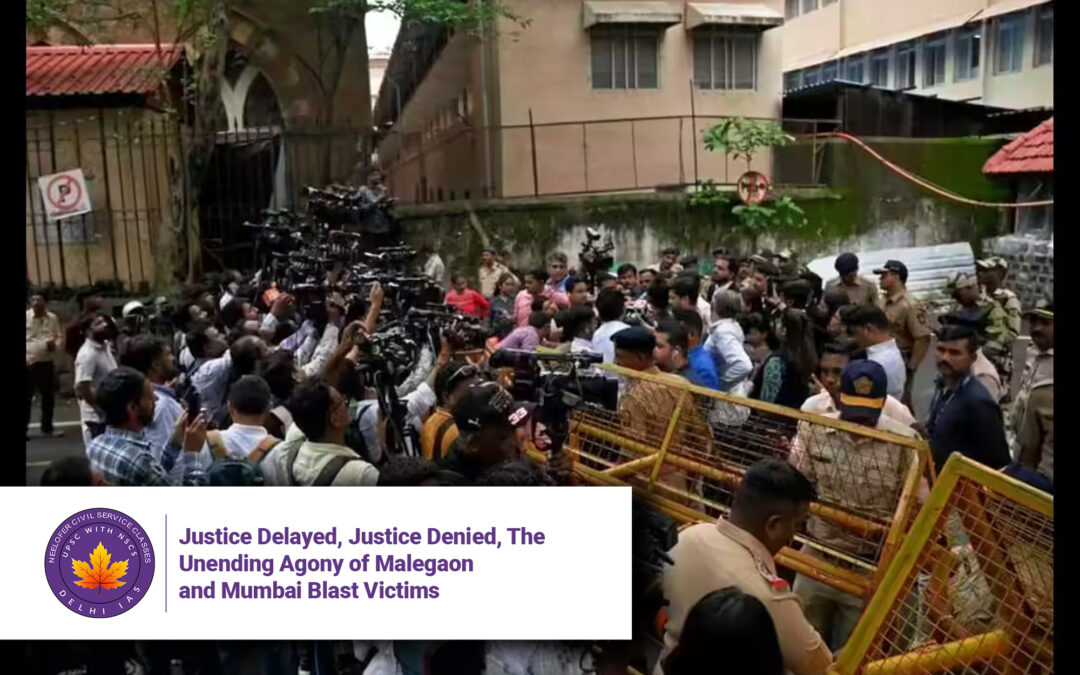
Justice Delayed, Justice Denied, The Unending Agony of Malegaon and Mumbai Blast Victims
Introduction
Nearly two decades after the 2006 Mumbai train blasts (189 killed) and the 2008 Malegaon blasts (6 killed), the victims and their families remain trapped in a Kafkaesque nightmare—one where justice is elusive, compensation is inadequate, and the state’s apathy is glaring. The recent acquittal of Ehtesham Siddique (sentenced to death in 2015) by the Bombay High Court has reopened old wounds, exposing faulty investigations, prosecutorial lapses, and systemic bias in India’s anti-terror legal machinery.
This article examines:
-
The human cost of delayed justice (victims’ stories)
-
Why the cases collapsed (RTI revelations, evidence gaps)
-
Differential treatment of accused (Sadhvi Pragya vs. Muslim detainees)
-
5 reforms needed to fix India’s anti-terror framework
Why in News?
-
Bombay HC acquits Ehtesham Siddique (Mumbai blasts accused) after 19 years, citing lack of evidence.
-
Malegaon case stalls: Key accused (Sadhvi Pragya, Lt. Col. Purohit) enjoy bail; trial crawls.
-
Victims’ plight:
-
Rajesh Jha (blast survivor): Lost hearing, became CA but no govt. aid.
-
Parag Sawant: Died after 9 years in coma; widow Priti abandoned.
-
Key Issues and Analysis
1. The Victims: Forgotten by the State
A. Physical & Financial Ruin
-
Medical costs: Most survivors sold assets for treatment (no state support).
-
Example: Rajesh Jha’s ear drum surgery funded by crowdfunding.
B. Psychological Trauma
-
Priti Sawant’s testimony:
“Parag woke from coma but never spoke. For 9 years, I waited for justice—only to see his killers walk free.”
C. Compensation Failures
-
2006 Mumbai blasts: ₹5 lakh/heir (delayed by 7 years).
-
2008 Malegaon: ₹3 lakh/heir (many still unpaid).
2. Why the Cases Collapsed: A System in Shambles
A. Mumbai Blasts: The RTI Bomb
-
Ehtesham Siddique filed 300+ RTIs exposing:
-
No call records (key evidence “lost”).
-
Fake ID parades (ATS officer unauthorized).
-
-
Prosecution admitted lapses in court.
B. Malegaon: Selective Leniency
-
Sadhvi Pragya:
-
Got bail despite confessing (later retracted).
-
Elected as MP (BJP ticket) while on trial.
-
-
Muslim accused:
-
Tortured in jail (Human Rights Watch report).
-
No speedy trial.
-
Legal Paradox:
-
UAPA (anti-terror law): Used ruthlessly against minorities, diluted for Hindutva accused.
3. Comparative Analysis: Global Terror Trials
| Case | Duration | Verdict | Compensation |
|---|---|---|---|
| India (Mumbai 2006) | 19 years | Acquittal (evidence lost) | ₹5L (delayed) |
| USA (9/11) | 5 years | Convictions | $7B victim fund |
| UK (7/7 London) | 3 years | Convictions | £3M/family + therapy |
Key Difference:
-
West prioritizes victim rehabilitation; India abandons them.
5 Reforms for a Fairer Anti-Terror System
1. Fast-Track Courts
-
Max 5-year deadline for terror trials (model: POTA courts).
2. Victim Protection Law
-
Mandatory medical/financial aid (funded by terror fines).
3. Prosecutorial Accountability
-
Jail cops/prosecutors for evidence tampering.
4. Uniform UAPA Application
-
No bail for any terror accused until trial ends (remove bias).
5. Truth & Reconciliation Commission
-
Compensate wrongfully jailed (like Ehtesham Siddique).
Conclusion: When Justice Fails, Democracy Bleeds
The Mumbai and Malegaon cases are not just legal failures—they are moral catastrophes. The victims’ suffering continues because:
✔ Investigations were botched (intentionally or negligently).
✔ Political interference shielded some accused.
✔ No systemic empathy for survivors.
As journalist Vinaya Deshpande Pandit writes:
“These stories don’t end—they just fade from headlines, leaving scars that never heal.”
India must choose: Will it be a democracy that protects victims, or a regime that abets their agony?
5 Key Questions & Answers
Q1: Why was Ehtesham Siddique acquitted?
A1: No call records, fake ID parade—prosecution had zero evidence.
Q2: How did Sadhvi Pragya get bail?
A2: Political patronage (BJP MP) + weak UAPA enforcement for Hindutva accused.
Q3: What’s the avg. compensation for blast victims?
A3: ₹3–5 lakh (vs. $2M/9/11 victim in U.S.).
Q4: Can victims sue the state for delays?
A4: No legal provision—need new victim rights law.
Q5: What’s the #1 reform needed?
A5: Fast-track courts with strict deadlines.
