
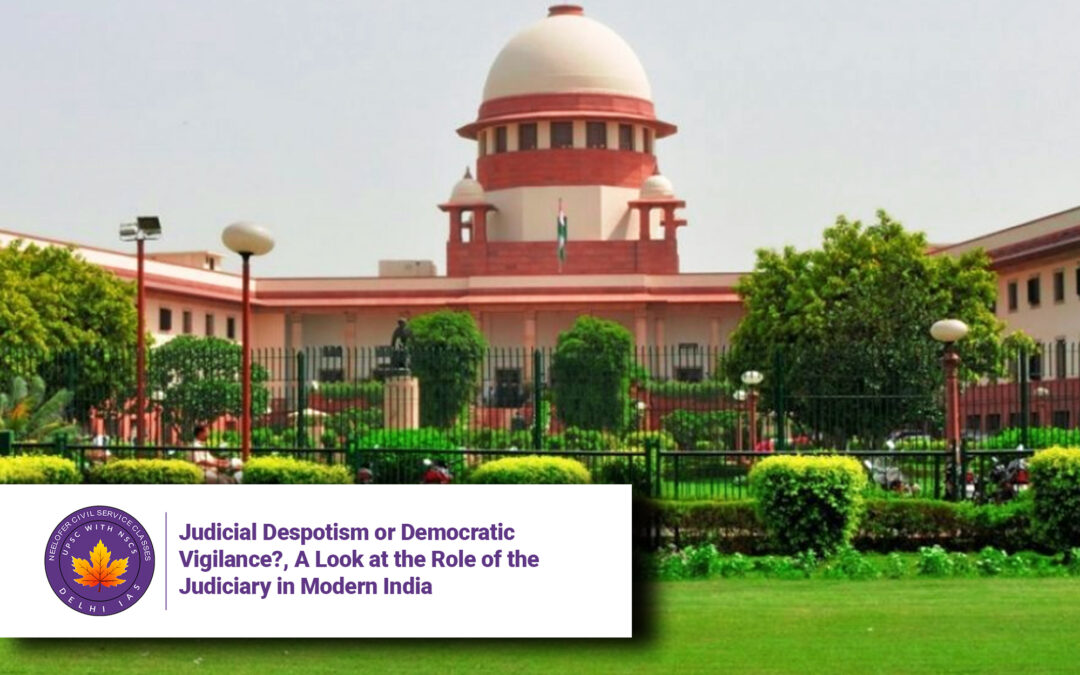
Judicial Despotism or Democratic Vigilance?, A Look at the Role of the Judiciary in Modern India
Why in News?
A series of controversial Supreme Court judgments have raised concerns across political and legal circles about the judiciary allegedly overstepping its constitutional limits. Questions are now being raised about whether India is witnessing a trend toward judicial despotism, where judicial activism crosses into judicial overreach. 
Introduction
The term “judicial despotism” may not appear in the Constitution, but the principle of judicial review — a vital democratic safeguard — allows courts to strike down unconstitutional laws or actions. Recent judgments have reignited debates about whether the judiciary is respecting the separation of powers or increasingly taking on the role of the legislature or executive.
Key Issues
1. Judicial Review vs. Judicial Activism
Judicial review, as protected under Articles 32 and 226, is an essential part of the Constitution. However, judicial activism can risk becoming judicial overreach when courts venture into areas reserved for elected bodies. For instance, the Supreme Court’s decision to uphold the abrogation of Article 370, and its verdict on the Delhi Services Act, have drawn criticism from some as examples of excessive judicial power.
2. Misuse of PILs and Article 142
The judiciary has been accused of misusing its powers under Article 142, which allows the Supreme Court to pass any order necessary for “complete justice.” Critics argue this has been used to bypass standard legal procedures. Public Interest Litigations (PILs), originally meant to empower marginalized voices, are now allegedly misused to target political adversaries.
3. The Balance of Powers
The article warns against judicial decisions that undermine the doctrine of separation of powers. Political decisions like resolving territorial disputes, appointments, or parliamentary privileges should ideally be settled through legislative or executive channels, not judicial directives.
4. Rise of Judicial Intolerance
The article highlights a growing intolerance to criticism within the judiciary. Instead of welcoming fair critique, some recent reactions show discomfort with opposing views, which contradicts the principle of judicial accountability in a democracy.
Challenges and the Way Forward
-
Uphold Democratic Principles: Courts must act as impartial guardians of the Constitution, not alternate power centers.
-
Strengthen Judicial Restraint: The judiciary must respect its institutional boundaries, avoiding judgments that amount to lawmaking.
-
Encourage Transparent Appointments: The opaque collegium system for judicial appointments needs reform to enhance public trust.
-
Promote Accountability: Judicial actions should be transparent and open to public scrutiny, including their financial and institutional functioning.
-
Curb the Misuse of Powers under Article 142: This Article should be used sparingly, with clear legal backing and justification.
Conclusion
While the judiciary plays a critical role in defending constitutional rights and democracy, it must also respect the constitutional limits set on its powers. A vigilant judiciary is a boon, but judicial overreach risks damaging the delicate balance of Indian democracy. A healthy separation of powers must be preserved for India’s democratic system to function effectively.
5 Q&A Based on the Article
Q1. What is judicial despotism?
A: Judicial despotism refers to a scenario where the judiciary oversteps its constitutional limits, acting like a super-legislature or executive, thereby disturbing the balance of powers in a democracy.
Q2. What constitutional provisions protect judicial review in India?
A: Articles 32 and 226 empower the Supreme Court and High Courts, respectively, to enforce fundamental rights and review unconstitutional laws or actions.
Q3. Why has Article 142 come under criticism?
A: Article 142 allows the Supreme Court to pass any order necessary to do “complete justice.” Critics argue it has been misused for judicial overreach, bypassing regular legal channels.
Q4. What was controversial about the Supreme Court’s handling of Article 370?
A: The Supreme Court’s validation of the abrogation of Article 370, which revoked Jammu & Kashmir’s special status, was criticized for failing to adequately review the constitutional implications of such a major political decision.
Q5. What reforms does the article suggest for the Indian judiciary?
A: The article advocates for judicial restraint, transparency in appointments, clearer boundaries between branches of government, and increased tolerance of criticism.
