
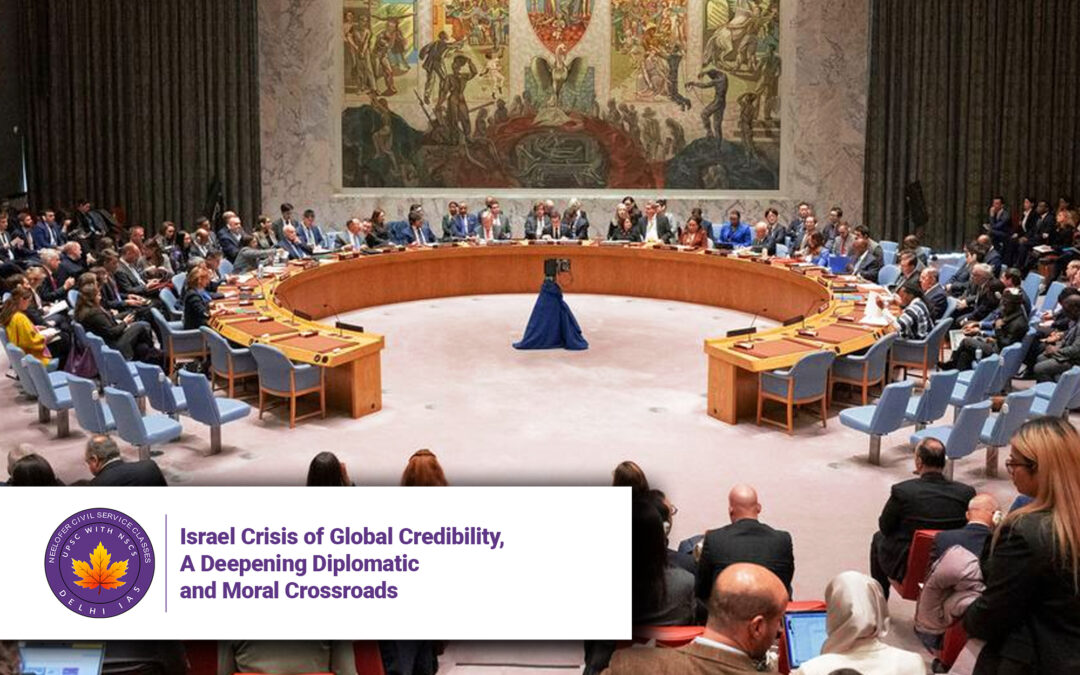
Israel Crisis of Global Credibility, A Deepening Diplomatic and Moral Crossroads
Israel, once widely regarded as a resilient democracy committed to international law, is now facing one of the most profound crises of global credibility in its history. At the heart of the current storm lies Prime Minister Benjamin Netanyahu’s newly announced plan for a full military takeover of Gaza. This strategy, combined with a growing humanitarian catastrophe in the territory and repressive measures in the West Bank, has amplified international outrage.
The image of starving children in Gaza has dominated news headlines, intensifying calls for Israel to halt its military operations. However, Netanyahu’s stance — aimed at eliminating Hamas and potentially depopulating and annexing Gaza, and perhaps parts of the West Bank — is pushing Israel further into political isolation.
International Backlash: A Rare Convergence of Criticism
Israel’s actions have triggered rare consensus across diverse quarters — from traditional allies to human rights organisations and international legal bodies.
The International Criminal Court (ICC) has issued arrest warrants for Netanyahu and former Israeli defence minister Yoav Gallant, citing charges of war crimes and crimes against humanity. These include allegations of genocide in Gaza. Prominent legal scholars, genocide experts, and human rights groups worldwide have echoed these accusations.
Adding to Israel’s troubles, countries traditionally seen as close friends — including the Netherlands, Japan, Spain, Australia, Turkey, and Sweden — have registered unprecedented levels of public disapproval. According to a Pew Research poll in early 2025:
-
Netherlands: 78% of respondents view Israel unfavourably.
-
Japan: 79% negative view.
-
Spain: 75%.
-
Australia: 74%.
-
Turkey: 93%.
-
Sweden: 75%.
This negative perception reflects growing dissatisfaction not only among governments but also within civil societies across the globe.
Traditional Allies Speak Out
Some of Israel’s most prominent traditional supporters have taken the unusual step of openly criticising Netanyahu’s policies.
Former prime ministers Ehud Olmert and Ehud Barak, literary icon David Grossman, and Masorti Judaism figures like Rabbi Jonathan Wittenberg and Rabbi Delphine Horvilleur have all condemned the Gaza policy.
Hundreds of retired Israeli security officials have appealed directly to US President Donald Trump to use his influence to end the war. Their appeals have been driven by concerns that Israel’s current trajectory risks permanent damage to its diplomatic relationships and internal cohesion.
Shift in US Public Opinion
While US governmental support — particularly under Donald Trump — remains crucial for Israel, the American public’s view is changing. Without billions of dollars’ worth of US military aid and arms exports, Israel’s prolonged Gaza campaign and West Bank occupation would be far harder to sustain. Yet despite Trump’s deep pro-Israel stance, Gallup polling from March 2025 revealed that fewer than half of Americans now express sympathy toward Israel.
Even among Trump’s political base, cracks are showing. Figures like Steve Bannon and Marjorie Taylor Greene have questioned the sustainability of Netanyahu’s strategies. Trump himself publicly dismissed Netanyahu’s claim that “there is no starvation in Gaza,” hinting at a growing divergence between the Israeli leadership and some of its staunchest ideological allies in the US.
European and Global Policy Shifts
France has announced plans to recognise the State of Palestine by September 2025. The UK and Canada have expressed support for similar recognition, while Germany — historically cautious on the issue — has begun formal steps toward recognising Palestinian statehood. Australia’s Prime Minister Anthony Albanese has indicated recognition is only a matter of time.
Spain and Sweden have already taken harder measures, including suspending the EU–Israel trade agreement. The Netherlands has criticised Israeli tactics as a “security threat,” pointing to alleged interference in Dutch politics.
Domestic Israeli Sentiment
Inside Israel, there is deep division. A poll by Israel’s Channel 12 found that 74% of Israelis support a deal to end the war in exchange for releasing hostages held by Hamas. This contrasts sharply with Netanyahu’s refusal to negotiate with Hamas on such terms.
A US academic poll in early 2025 showed:
-
82% of Jewish Israelis support expelling Palestinians from Gaza.
-
Only 16% believe peaceful coexistence with a Palestinian state is possible — the lowest figure since polling began on this question in 2013.
These numbers highlight the widening gap between Israel’s domestic attitudes and international expectations. While many Israelis support tough measures against Hamas, there is a growing minority that sees Netanyahu’s policies as strategically and morally bankrupt.
Humanitarian Concerns and Limited Concessions
International pressure has forced Israel to allow a modest increase in humanitarian aid into Gaza. However, aid agencies say these measures fall far short of what is needed to address the mass starvation, medical shortages, and displacement affecting Gaza’s 2.3 million residents. Netanyahu’s plan for a complete military takeover signals that these concessions are temporary, aimed primarily at easing immediate diplomatic heat rather than marking a change in strategic goals.
The Strategic Calculus
Netanyahu’s current approach rests on three pillars:
-
Military Control of Gaza: Remove Hamas and potentially expel large numbers of Palestinians.
-
Territorial Annexation: Secure de facto or formal control over Gaza and possibly extend West Bank annexation.
-
Reliance on US Support: Maintain the backing of Washington to counterbalance diplomatic isolation.
This strategy is fraught with risks. While it appeals to Netanyahu’s right-wing political base, it risks alienating moderates in Israel, deepening Palestinian resistance, and provoking stronger measures from the international community — including economic sanctions, arms embargoes, and travel bans.
Long-Term Risks
The erosion of Israel’s international image could have lasting consequences:
-
Diplomatic Isolation: Recognition of Palestine by more countries will further delegitimise Israeli claims over occupied territories.
-
Economic Sanctions: Trade suspensions by major economies could hurt Israel’s high-tech, defence, and agricultural exports.
-
Security Strains: Without US support, Israel would face far greater difficulty sustaining military operations.
-
Internal Polarisation: Divisions between hawks and moderates inside Israel could lead to political instability.
Conclusion
Israel’s current crisis is not just about Gaza — it is about the erosion of its claim to be a democratic state that upholds the rule of law. The country now stands at a crossroads. It can either recalibrate its policies to align with international expectations, or it can continue down a path of confrontation, risking deeper isolation and internal fractures.
Netanyahu’s full military takeover plan might offer short-term political gains among his base, but its long-term costs — economic, diplomatic, and moral — could far outweigh any perceived victories. The coming months will reveal whether Israel can recover its standing or whether it will cement its position as an increasingly isolated state in a polarised world.
5 Key Q&A for Revision
Q1. What is the main cause of Israel’s current international credibility crisis?
It stems from Prime Minister Netanyahu’s plan for a full military takeover of Gaza amid a growing humanitarian crisis, combined with repressive policies in the West Bank. This has drawn widespread condemnation from allies, international bodies, and human rights groups.
Q2. How has public opinion shifted in countries traditionally supportive of Israel?
Polls show overwhelming negative views — e.g., 78% unfavourable in the Netherlands, 79% in Japan, 75% in Spain, 74% in Australia, 93% in Turkey, and 75% in Sweden. This indicates a significant erosion of goodwill toward Israel.
Q3. What role does US support play in Israel’s strategy?
US military aid and arms exports are critical for sustaining Israel’s military campaigns. Without American support, Israel would struggle to maintain its operations in Gaza and the West Bank. However, US public opinion is shifting, with less than half of Americans now sympathetic toward Israel.
Q4. What significant policy changes have been made by other countries in response to Israel’s actions?
France, the UK, Canada, and Germany are moving toward recognising Palestine. Spain and Sweden have suspended certain EU–Israel agreements, while the Netherlands has labelled Israel’s tactics a security threat.
Q5. How divided is Israeli public opinion on the war and hostage negotiations?
While 82% support the expulsion of Palestinians from Gaza, 74% also support ending the war in exchange for releasing hostages — indicating complex and sometimes contradictory public attitudes.

