
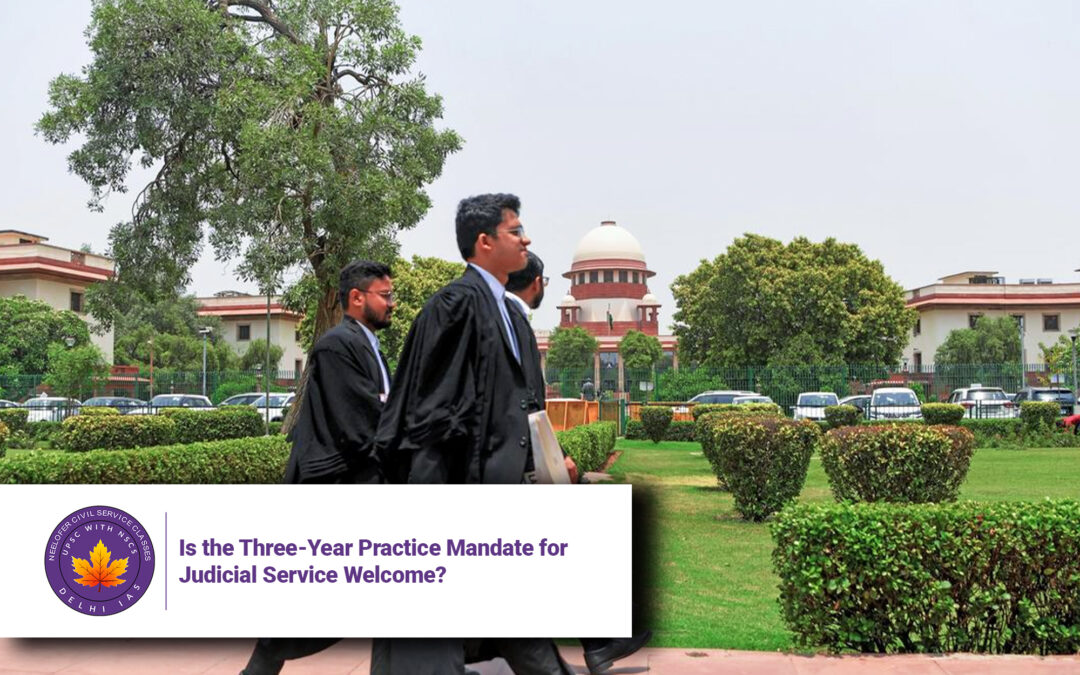
Is the Three-Year Practice Mandate for Judicial Service Welcome?
Why in News?
On May 20, 2024, the Supreme Court restored the requirement of a minimum of three years of legal practice as a mandatory condition to apply for entry-level judicial services. This overturned the 2002 decision that had previously removed this mandate. 
Introduction
The new ruling seeks to ensure that judicial officers are not selected without practical exposure to the legal system. However, this has sparked a debate across legal circles about its impact on merit, diversity, and accessibility to judicial careers, especially for underprivileged and women candidates.
Key Issues and Background
❖ The Original Mandate and Reversal
-
Initially mandated in 1993, the requirement for three years of practice was removed in 2002.
-
The 2024 Supreme Court judgment now reinstates it, arguing that practical experience is essential before taking on judicial responsibilities.
❖ Mixed Reactions Among Legal Experts
-
Bharat Chugh, former judge, argues that practice alone does not guarantee better judges and that such rules may lack empirical support.
-
Prashant Reddy, legal scholar, supports the mandate but believes it must be combined with more comprehensive reforms, such as improved legal education and internships.
❖ Courtroom Readiness and Ground Realities
-
The Bar Council of India emphasized that law graduates lack the practical training and maturity required for judicial service.
-
The High Courts support this view, citing concerns about the lack of experience among young judges.
The Core of the Concern
❖ Implementation and Impact on Talent
-
While the goal is to promote experienced and capable judiciary members, junior advocates are often restricted to clerical tasks, missing real legal exposure.
-
The quality of legal experience gained during these three years may vary widely, and low-income candidates may be disadvantaged.
❖ Impact on Marginalized Groups and Women
-
Many women face financial and social barriers in continuing legal practice for three years.
-
The rule might discourage diverse candidates, particularly women, from entering the judiciary.
-
The judiciary already lacks gender representation, especially in the lower courts.
Key Observations
-
BC (Bharat Chugh) fears the mandate will create a barrier to entry for talented candidates who cannot afford to sustain themselves in low-paying legal practice.
-
PR (Prashant Reddy) suggests this is another case of courtroom policymaking, not thoroughly debated or legislated.
-
There’s a lack of support systems, such as internships or stipends, to ensure equal access for aspiring judges.
Conclusion
While the three-year practice mandate seeks to improve the quality of judicial officers, it also introduces new challenges. For it to succeed, India’s judicial reform must be inclusive, supported by stronger legal education, mentorships, stipends, and transparent policymaking. Without addressing ground-level inequalities, such mandates may end up excluding the very talent the judiciary needs.
Q&A Section
-
What is the recent change in judicial service eligibility?
The Supreme Court has reinstated the requirement of three years of legal practice before applying for entry-level judicial posts. -
Why was this requirement reinstated?
To ensure that candidates have real-world legal exposure and maturity before taking up judicial roles. -
What are the criticisms of this mandate?
It may disproportionately affect marginalized groups, women, and those who cannot afford three years of low-paid legal practice. -
How are women affected by this rule?
Many women face financial and social hurdles in continuing legal practice, which may deter them from pursuing judicial careers. -
What is the long-term goal of this mandate?
To improve the quality and preparedness of judicial officers by ensuring they have real court experience before assuming office.

