
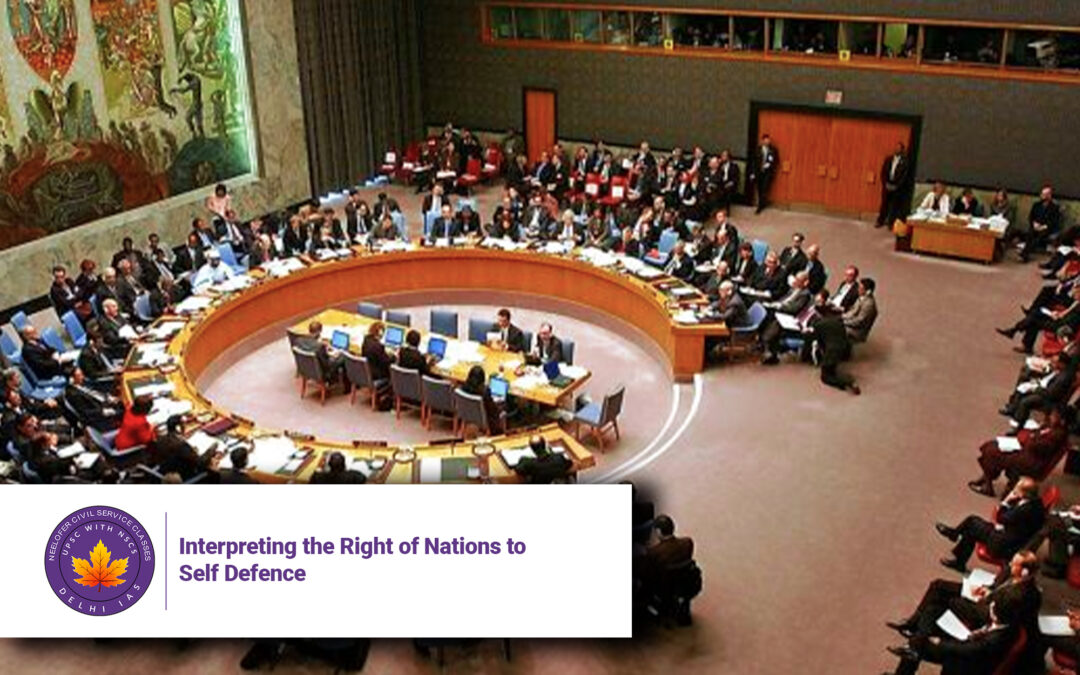
Interpreting the Right of Nations to Self Defence
As U.S. military actions escalate in West Asia, global legal experts debate the interpretation of international law on self-defence.
Why in News?
President Donald Trump has recently taken credit for averting an escalation between Iran and Israel. This comes after a U.S. military strike on Iran’s nuclear facilities. While America claims it acted in self-defence, the legal grounds of such actions under international law remain highly contested.
Introduction
The U.S. has invoked Article 51 of the United Nations Charter — the right to self-defence — to justify its attack on Iranian nuclear sites. However, the question arises: Can military action be considered lawful self-defence under international law, especially when there is no direct or imminent armed attack? 
Key Issues and Legal Complexities
1. Scope of Article 51 and Precedent Confusion
-
Article 51 allows nations to defend themselves in case of an armed attack.
-
The U.S. justified its actions by claiming Iran posed a future threat, especially through its alleged nuclear ambitions.
-
Critics argue that using force pre-emptively, without a clear armed attack, undermines the very spirit of Article 51.
2. Scholarly Debate on “Imminent Threat”
-
Some scholars believe anticipatory self-defence is permitted if an attack is imminent.
-
Others caution that the bar for “imminence” has been diluted dangerously and now resembles strategic offence.
3. Iran’s Perspective and Lack of Evidence
-
According to the public domain data, Iran has not carried out a recent armed attack on the U.S.
-
Therefore, the legality of the American strike is questioned by many legal experts.
Challenges and the Way Forward
Rising Grey Zones in Warfare
In modern geopolitics, threats are often ambiguous — cyberattacks, proxy militias, or weapon developments. States must carefully balance national interest with adherence to international norms.
Need for Clearer Norms on Pre-emptive Action
-
International law lacks clarity on pre-emptive strikes when faced with non-traditional warfare tactics.
-
Calls have grown louder for legal reform that clearly distinguishes between preventive war and lawful defence.
Conclusion
The American strikes on Iran’s nuclear sites have reignited global debate over what constitutes a legitimate act of self-defence. While security concerns are real, the misuse or expansion of legal justifications like Article 51 may set a dangerous precedent for future conflicts. Nations must act not only in defence of their borders but in defence of international law itself.
Q&A Section
1. What is Article 51 of the UN Charter?
Article 51 recognizes a state’s inherent right to self-defence if an armed attack occurs, until the Security Council takes measures to maintain peace.
2. Why is the U.S. action against Iran being questioned?
Because there is no clear evidence of an immediate Iranian armed attack, many argue the U.S. violated Article 51 by using force pre-emptively.
3. What is anticipatory self-defence, and is it legal?
It refers to attacking first if an attack is imminent. Its legality under international law is debated, especially without proof of an imminent threat.
4. How does this situation impact global diplomacy?
It risks normalizing the use of force without clear justification, weakening trust in international institutions and rules.
5. What could be a potential solution?
Global consensus on refining the scope of Article 51 and introducing clear legal thresholds for anticipatory defence could prevent misuse and maintain peace.

