
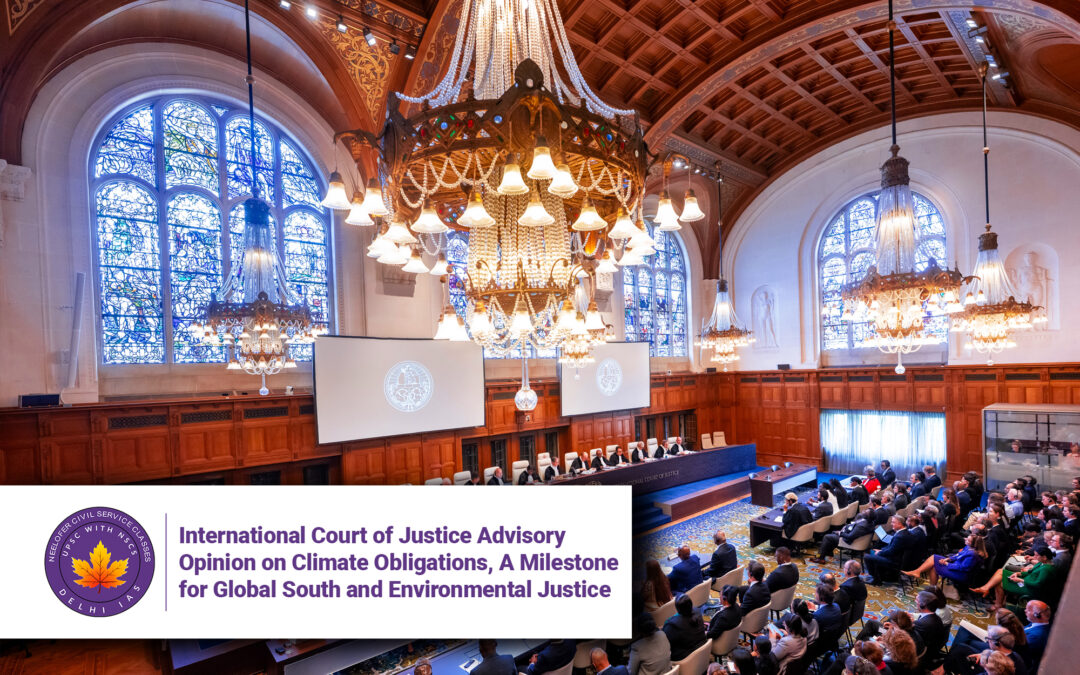
International Court of Justice Advisory Opinion on Climate Obligations, A Milestone for Global South and Environmental Justice
Why in News?
The International Court of Justice (ICJ) recently delivered an advisory opinion on the obligations of countries to reduce greenhouse gas emissions and address climate change under international law. This move has drawn widespread global attention, especially from developing countries, as it provides much-needed legal clarity on climate responsibilities and reiterates key principles like Common But Differentiated Responsibilities and Respective Capabilities (CBDR-RC). The opinion strengthens the voice of the Global South in ongoing climate debates, especially in the context of the UN Framework Convention on Climate Change (UNFCCC) and the Paris Agreement.
Introduction
The ICJ’s opinion responds to a long-standing demand from vulnerable nations, particularly island nations and developing countries, for greater accountability and equity in the international climate regime. In recent years, the climate crisis has increasingly become a matter of justice, equity, and human rights, not just science and economics. The ICJ’s legal interpretation offers a renewed understanding of international law and its implications for countries that have contributed disproportionately to climate change.
The advisory opinion was issued after the UN General Assembly sought legal clarification on the responsibilities of states under international law to protect current and future generations from the impacts of climate change. Importantly, the ICJ’s opinion does not introduce new obligations but instead clarifies and reinforces existing ones.
Key Issues Discussed in the ICJ Opinion
1. Reaffirmation of Fundamental Climate Principles
The ICJ strongly reaffirmed the principles of the UNFCCC, particularly:
-
Common But Differentiated Responsibilities and Respective Capabilities (CBDR-RC)
-
Equity
-
Sustainable development
The opinion specifically underlined that developed countries have the primary responsibility for emissions reductions and financial and technological support, in line with Article 3 of the UNFCCC. This counters the recent trends of downplaying differentiation in obligations and the push for uniform responsibilities.
2. Climate Targets and Scientific Thresholds
The ICJ endorsed the scientific benchmarks set in the Paris Agreement:
-
Limiting global warming to below 2°C, preferably 1.5°C
-
Immediate and ambitious emissions reduction by developed countries
-
Time-bound obligations
This comes at a time when the UNEP’s Emissions Gap Reports have repeatedly warned of the global community’s failure to meet emissions targets. The ICJ referenced findings that emissions must drop by 45% from 2010 levels by 2030 and reach net zero by 2050 to meet these targets.
3. Clear Differentiation Between Global North and Global South
A major highlight of the opinion is its emphasis on climate equity, particularly the differentiated obligations of nations based on their historic contributions to emissions. The ICJ strongly opposed the trend of “flattening” differentiation, where all countries are expected to do the same irrespective of capacity or responsibility.
The opinion rebukes the dilution of climate justice and points out that developed countries must do more, in terms of reducing emissions and offering support to vulnerable nations.
4. Legal Consequences of Inaction
The ICJ did not shy away from pointing out the legal consequences for countries that fail to meet their obligations:
-
Failure to act can violate international obligations
-
May be subjected to legal accountability
-
Obligations must be met collectively and in good faith
However, it also acknowledged that the degree of obligation may vary, depending on a country’s capability and specific context.
5. Climate Action Beyond Borders
Another critical area addressed is the cross-border impact of emissions. The ICJ clarified that:
-
Countries are not only responsible for emissions within their borders but also for transboundary harm
-
They must act to prevent or minimize such harm, in line with the no-harm principle in international law
This supports the case of climate-vulnerable nations who have suffered disproportionately despite contributing little to the crisis.
Has the ICJ Introduced Any New Obligations?
No, the ICJ has not introduced new legal obligations. Instead, it has clarified existing ones, emphasizing that:
-
The current legal framework is sufficiently strong, if implemented in good faith
-
Legal obligations stem from existing international agreements, including the UNFCCC, Paris Agreement, and other environmental treaties
-
States must pursue actions that are scientifically justified, time-bound, and effective
The ICJ noted that obligations are not simply procedural—they must lead to real-world outcomes like emission reduction, renewable energy transitions, and adaptation support.
The Significance for the Global South
The advisory opinion is a major victory for developing countries, particularly island nations and the Global South, for the following reasons:
-
It strengthens their call for historical accountability
-
Validates their demand for financial and technical support
-
Legally reinforces their right to sustainable development
-
Provides leverage in future climate negotiations and loss and damage claims
This opinion will likely serve as a foundation for future litigation against polluting countries and corporations, especially as climate-related impacts—heatwaves, floods, sea level rise—intensify.
Gaps Acknowledged in the Current Regime
The ICJ also candidly discussed some of the weaknesses in the international climate framework, including:
-
Lack of enforceability in climate agreements
-
Voluntary nature of Nationally Determined Contributions (NDCs)
-
Insufficient support for vulnerable nations
-
Failure of developed countries to deliver on climate finance promises
This critique could fuel demands for a stronger international enforcement mechanism, possibly through future amendments to the Paris Agreement or the establishment of a climate court or tribunal.
Challenges and the Way Forward
1. Political Will
The biggest challenge remains the lack of political will among major emitters. Despite growing evidence of climate impacts, fossil fuel investments continue to grow, and climate finance remains under-delivered.
2. Implementation Gap
Many developing nations face capacity challenges in implementing mitigation and adaptation measures. These include:
-
Lack of technology access
-
Weak institutions
-
Limited data and research
3. Loss and Damage
Though the ICJ opinion supports climate justice, loss and damage remains a complex and unresolved area. The Santiago Network and Loss and Damage Fund still require clear governance and fair financing.
4. Legal Enforcement
ICJ’s advisory opinions are not binding, though they carry significant legal and moral weight. Enforcement will depend on:
-
Pressure from civil society
-
Strategic use in domestic and international courts
-
Mobilization by vulnerable nations
Conclusion
The ICJ’s advisory opinion marks a historic step in the global climate justice movement. It reaffirms the foundational principles of equity, differentiation, and responsibility that have been at the heart of the climate discourse. While it does not impose new obligations, it clarifies the legal duties of states under international law and offers a powerful tool for accountability and advocacy.
Most importantly, the opinion strengthens the position of the Global South, which has long called for meaningful action and justice in the face of a crisis it did little to create. As countries prepare for upcoming COP negotiations, this opinion can help shape future climate diplomacy, litigation, and cooperation.
The road ahead demands not just legal clarity but bold, urgent, and equitable action—something the ICJ has now clearly underscored as a global imperative.
Five Questions & Answers
Q1. What is the ICJ advisory opinion about?
A1. The ICJ clarified the legal obligations of countries under international law to reduce greenhouse gas emissions and protect current and future generations from climate change impacts.
Q2. Does the opinion create new legal responsibilities?
A2. No, it reinforces and interprets existing obligations under agreements like the UNFCCC and the Paris Agreement.
Q3. How does it help the Global South?
A3. The opinion emphasizes differentiated responsibilities, holding developed countries more accountable and supporting developing countries’ right to sustainable development.
Q4. What are some gaps identified in the current regime?
A4. Weak enforceability, voluntary climate pledges (NDCs), limited financial support for poor nations, and lack of legal remedies for loss and damage.
Q5. Is the ICJ opinion legally binding?
A5. No, but it holds strong moral and legal significance and can influence international and domestic climate actions and negotiations.

