
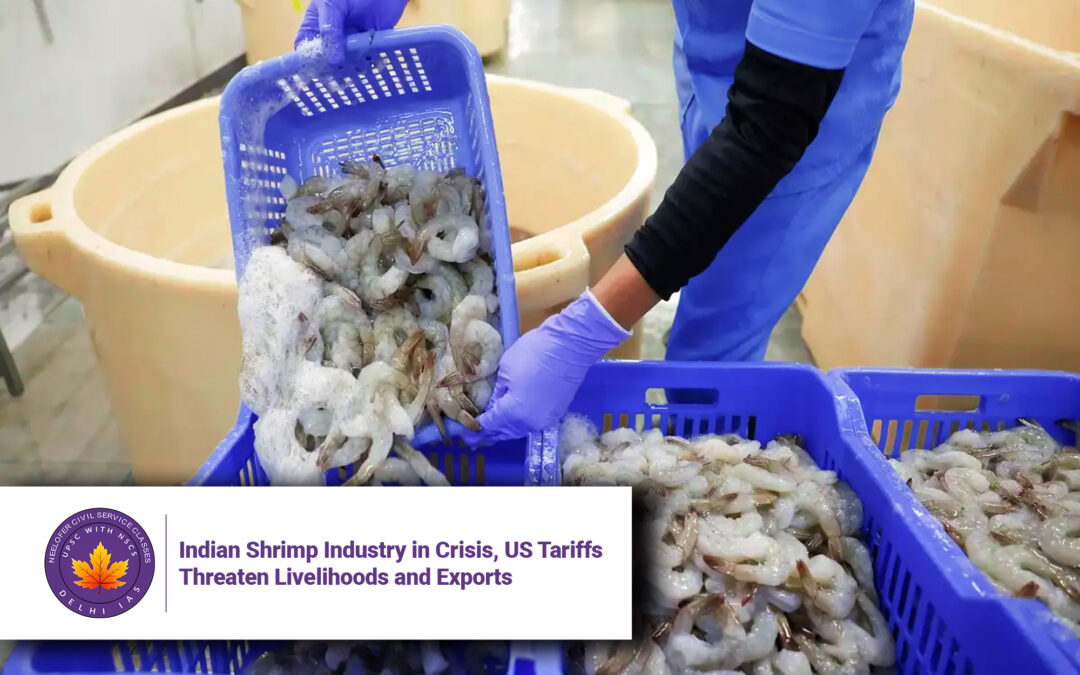
Indian Shrimp Industry in Crisis, US Tariffs Threaten Livelihoods and Exports
Introduction
The Indian shrimp farming industry, once a thriving sector contributing significantly to the country’s aquaculture exports, is now facing an existential crisis. The United States’ decision to impose a 75% basic tariff on Indian shrimp imports—up from the previous 7.5%—has sent shockwaves through the sector. Combined with existing anti-dumping and countervailing duties, the total effective duty now stands at 83%, making Indian shrimp far less competitive in its largest export market.
This sudden policy shift by the US has jeopardized the livelihoods of millions of shrimp farmers, particularly in coastal states like Andhra Pradesh, West Bengal, Tamil Nadu, and Gujarat. With shrinking profit margins, rising production costs, and limited alternative markets, India’s shrimp industry is in urgent need of government intervention, diversification strategies, and financial support to survive this trade shock.
Why in News?
-
US imposes 75% tariff on Indian shrimp (up from 7.5%), raising the total duty to 83%.
-
India exported $25 billion worth of shrimp to the US in 2023-24, making up 38% of America’s total shrimp imports.
-
Competitors like Ecuador (16.4%), Indonesia (17%), and Vietnam (11%) enjoy lower tariffs, putting India at a disadvantage.
-
Production costs have surged by 25% due to rising feed prices (fishmeal, soybean) and rupee depreciation.
-
Small and medium farmers face bankruptcy as profit margins vanish.
Key Issues and Analysis
1. The US Tariff Shock: Why India’s Shrimp Industry is Reeling
India’s shrimp industry had been booming, growing at an impressive 18% CAGR between 2011 and 2023, largely driven by strong US demand. However, the new tariff structure has disrupted this growth trajectory:
-
India’s effective duty (83%) is far higher than competitors:
-
Ecuador: 18%
-
Indonesia: 25.3%
-
Vietnam: 20%
-
-
Indian shrimp is now priced out of the US market, forcing exporters to absorb costs or lose business.
-
Farmers’ profit margins have collapsed—many are selling at a loss (below ₹200/kg against a production cost of ₹250/kg).
Impact:
-
Exports to the US could drop by 30-40% in 2025.
-
Over 1 million jobs at risk in farming, processing, and logistics.
2. Rising Costs and Shrinking Margins: A Perfect Storm
Even before the tariff hike, Indian shrimp farmers were struggling with:
-
Soaring feed costs (60% of production expenses) due to global inflation in fishmeal and soybean.
-
Rupee depreciation increasing import costs for feed and equipment.
-
Extreme weather events (cyclones, floods) disrupting production.
Case Study: Andhra Pradesh (India’s Shrimp Hub)
-
60% of India’s shrimp farms are in Andhra.
-
Small farmers (80% of sector) are most vulnerable—many lack access to credit and insurance.
-
Bankruptcies rising as working capital dries up.
3. Market Diversification: Can India Reduce US Dependence?
The US accounts for nearly 40% of India’s shrimp exports, making diversification critical. Potential alternatives:
A. European Union & UK
-
India-UK Free Trade Agreement (FTA) negotiations could provide tariff relief.
-
EU demand for sustainably farmed shrimp is growing—India can capitalize with certified organic shrimp.
B. East Asia (China, Japan, South Korea)
-
China’s seafood imports are rising—India can leverage its competitive pricing.
-
Japan prefers high-quality, processed shrimp—India must upgrade processing facilities.
C. Middle East & Domestic Market
-
Gulf countries import frozen shrimp—India can expand here.
-
Boosting domestic consumption: Promoting shrimp as a protein-rich, affordable food through retail campaigns.
Challenge:
-
Rebranding takes time—US tariffs are an immediate crisis.
4. Policy Interventions Needed to Save the Industry
A. Short-Term Measures
-
Emergency financial aid for farmers (subsidies, low-interest loans).
-
Export incentives (tax breaks, freight support).
-
Diplomatic push for US tariff rollback (WTO dispute if needed).
B. Long-Term Reforms
-
Reduce feed costs by promoting local alternatives to imported fishmeal.
-
Invest in disease-resistant shrimp breeds to improve yield.
-
Strengthen Marine Products Export Development Authority (MPEDA) to explore new markets.
Case Study: Ecuador’s Success – Lessons for India
Ecuador, India’s biggest competitor in the US market, has thrived due to:
-
Lower tariffs (18%) due to trade agreements.
-
Higher productivity (larger farms, automated processing).
-
Strong government support (subsidies, R&D in aquaculture).
Key Takeaway:
India must emulate Ecuador’s efficiency while leveraging its low-cost labor advantage.
Conclusion: A Make-or-Break Moment for Indian Shrimp
The US tariff hike is a severe blow, but not a death sentence. The Indian shrimp industry must:
-
Diversify exports aggressively (EU, UK, East Asia).
-
Cut production costs through innovation.
-
Lobby for policy support (subsidies, trade deals).
Final Thought:
If India fails to act, it risks losing its position as the world’s top shrimp exporter to Ecuador and Vietnam. The government, farmers, and exporters must collaborate now to turn this crisis into an opportunity for long-term resilience.
5 Key Questions & Answers
Q1: Why did the US raise tariffs on Indian shrimp?
A1: As part of trade protectionism policies, the US imposed a 75% basic tariff (up from 7.5%) to favor domestic producers.
Q2: How much will Indian shrimp exports be affected?
A2: Exports to the US could drop by 30-40%, risking $7-10 billion in revenue loss.
Q3: Which Indian states will be hit hardest?
A3: Andhra Pradesh, Gujarat, Tamil Nadu, and West Bengal—home to most shrimp farms.
Q4: Can India negotiate lower tariffs?
A4: Possible, but unlikely soon. India must diversify markets in the meantime.
Q5: What’s the solution for small farmers?
A5: Government aid (loans, subsidies) + shift to domestic/EU markets.

