
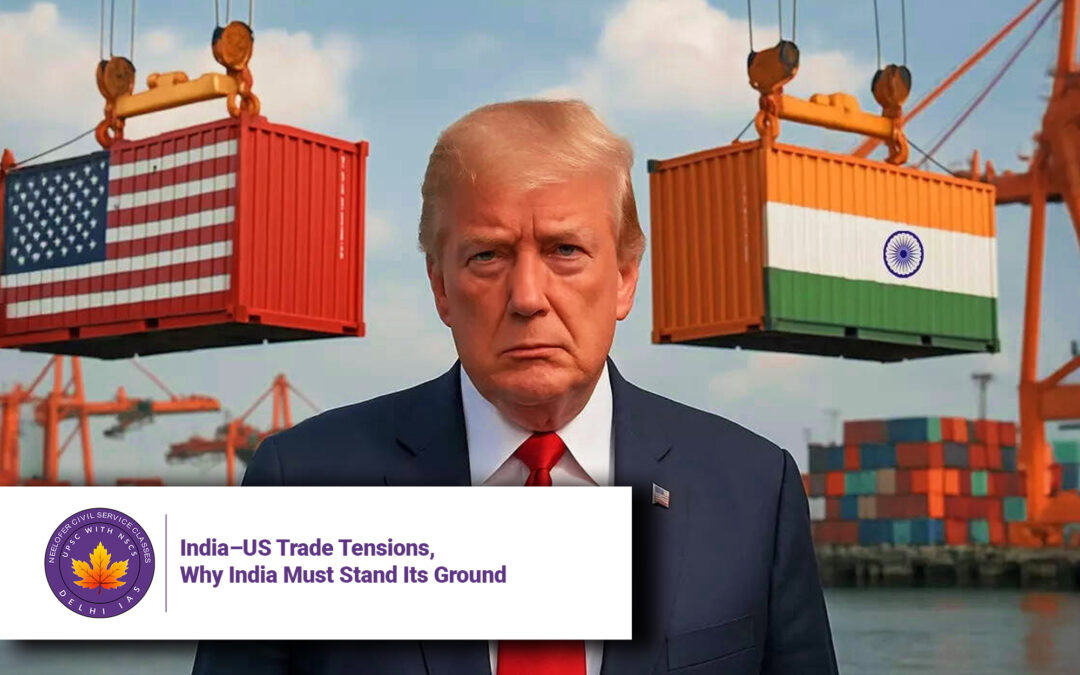
India–US Trade Tensions, Why India Must Stand Its Ground
Introduction
The evolving economic and diplomatic relationship between India and the United States has entered a new phase of friction. Recent U.S. trade policies, particularly those under former President Donald Trump’s administration, have put India in a challenging position. With tariffs on key exports, threats of further duties, and a transactional approach to strategic partnerships, Washington has signaled that its economic interests come first—sometimes at the cost of its allies.
The article in question, “Why Lose Sleep?”, underscores a central theme: India must not panic or compromise its long-term strategic goals in response to U.S. pressure. Instead, it should focus on diversifying its markets, investing in high-value industries, and strengthening domestic manufacturing to safeguard against unpredictable policy swings from its largest trade partners.
The West’s Discomfort with a Strong India
The West—particularly the U.S.—has a complex relationship with India’s rise as a global economic power. A confident, self-reliant India that resists undue influence challenges entrenched geopolitical dynamics. Trump’s stance towards India was often transactional, seeking unilateral concessions without recognizing India’s legitimate economic concerns.
India’s refusal to bow to such pressure has often resulted in retaliatory rhetoric from Washington. Trump, frustrated with India’s insistence on protecting certain domestic industries, even labeled the country’s economy “tariff king.” This is despite India’s tariffs being comparable to many developing economies that protect local markets from aggressive foreign competition.
India’s Firm Stand on Trade Sovereignty
One of the central points emphasized is India’s need to decouple from the U.S. in critical sectors where dependence could become a vulnerability—particularly defense procurement and sensitive technology.
The U.S. has in the past supplied advanced military hardware, but Trump’s willingness to engage Pakistan (including potentially supplying F-35 fighter jets) shows the danger of over-reliance on an unreliable partner. India’s strategic autonomy demands sourcing arms from a diversified set of partners, including domestic defense manufacturers, rather than putting all eggs in one basket.
The IMF Forecast and the Trump Effect on GDP
The International Monetary Fund (IMF) recently revised India’s GDP growth forecast downward—from 6.2% to 6.4% for the current year—citing global headwinds and trade uncertainties. While the worst-case scenario from Trump-era trade disputes would shave only 0.2–0.3 percentage points from growth, the symbolic impact is more significant: it underscores the fragility of overdependence on a single market.
Domestic consumption remains the backbone of India’s economy, accounting for 71.4% of GDP in FY2024. Exports comprise about 21.2% and imports 25.2%, resulting in a trade deficit of 2.3% of GDP. Although exports support millions of jobs, over-reliance on the U.S. market exposes India to sudden disruptions.
India’s Export Profile and U.S. Dependence
In 2024–25, India exported $438 billion worth of goods, with the U.S. buying 17% of that total ($72 billion). While the UAE is the second-largest destination, the U.S. remains a dominant buyer of several categories:
-
Engineering goods: $57 billion
-
Electronic goods: $39 billion
-
Textile & apparel: $35 billion
-
Drugs & pharmaceuticals: $31 billion
-
Gems & jewellery: $29 billion
-
Smartphones: $24 billion
-
Rice: $24 billion
Some of these categories—like pharmaceuticals and jewellery—rely heavily on U.S. buyers, with market shares ranging from 30% to 44%. This creates a risk: if Washington imposes tariffs or bans, these sectors could be severely hit.
The Tariff Threat
Trump’s administration already imposed tariffs on Indian steel and aluminum—25% and 10% respectively—and threatened new duties on additional goods. These measures aimed to protect U.S. industries but ended up boosting exports from competitors like Bangladesh and Vietnam, eroding India’s competitive edge.
The immediate impact was manageable—losses estimated at $20–30 billion—but the long-term risk lies in eroding market share, which is difficult to regain once lost.
Services Exports and Strategic Vulnerabilities
India’s services exports are another area of dependence. Worth $383 billion in FY2025, they include IT, software development, cloud infrastructure, AI/ML analytics, back-office processing, and R&D. About 45% of these services go to the U.S., meaning sudden policy shifts (like stricter visa rules or outsourcing restrictions) could cause significant economic shock.
Why Decoupling is Critical
The U.S. accounts for about 45% of India’s software exports and 30% of goods exports. While this relationship is economically valuable, it is risky to rely so heavily on a single partner that has demonstrated unpredictability. The recommended approach is not total disengagement but strategic diversification—expanding trade ties with Europe, the GCC, East Asia, Africa, and Latin America.
Leveraging Trade Agreements
India has been actively negotiating Free Trade Agreements (FTAs) with various blocs and countries, including:
-
EU
-
UK
-
EFTA (Iceland, Liechtenstein, Norway, Switzerland)
-
ASEAN
-
MERCOSUR (Brazil, Argentina, Uruguay, Paraguay)
-
Australia
-
GCC
These agreements will expand India’s export markets, helping reduce overdependence on the U.S. and cushioning the impact of any single-country policy shock.
Strategic Industry Investments for Long-Term Gains
The article strongly advocates for investments in high-value manufacturing—precision engineering, green tech, AI-driven products, and advanced electronics. Instead of remaining stuck in low-value assembly work or exporting raw materials, India must climb up the value chain.
This includes:
-
Precision engineering tools
-
Sophisticated electrical machinery
-
Modernized textile clusters
-
R&D in pharmaceuticals
-
Renewable energy technology
-
Semiconductor manufacturing
The government’s Production-Linked Incentive (PLI) schemes and targeted credit support for MSMEs are key policy tools to enable this transition.
The Bottom Line: Strategic Patience Over Panic
Trump’s trade policies were erratic, and similar unpredictability could emerge from future U.S. administrations. India must avoid overreacting to short-term provocations and instead stay focused on a multi-decade vision of economic resilience.
The piece ends with a clear warning:
-
Never buy U.S. defense equipment to avoid strategic vulnerability.
-
Ignore political “tantrums” designed for domestic American gain.
-
Retaliate decisively if critical sectors like IT services are attacked.
By following these principles, India can navigate turbulent trade waters without sacrificing long-term growth and autonomy.
Conclusion
India’s rise as an economic powerhouse will inevitably draw both admiration and friction from major global powers. The U.S. remains an important partner, but not one to depend on exclusively. In a volatile geopolitical and economic landscape, India’s best strategy is diversification, value addition, and strengthening domestic industries to withstand shocks.
The central message is clear: Strategic autonomy is priceless. In trade, as in diplomacy, India must be ready to walk away from any deal that compromises its sovereignty or long-term growth prospects.
5 Questions & Answers
Q1. Why does the article advise against India buying U.S. defense equipment?
A1. Because the U.S. has shown itself to be an unreliable partner, willing to arm rivals like Pakistan, making India vulnerable in critical security areas.
Q2. How much of India’s goods exports go to the U.S.?
A2. About 17% of India’s goods exports, worth $72 billion in 2024–25, go to the U.S.
Q3. Which Indian sectors are most dependent on the U.S. market?
A3. Pharmaceuticals, gems & jewellery, engineering goods, textiles, and IT services are the most U.S.-dependent sectors.
Q4. What is the estimated short-term loss from U.S. tariffs on steel and aluminum?
A4. Around $20–30 billion, with the greater risk being long-term erosion of market share to competitors.
Q5. What long-term strategy does the article recommend for India’s trade policy?
A5. Diversifying trade partners, signing more FTAs, investing in high-value industries, and avoiding overdependence on any single market, especially the U.S.
