
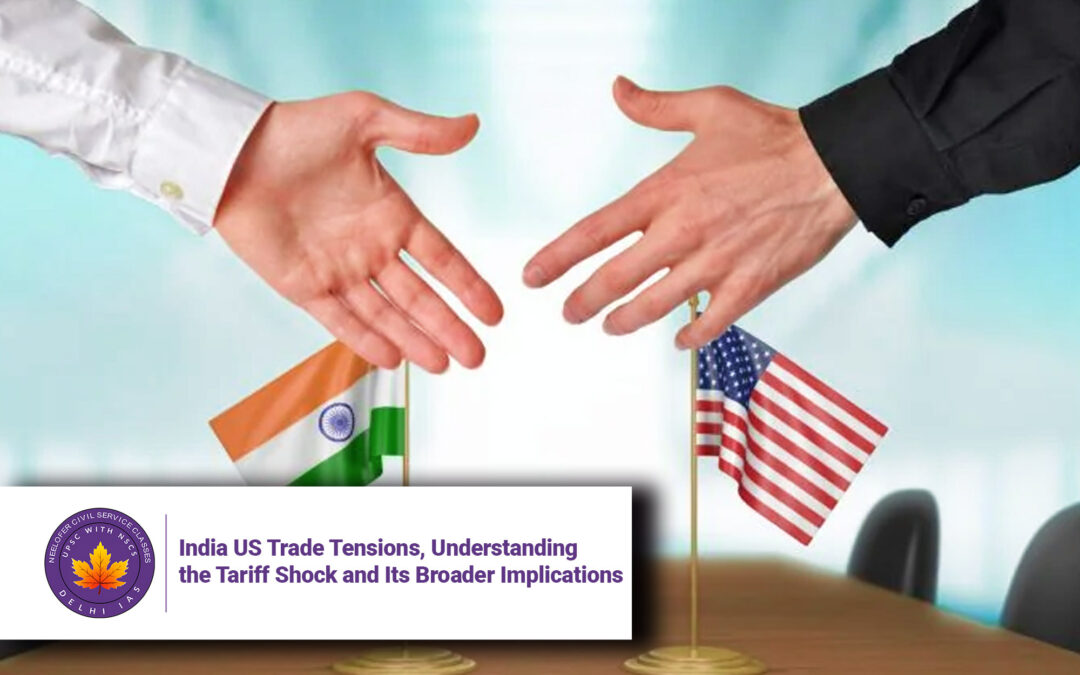
India US Trade Tensions, Understanding the Tariff Shock and Its Broader Implications
The recent escalation in trade tensions between India and the United States has created ripples across diplomatic, economic, and corporate circles. The US administration, under President Donald Trump, has imposed significant tariffs on Indian exports, citing India’s continued import of crude oil from Russia despite Western sanctions. This move has introduced a layered penalty system that threatens to alter the dynamics of bilateral trade, with potential spillover effects on India’s growth trajectory, stock markets, and sectoral competitiveness.
The Tariff Timeline: A Rapid Escalation
The chain of events began with the US announcing a 25% reciprocal tariff on Indian goods effective August 7. Barely a day later, on August 6, the US imposed an additional 25% penalty levy on Indian imports for continuing to buy Russian crude. The penalty takes effect 21 days later — from August 27. When combined, the effective tariff on several categories of Indian goods going to the US will rise to 50%, compared to a mere 3% earlier.
These measures have targeted multiple sectors, including finished goods, steel, aluminium, chemicals, textiles, gems, jewellery, and electrical machinery. The impact is compounded by the fact that the US is India’s largest export destination, accounting for nearly one-fifth of the country’s total exports.
The US has justified its move by citing Section 232 of its trade regulations, which allows tariff hikes if imports are deemed to threaten national security. While some sectors under ongoing Section 232 investigations (like pharmaceuticals, semiconductors, and electronics) have been spared for now, the exemption covers only about 30% of India’s exports.
Why the US Move Matters for India
India enjoys a merchandise trade surplus with the US — for FY2024-25, projected at $41.18 billion — a figure steadily increasing over recent years. This surplus has often been a friction point in US trade policy, and tariffs represent a tool to narrow it. But the new penalty levy takes the confrontation further, essentially acting as a non-tariff barrier on crude oil imports from Russia, pressuring India to either reduce these imports or face sustained trade penalties.
The timing of these tariffs is particularly critical. India’s export growth has already been facing headwinds from a global economic slowdown, weak demand in major markets, and falling commodity prices. An additional tariff shock on the country’s largest export market risks intensifying the challenge.
Broader Economic Implications
1. Impact on Exports and GDP
In FY2025, India’s exports to the US are estimated at $86.5 billion, making up nearly 20% of total exports. If the tariff elasticity is assumed to be high — meaning that higher tariffs lead to a steep fall in demand — the impact could be severe. A halving of export competitiveness due to a 50% tariff could lead to a 40–50% drop in exports to the US in some product categories, according to the Global Trade Research Initiative (GTRI).
Nomura estimates that such a steep tariff is akin to a trade embargo, which would lead to a sudden stop in the affected sectors. The GDP hit from reduced US exports could be around 0.3% in FY2025 alone, rising to 0.4% in FY2026, with the Current Account Deficit (CAD) widening by around 0.5 percentage points.
2. Sectoral Impact
Some of the most heavily affected sectors are:
-
Textiles and Apparels: With a 37% share of the targeted exports, these could see sharp order declines, especially against competitors like Vietnam, Indonesia, and Malaysia who face lower US tariffs.
-
Chemicals: Making up about 15% of the exports in question, with smaller firms facing severe cost pressures.
-
Electrical Machinery: Accounting for 32%, these exports may lose competitiveness rapidly.
-
Gems and Jewellery: At 30% of targeted goods, these luxury exports could see a steep contraction as US buyers shift to alternative suppliers.
Smaller and mid-sized enterprises in these sectors are particularly vulnerable. Their margins are already squeezed, and a tariff shock will make many uncompetitive overnight.
3. Stock Market Implications
While the benchmark indices may not be directly hit — since most affected companies are not large-cap heavyweights — there will be significant pain for mid-cap and small-cap counters like Kitex, Camlin, Aarti Industries, Atul, Bharat Forge, and Sona BLW. Expect sharp declines in their revenue guidance and possible profitability downgrades.
There is also an indirect impact: reduced export earnings can weaken the external demand outlook for Indian firms overall, potentially affecting investor sentiment across the board. If India is forced to cut Russian oil imports, this could further complicate the energy price outlook, with implications for refiners like Reliance and other oil marketing companies.
Policy and Diplomatic Dimensions
India’s Policy Dilemma
India faces two unappealing options:
-
Comply with US demands and reduce Russian crude imports — risking higher energy costs, supply chain disruptions, and strained Russia–India relations.
-
Maintain current Russian oil imports and absorb US penalties — hurting export competitiveness, especially in high-growth sectors.
A third path would involve intensive negotiation with the US to secure exemptions or reduce tariff severity. However, this would require offering concessions in other contentious areas like agricultural access, e-commerce policy, and tariff ceilings.
Impact of the Additional Penalty Levy
The penalty levy of another 25% mirrors the impact of reciprocal tariffs and is equally damaging for exports. While certain commodities are exempt, the combined blow of reciprocal tariffs plus the penalty could reduce India’s growth rate by 0.6–0.7 percentage points from its baseline forecast of 6.5% for the current year.
The discriminatory nature of this penalty is also worth noting: many countries continue to import oil from Russia, but India has been singled out for higher tariffs. This selective targeting could form the basis for India to challenge the US action at the World Trade Organization (WTO), though dispute resolution there is a long-drawn process.
Exchange Rate and Inflation Risks
Tariffs also have secondary macroeconomic effects:
-
Rupee Depreciation: A drop in export revenues combined with a stronger dollar could put the rupee under renewed pressure.
-
Imported Inflation: Higher tariffs and possible currency weakening could raise input costs for Indian manufacturers.
-
Energy Price Pass-Through: If crude import costs rise due to reduced Russian supply, domestic fuel inflation could accelerate.
Key Strategic Considerations Going Forward
-
Diversification of Export Markets: India must push aggressively into markets like ASEAN, Africa, and Latin America to reduce dependence on the US.
-
Negotiated Sectoral Relief: Targeted lobbying to exempt labour-intensive sectors like textiles and gems could soften the blow.
-
Domestic Tariff Adjustments: India could strategically adjust its own tariff rates to leverage better negotiation positions.
-
Energy Security Planning: Ensuring alternative crude supply lines will reduce vulnerability to geopolitical trade pressure.
Conclusion
The current tariff episode underscores the fragility of trade relationships in a geopolitically charged environment. For India, the road ahead will require deft balancing — safeguarding its strategic oil partnerships while preventing a deep erosion in export competitiveness. The policy response will need to be swift, multi-layered, and pragmatic to prevent the tariffs from becoming a prolonged drag on growth.
5 Key Q&A for Analysis
Q1. What triggered the latest round of US tariffs on India’s exports?
The tariffs stem from two actions: (1) a 25% reciprocal tariff imposed due to trade surplus concerns, and (2) an additional 25% penalty levy for India’s continued crude oil imports from Russia. Together, these measures have raised the total tariff rate on many Indian goods to 50%.
Q2. Which sectors will be most affected by the tariffs?
The hardest-hit sectors include textiles and apparels (37% of targeted exports), electrical machinery (32%), gems and jewellery (30%), and chemicals (15%). Smaller and mid-sized exporters in these areas will face steep cost pressures and loss of competitiveness in the US market.
Q3. What is the expected impact on India’s GDP growth?
Estimates suggest that the combined tariff and penalty impact could reduce GDP growth by around 0.3% in FY2025 and by up to 0.4% in FY2026. If prolonged, the hit could be as high as 0.6–0.7 percentage points from the baseline growth projection of 6.5%.
Q4. How will the tariffs impact India’s external accounts?
The Current Account Deficit (CAD) could widen by around 0.5 percentage points due to reduced export earnings. In FY2024-25, this could mean a CAD increase from an estimated 6.0% of GDP to 6.5% or higher.
Q5. What policy options does India have to respond to the US tariffs?
India can (1) negotiate with the US for exemptions, (2) diversify export markets, (3) adjust its own tariff structures to improve bargaining power, and (4) strengthen alternative crude import sources to reduce dependence on Russia.

