
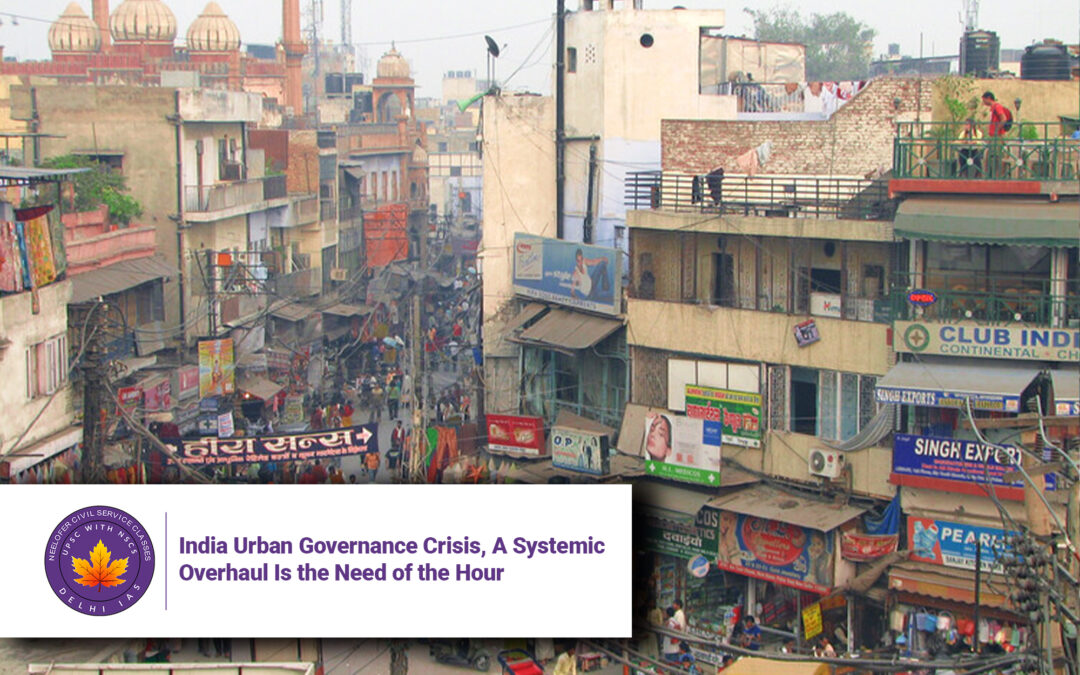
India Urban Governance Crisis, A Systemic Overhaul Is the Need of the Hour
Why in News?
Despite large-scale investments and policy reforms in India’s urban infrastructure over the past decade, Indian cities continue to struggle with deep-rooted systemic issues. A report highlights critical governance failures—especially in urban planning, local governance, and financial sustainability—that threaten to undermine India’s urban growth story. 
Introduction
India’s urban transformation is at a crossroads. With a 932% increase in the Ministry of Housing and Urban Affairs’ budget since 2009-10 and the construction of 8.7 million houses under PMAY-Urban, there have been significant improvements. Yet, these achievements have not translated into better city life. Traffic congestion, pollution, water mismanagement, and poor infrastructure still plague Indian cities, showing that infrastructure alone cannot fix broken governance systems.
Key Issues and Institutional Concerns
1. Weak Urban Governance Structures
-
Urban local bodies lack power, funding, and human resources.
-
Across 15 states, council elections have been delayed—some by over 4 years, as in Odisha (1,646 days).
-
Only 5 out of 35 states/UTs have implemented ward committees as required by the 74th Amendment.
2. Limited Devolution of Power
-
Only 16% of funds for urban local bodies are raised by the cities themselves.
-
The rest depends on grants, leading to weak fiscal autonomy.
-
Functions like water supply, sanitation, and solid waste management are poorly devolved.
3. Staffing and Human Capital Deficit
-
Across 15 states, urban local bodies face an average staff vacancy of 37%.
-
Only 14 out of 35 states/UTs have a performance-linked HR system in place.
-
This affects planning, execution, and citizen service delivery.
4. Planning and Design Issues
-
City governance does not consider typology differences, especially between large metros and small towns.
-
Governance is often fragmented across departments, weakening coordination and planning.
5. Rural-Urban Transition Ignored
-
Cities governing rural-like areas (with low population densities) are often managed like typical urban zones, creating a mismatch in governance models.
-
Odisha’s rural-urban transition is a key example that needs tailored solutions.
Challenges and the Way Forward
1. Strengthen Planning and Design
-
Cities must be classified and governed by size and characteristics, not a one-size-fits-all approach.
-
Towns with rural characteristics need distinct planning and finance models.
2. Fiscal Empowerment of Local Bodies
-
Cities should be empowered to generate their own revenues.
-
Implementing property tax reforms, user charges, and ensuring transparency in financial audits is essential.
3. Reform Human Resources
-
Appoint professional city managers.
-
Fill vacancies with competent staff.
-
Provide training and link performance to accountability.
4. Institutional Decentralization
-
State Election Commissions must ensure timely elections.
-
Ward committees and Area Sabhas should be fully functional for citizen participation.
5. Constitutional and Legal Reform
-
Amend the 74th Constitutional Amendment to make devolution of powers legally enforceable.
-
Grant cities more financial and administrative autonomy.
Conclusion
India must recognize that urban infrastructure alone cannot transform city life. Governance reforms—empowering local bodies, ensuring timely elections, devolving funds and functions, and building institutional capacity—are the pillars of sustainable urban development. The future of India’s cities lies not just in flyovers and metros, but in the strength of its governance systems.
Q&A Section
Q1. What is the main issue with India’s urban governance?
A fragmented and underpowered local governance system, lacking funds, authority, and staff.
Q2. How delayed are council elections in some states?
States like Odisha have delayed council elections by over 1,646 days (more than 4 years).
Q3. How many states have implemented ward committees?
Only 5 out of 35 states/UTs have implemented the required ward committees and area sabhas.
Q4. What is the average vacancy rate in urban local bodies?
Urban bodies face an average staff vacancy of 37%, affecting service delivery.
Q5. What reforms are being suggested for Indian cities?
Key reforms include: better planning, fiscal decentralization, timely council elections, performance-linked staffing, and amending the 74th Constitutional Amendment.
