
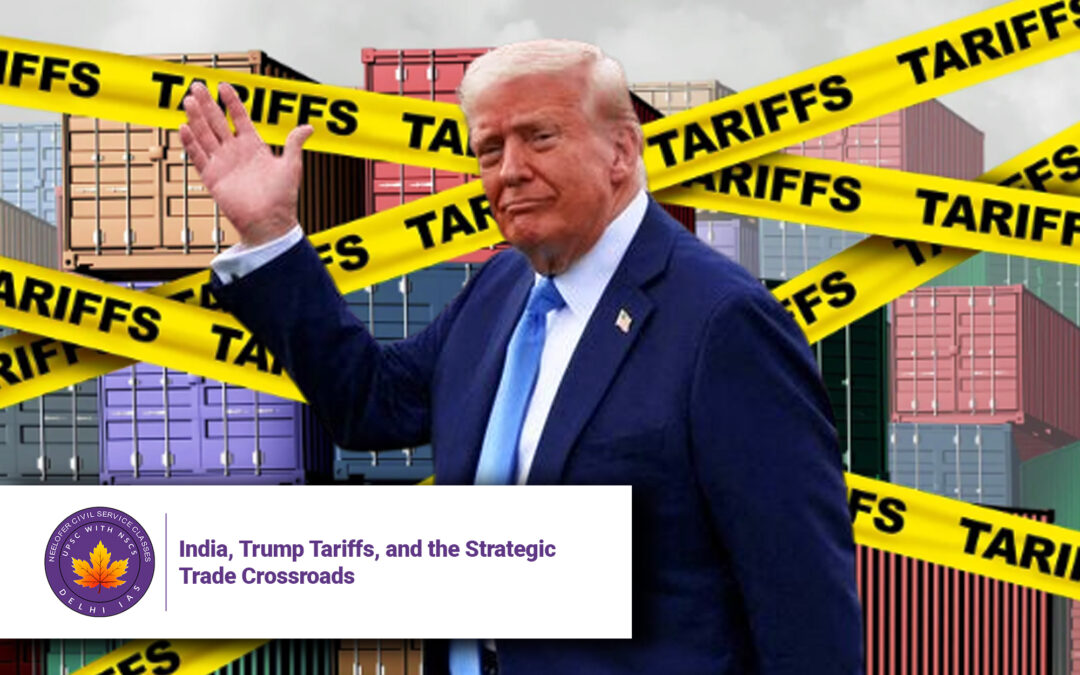
India, Trump Tariffs, and the Strategic Trade Crossroads
Why in News?
Former US President Donald Trump recently proposed imposing a 25% tariff on Indian imports and suggested that India should face penalties for purchasing military equipment and energy from Russia. This development has rekindled debates around the complexities of India-US trade relations, India’s strategic autonomy, and the future of its foreign policy direction in a multipolar world.
While this announcement may appear hostile on the surface, it offers India a crucial opportunity to reconsider its global trade posture, reduce overdependence on certain markets, and assert its sovereign right to pursue national interests.
Introduction
India and the United States have shared a long trajectory of economic cooperation and political engagement. Over the past two decades, ties between the two democracies have grown substantially in the fields of defense, technology, and energy. However, the bilateral relationship has also faced strains, especially during the Trump administration, due to tariff wars, withdrawal of trade privileges under the Generalized System of Preferences (GSP), and India’s defense partnership with Russia.
The re-emergence of Trump on the political stage, with his aggressive stance on tariffs and geopolitical alignment, reopens the chapter of economic nationalism and strategic conditionalities. For India, it is not merely a trade issue but a challenge to its policy of strategic autonomy.
Key Issues
1. Imposition of 25% Tariff on Indian Imports
-
The proposed 25% tariff on Indian goods is part of Trump’s broader “America First” policy.
-
India exports a range of goods to the US, including pharmaceuticals, textiles, IT services, and engineering products. A blanket tariff would hurt many of these sectors.
-
While the current US administration under Joe Biden has taken a different approach, Trump’s potential return to power in the 2024 election cycle revives this concern.
2. Penalty for Buying Russian Equipment and Oil
-
India is one of the world’s largest importers of Russian defense equipment, including the S-400 air defense system.
-
India also continues to purchase discounted crude oil from Russia, which is crucial for its energy security and fiscal balance.
-
Trump’s threat to impose penalties for these transactions represents a challenge to India’s long-standing position of maintaining diversified partnerships based on national interest.
3. Strategic Autonomy vs Strategic Coercion
-
India’s doctrine of strategic autonomy is rooted in its non-aligned movement legacy and pragmatic foreign policy.
-
External pressures from the US to reduce ties with Russia can be viewed as undermining India’s sovereign decision-making.
-
The penalties, if imposed, would signal a shift from partnership to coercion in bilateral relations.
4. Impact on Indian Industry and Export Competitiveness
-
Sectors like apparel, auto parts, leather, jewelry, and chemicals may face the brunt of such a tariff hike.
-
Small and medium enterprises (SMEs), which form the backbone of Indian exports, could suffer disproportionately due to price-based competition.
-
The Indian IT and pharma sectors, although robust, may also face non-tariff barriers under the guise of “America First” policies.
5. WTO Implications and Trade Disputes
-
The imposition of arbitrary tariffs violates WTO norms, especially when not based on reciprocal treatment or specific security exceptions.
-
India may choose to contest such measures through the WTO Dispute Settlement Body, although the WTO’s appellate mechanism remains largely dysfunctional.
-
Such disputes could also lead to retaliatory tariffs from India, further escalating trade tensions.
Alternative Approaches
Instead of taking a reactive or defensive posture, India can use this geopolitical development as an opportunity to push forward structural reforms and strategic recalibration.
1. Diversifying Export Destinations
-
India can reduce dependence on the US by expanding trade with ASEAN, EU, Africa, and Latin America.
-
Initiatives like the India-Middle East-Europe Economic Corridor (IMEC) and FTAs with the UK, EU, and Australia can offer alternative markets.
2. Boosting Domestic Manufacturing and Value-Addition
-
Schemes like Production Linked Incentives (PLI) can be accelerated to make Indian goods globally competitive.
-
Enhancing ease of doing business, logistics infrastructure, and labor reforms will make India an attractive manufacturing hub.
3. Recalibrating Defense Procurement Strategy
-
India can adopt a balanced approach—while diversifying arms suppliers, it should not abandon Russian technology where cost-effectiveness and strategic compatibility are proven.
-
Strengthening indigenous defense manufacturing under ‘Aatmanirbhar Bharat’ can reduce reliance on any one source.
4. Bilateral and Multilateral Dialogue
-
Engage in quiet but firm diplomacy to make the US understand India’s compulsions and strategic calculations.
-
Work with other middle powers like France, Japan, and Australia to maintain a multipolar balance in global diplomacy.
Challenges and the Way Forward
Challenges
-
Dependence on US Markets
-
Nearly 18% of India’s merchandise exports go to the US. Sudden disruption could affect employment and GDP growth.
-
-
Pressure from Multiple Fronts
-
India faces pressure from the West to curb Russia ties, from Russia to continue engagement, and from China through its aggressive posture at the borders.
-
-
Limited Leverage
-
While India is rising economically, it still does not hold the same level of leverage over the US as China or the EU do in trade negotiations.
-
-
Domestic Political Sensitivities
-
Any retaliatory or policy adjustment must factor in domestic political considerations, especially during election seasons.
-
Way Forward
-
Enhance Strategic Communication
-
India should clearly articulate its policy goals and constraints in international fora and bilateral engagements.
-
-
Deepen Economic Reforms
-
Structural reforms in taxation, labor, MSME credit, and digital trade will ensure resilience against external shocks.
-
-
Prioritize Energy Security
-
Given global oil price volatility, India must balance diplomatic engagement with energy diversification strategies including renewable expansion.
-
-
Avoid Overreaction
-
India should not respond to Trump’s statements impulsively. Policy shifts should be based on actual developments, not campaign rhetoric.
-
-
Legal and Trade Remedies
-
India should explore legal options through international trade law while also investing in domestic legal capacity to contest such issues.
-
Conclusion
Donald Trump’s tariff threats and penalties against India may be designed more for domestic political posturing than actual implementation. Nonetheless, they represent an important warning sign of potential turbulence in the India-US trade and strategic relationship.
India must not view this development in isolation. Instead, it must leverage the situation to push forward its long-pending reforms, diversify its economic and strategic dependencies, and reinforce its position as a responsible global player with autonomous decision-making. Strategic maturity, not emotional reaction, will define India’s response and ensure it emerges stronger and more independent in the face of external pressure.
Five Key Questions and Answers
Q1. What did Donald Trump propose regarding Indian imports?
A1. He proposed a 25% tariff on Indian imports and suggested penalties for India’s military and energy purchases from Russia.
Q2. How would these tariffs impact the Indian economy?
A2. The tariffs would hurt key export sectors like textiles, pharmaceuticals, and engineering goods, especially affecting small and medium enterprises.
Q3. Why does India continue to trade with Russia despite US objections?
A3. India prioritizes strategic autonomy and considers Russia a long-standing defense and energy partner critical for national security.
Q4. Can India legally challenge these tariffs?
A4. Yes, India can challenge the imposition through the WTO, though the efficacy of such mechanisms is currently limited.
Q5. What should be India’s strategic response?
A5. India should diversify trade partnerships, accelerate domestic manufacturing reforms, maintain diplomatic engagement, and strengthen its self-reliance in critical sectors.

