

India Monsoon Forecast, Preparing for Surplus and Surprises
Why in News?
The India Meteorological Department (IMD) has forecasted that India will receive “above normal” monsoon rainfall for the June–September 2025 season. However, alongside this good news, experts warn that India must remain cautious and prepare for weather extremes, despite the positive outlook. 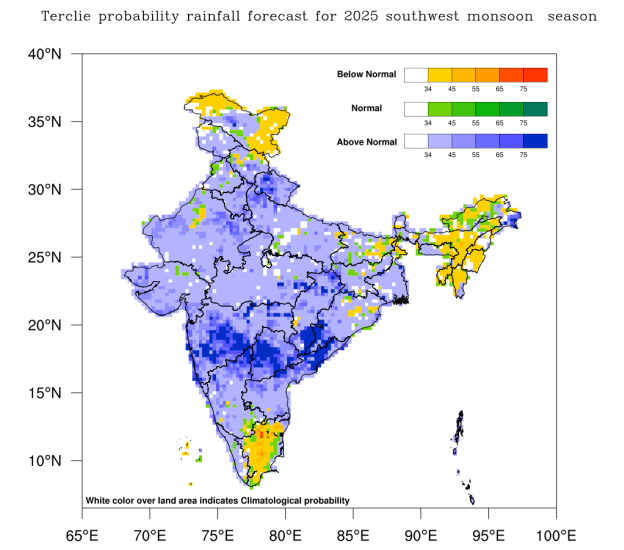
Introduction
India’s agriculture and economy heavily depend on the summer monsoon. The IMD’s prediction of 5% above normal rainfall is welcome news, especially for farmers growing kharif crops like pulses, which need more water. Yet, the unpredictable nature of climate and the possibility of extreme events mean that the country must stay alert.
Key Issues and Institutional Concerns
1. Two-Stage Monsoon Forecast System
IMD uses a two-stage system:
-
First forecast in April
-
Updated forecast in mid-May
These forecasts include overall rainfall as well as regional and temporal distribution. However, their accuracy can be limited by global climate complexities.
2. Influence of El Niño and Other Parameters
-
Normally, El Niño leads to weak monsoons in India.
-
In 6 out of 10 years, an El Niño is linked to low rainfall.
-
Interestingly, this year El Niño is present, yet India expects good rains.
-
The Eurasian snow cover (below normal this year) also points to a favorable monsoon.
3. Cyclonic Activity and Regional Weather Patterns
-
Bay of Bengal and Arabian Sea cyclonic conditions significantly affect rainfall.
-
Even if rainfall is “normal,” its distribution and intensity can vary dangerously.
Challenges and the Way Forward
-
Extreme Events: Kerala floods in July 2024 (which killed 230 people) were caused during a “normal” monsoon year, proving that total rainfall alone doesn’t reflect risk.
-
Localized Floods and Droughts: Uneven distribution can damage crops and livelihoods.
-
Infrastructure Readiness: State and Central governments must prepare for floods, waterlogging, and other monsoon hazards.
The IMD and governments should not take above-normal rainfall as a sign to relax. They should instead:
-
Strengthen early warning systems
-
Pre-position disaster relief teams
-
Monitor reservoir levels
-
Create emergency evacuation plans
Conclusion
The IMD’s 2025 forecast of “above normal” rainfall offers hope for Indian agriculture and food security. However, the shadow of unpredictability still looms large due to changing climate dynamics. India must combine optimism with caution, ensuring preparedness for both floods and droughts—because in the age of global warming, even good news must be handled with care.
Q&A Section
Q1. What is India’s monsoon forecast for June–September 2025?
India is expected to receive 5% above normal rainfall during this period.
Q2. What are the key crops that benefit from a good monsoon?
Pulses and other kharif crops rely on timely and sufficient monsoon rainfall.
Q3. How reliable are monsoon forecasts?
They provide a general outlook but can’t always predict distribution and extremes accurately due to climate complexity.
Q4. What factors influence India’s monsoon?
El Niño, Eurasian snow cover, and cyclonic activity in the Bay of Bengal and Arabian Sea are major influencers.
Q5. Why should India prepare despite a good forecast?
Because extreme weather events like floods can still occur even in “normal” monsoon years, affecting lives and livelihoods.
