
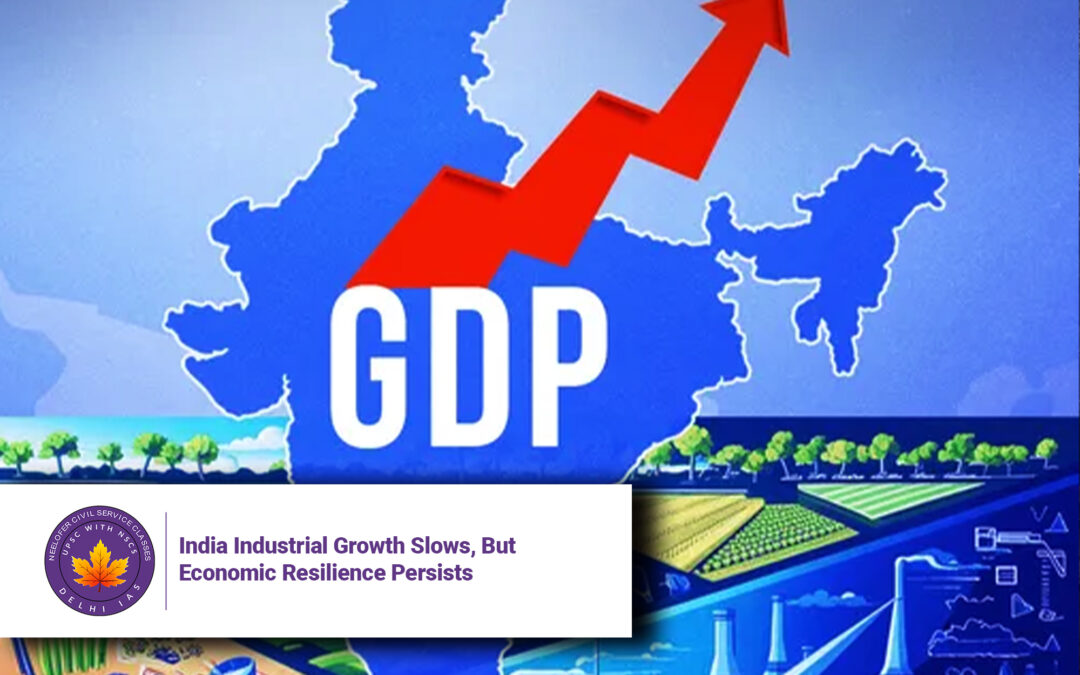
India Industrial Growth Slows, But Economic Resilience Persists
Why in News?
India’s industrial production slowed to a six-month low in February 2025, raising concerns over meeting the Centre’s 6.5% GDP growth target for FY2025. Despite the dip, underlying economic fundamentals remain strong, with robust investment and foreign capital flows offering hope for revival. 
Introduction
The Index of Industrial Production (IIP) in India dropped to 2.9% in February, a sharp decline from January’s 5.2% and last February’s 5.6%. The slowdown was broad-based, with significant drops in manufacturing and consumer durables, pointing to weakening demand. Despite this, signs of resilience in core sectors and foreign investments indicate the economy retains strong fundamentals.
Key Issues and Background
Industrial Output and Sectoral Trends
-
Industrial growth slowed across most categories:
-
Consumer Durables: Dropped to 3.8% (from 12.6% last year)
-
Manufacturing: Fell to 2.9% (from 4.9% in January)
-
Consumer Non-Durables: Shrunk by 2.1%
-
-
Mining and electricity also saw declines, while power production rose slightly by 0.6%.
Demand and Consumption Trends
-
The slowdown in consumer spending is evident.
-
A dip in inflation to 3.61% (from 5.09% last year) and the lowest food inflation in two years indicate that consumption revival expected from the Maha Kumbh may not have occurred.
The Core of the Concern
Growth Target Under Threat
-
India may miss its FY25 GDP growth target of 6.5%.
-
The February IIP data aligns with a 14-month low in the Manufacturing Purchasing Manager’s Index (PMI), recorded at 56.3 by S&P.
Key Observations
Economic Uncertainty and Market Volatility
-
Global uncertainty driven by U.S. policies under President Donald Trump and weak consumer sentiment led to market volatility.
-
Stock exchanges have seen sharp ups and downs, influenced by these developments.
Green Shoots in the Economy
Despite the challenges, some positives include:
-
High growth in specific sectors:
-
Motor vehicles, trailers & semi-trailers: 8.9%
-
Non-metallic minerals: 8%
-
Basic metals: 5.8%
-
-
Capital goods output surged to 8.2% (from 1.7%), showing investment demand.
Government Support and Capital Inflows
-
RBI injected ₹2.18 trillion into the banking system to stabilize liquidity.
-
Rupee-dollar swap arrangements worth ₹2.4 trillion added forex buffer.
-
India’s stock market rallied post the U.S. Fed’s decision to pause rate hikes.
Conclusion
While short-term industrial output has weakened, especially in consumer sectors, underlying economic indicators such as investment growth, capital inflows, and proactive government interventions suggest that India’s economy remains robust. Though the 6.5% GDP growth target appears ambitious, India still retains its position as the world’s fastest-growing major economy.
Q&A Section
Q1. What was India’s industrial growth rate in February 2025, and how does it compare to the previous month?
Ans: It slowed to 2.9%, down from 5.2% in January and 5.6% in February 2024.
Q2. Which sectors showed the steepest decline in output?
Ans: Consumer durables (down to 3.8% from 12.6%) and manufacturing (down to 2.9% from 4.9%) witnessed major declines.
Q3. What was the inflation rate in February 2025, and why is it significant?
Ans: Retail inflation dropped to 3.61%, the lowest in two years, indicating easing price pressures and weak consumption.
Q4. Which sectors recorded positive growth, indicating economic resilience?
Ans: Motor vehicles (8.9%), non-metallic minerals (8%), basic metals (5.8%), and capital goods (8.2%) showed strong performance.
Q5. What steps did the government and RBI take to support the economy?
Ans: RBI injected ₹2.18 trillion liquidity and conducted a ₹2.4 trillion rupee-dollar swap to stabilize currency and market confidence.
