
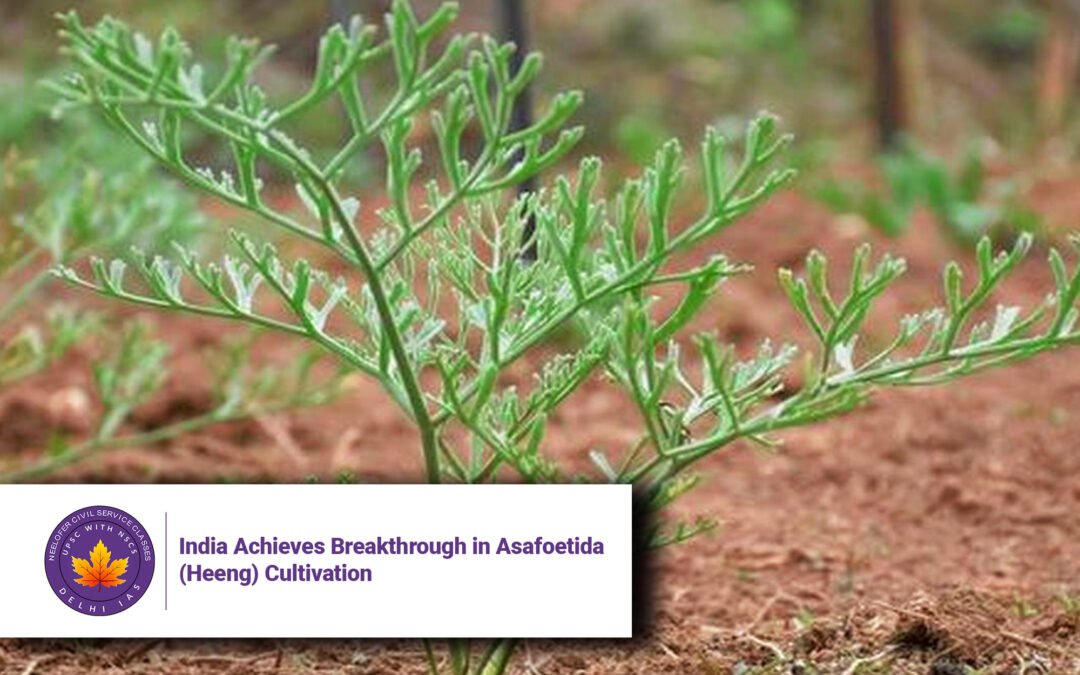
India Achieves Breakthrough in Asafoetida (Heeng) Cultivation
Why in News?
On May 28, 2025, the Council of Scientific and Industrial Research-Institute of Himalayan Bioresource Technology (CSIR-IHBT) reported the first successful flowering and seed set of asafoetida (heeng) at Palampur, Himachal Pradesh. This marks a significant achievement in making India self-reliant in cultivating this essential culinary and medicinal spice. 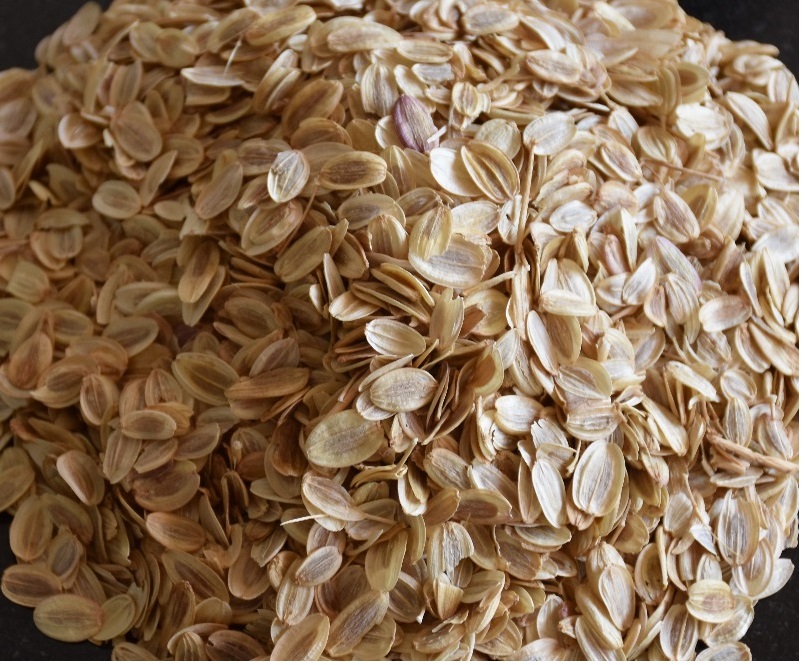
Introduction
Asafoetida, or heeng, is a pungent spice crucial to Indian cooking and Ayurvedic medicine. Despite being the world’s largest consumer, India has historically imported 100% of its heeng from countries like Afghanistan and Iran. A national mission initiated in 2018 has now borne fruit, with the successful domestication and acclimatisation of heeng in Indian soil.
Key Features
● Cultural and Medicinal Value
-
Heeng is widely used across Indian kitchens, mentioned in ancient texts like the Mahabharata and Charaka Samhita.
-
Known to enhance digestion, relieve abdominal pain, and refresh the senses.
● Botanical Profile
-
Botanical name: Ferula assa-foetida.
-
Thrives in cold, arid climates with sandy, well-drained soil.
-
Native to Iran, Afghanistan, and Central Asia.
-
Needs low rainfall (200–300 mm) and temperatures from –4°C to 40°C.
● Cultivation Process
-
A perennial plant that takes 5 years to mature.
-
Resin is extracted from taproot incisions and then processed.
-
Typically dormant in winter, it flowers only under suitable conditions.
Specific Impacts or Effects
● Shift from Import to Indigenous Cultivation
-
Until the early 2010s, India imported 1,500 tonnes of heeng annually.
-
This project aims to build self-reliance, reduce dependency, and improve farmer incomes.
● Scientific and Administrative Collaboration
-
Led by CSIR-IHBT with support from ICAR-NBPGR, the Himachal Pradesh government, and local farmers.
-
First imported seeds from Iran (2018) and later Afghanistan.
-
Developed protocols for germination, altitude-specific site selection, and agronomic practices.
● Farmer Participation and Expansion
-
First Indian heeng plant sown in Kwaring village, Lahaul Valley, on October 15, 2020.
-
Expanded to other villages in Mandi, Kinnaur, Kullu, Chamba, and Spiti.
● National Resource Centre
-
Heeng Germplasm Resource Centre inaugurated in 2022 at CSIR-IHBT, Palampur.
-
Acts as the national hub for research, seed development, and farmer training.
● Technological Innovation
-
Introduced ecological niche modelling and GPS-based site identification.
-
Established a dedicated tissue culture lab for large-scale propagation.
Challenges and the Way Forward
Challenges:
-
Long maturation period (5 years).
-
Narrow climatic suitability zone.
-
Scaling up cultivation to meet national demand.
Steps Forward:
-
Provide financial support and technical training to more farmers.
-
Continue tissue culture and seed development.
-
Expand cultivation beyond Himachal to similar agro-ecological zones.
Conclusion
The successful cultivation and flowering of heeng in India is a scientific milestone and agricultural breakthrough. It paves the way for India to become self-sufficient in one of its most valued spices while benefiting farmers in high-altitude regions. The initiative reflects the power of science-led farming, institutional collaboration, and agro-ecological innovation.
Q&A Section
Q1. What is the significance of May 28, 2025, in Indian agriculture?
It marks the first successful flowering and seed set of heeng in India, confirming its domestication.
Q2. Which institution led the heeng cultivation mission?
The CSIR-Institute of Himalayan Bioresource Technology (IHBT) in Palampur.
Q3. Why was India previously unable to grow heeng?
Heeng thrives in cold, dry climates, which are rare in India, and the plant had never been domesticated here before.
Q4. Where was heeng first planted in India?
In Kwaring village, Lahaul Valley, Himachal Pradesh, on October 15, 2020.
Q5. What are the next steps to boost heeng cultivation?
Scale up tissue culture propagation, expand farmer training, and introduce the crop to other high-altitude, low-moisture regions.

