
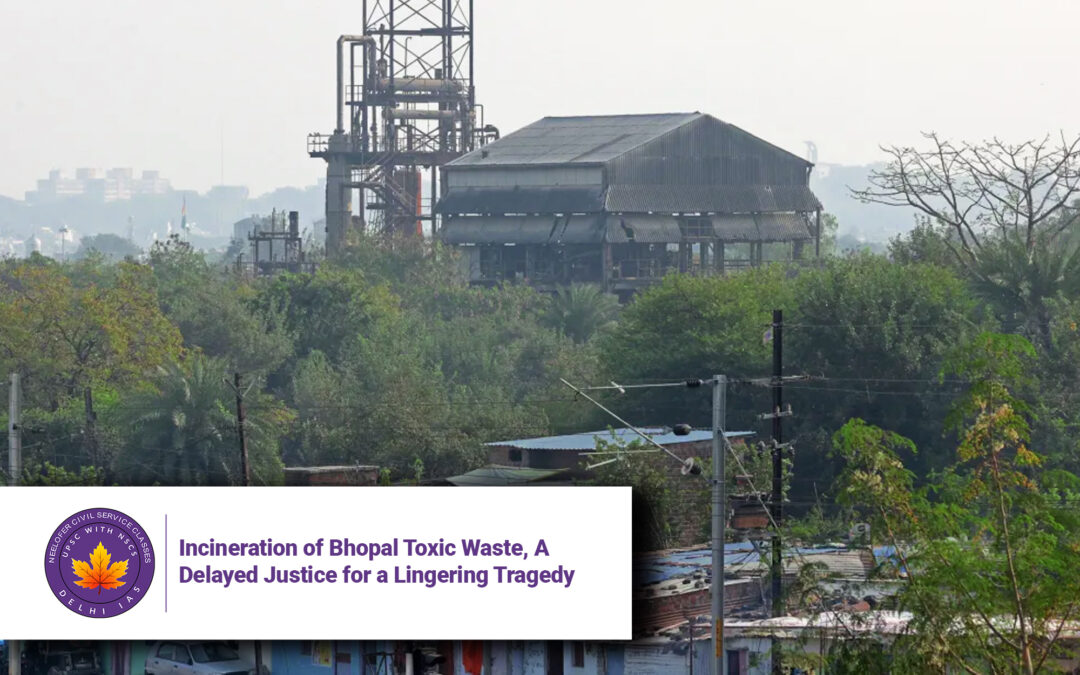
Incineration of Bhopal Toxic Waste, A Delayed Justice for a Lingering Tragedy
Why in News?
The Madhya Pradesh Pollution Control Board (MPPCB) recently confirmed the incineration of 337 tonnes of toxic waste from the 1984 Bhopal gas tragedy. This waste was stored at the defunct Union Carbide facility and has now been transferred to a private waste treatment facility in Pithampur. This move marks the closure of a significant, long-awaited chapter in one of the world’s worst industrial disasters. Though this incineration is a critical step in the path of justice and environmental rehabilitation, it also raises serious concerns regarding the delay, lack of initiative, and continued neglect toward victims and the contaminated site.
Introduction
The Bhopal gas tragedy, which occurred in December 1984, killed thousands and left countless others suffering lifelong health consequences. Nearly four decades later, the region continues to bear the scars—not just in the lives of survivors, but also in the soil, water, and environment contaminated by hazardous waste. The successful incineration of 337 tonnes of this waste brings partial closure, but also highlights the lethargic governmental machinery, inadequate compensation, and pending rehabilitation responsibilities.
The toxic waste incineration project, which cost ₹126 crore and was completed within six months, serves as a painful reminder that while technological and logistical solutions existed, political will was missing. This lack of urgency prolonged the suffering of thousands and delayed environmental justice.
A Timeline of Delayed Action
The waste incineration took more than a decade of legal battles and inter-agency interventions. Despite repeated orders and mounting public concern, real action was delayed until a coordinated effort involving the Madhya Pradesh High Court, Supreme Court of India, the Union Environment Ministry, and others finally moved the process forward.
This massive delay underscores a recurring pattern seen in environmental disasters—authorities wait until public pressure reaches a tipping point. The waste that was finally incinerated yielded over 800 tonnes of ash and residue, which will now need to be scientifically landfilled. But this is only a part of the problem. The Union Carbide site still holds more tonnes of contaminated soil, hazardous chemicals, and underground toxins.
Stakeholders and Their Roles
The push for this incineration effort came not from government bodies but from persistent activism by survivors’ groups, public health advocates, and legal crusaders. These groups filed petitions, led protests, and campaigned for over 30 years demanding accountability and justice.
Despite promises, both the state and central governments have failed to adequately compensate victims. Hospitals remain under-equipped, and there is a severe shortage of medical specialists trained to deal with the specific needs of survivors. Survivors allege that the advisory committee formed by the Supreme Court met only a few times and achieved little on the ground.
Toxic Legacy of the Union Carbide Site
Even after the 337 tonnes were incinerated, several more tonnes of hazardous waste remain buried at the site. Contaminated soil and underground water still pose a major risk to people living in the vicinity. Without regular surveillance and dedicated funds for cleanup, these areas may remain dangerous for decades.
This waste was stored insecurely for decades, exposing nearby residents to toxic leachate. Families living in slums around the factory site report higher incidences of birth defects, cancers, respiratory illnesses, and developmental delays—conditions that have been attributed to the toxins leaking from the plant.
The Role of Dow Chemical Company
Dow Chemical, which acquired Union Carbide, continues to deny responsibility for the site’s cleanup. The Indian government has attempted to hold the company liable, but legal and diplomatic challenges have slowed any progress. The Supreme Court’s closure of the “curative petition” route further complicates attempts to seek additional compensation from Dow.
This situation has left thousands of victims without full compensation or access to quality healthcare. There’s also an ongoing dispute about whether a new valuation of losses can still be forced upon Dow, and if any international legal remedies can be invoked to hold them accountable.
Unmet Promises and a Way Forward
The incineration is just one small step toward justice. What’s truly needed is a comprehensive, multi-agency effort to:
-
Remediate the contaminated land and groundwater
-
Provide continuous health surveillance and care for survivors
-
Offer fair and updated compensation
-
Hold Dow accountable through legal means
-
Establish a statutory body dedicated to unified relief, rehabilitation, and health services for victims
Additionally, the government must set up a transparent and independent mechanism to monitor the use of rehabilitation funds and ensure the affected population is consulted in every major decision.
Systemic Issues Exposed
This incident reveals a much larger problem—the sluggish pace of environmental justice in India. Despite numerous industrial disasters and toxic waste accidents, India lacks a strong policy for long-term environmental rehabilitation and corporate accountability. Victims often have to rely on the judiciary and civil society for redress, while governments act reactively rather than proactively.
The lack of political will is particularly troubling. All tools for action existed years ago—technology, funding, legal orders—but execution was delayed. This negligence is not just administrative; it’s moral failure.
Conclusion
The incineration of 337 tonnes of toxic waste from the Bhopal gas tragedy site, though an important milestone, is not a complete solution. It took over three decades and relentless activism to reach this point. The tragedy’s aftermath still haunts thousands, and many issues—medical support, environmental cleanup, legal justice—remain unresolved.
Governments must learn from this. Environmental justice delayed is justice denied. The focus must now shift from token gestures to systemic change. Only then can survivors truly begin to heal, and only then will the nation honor the memory of one of its darkest chapters.
Q&A Section
1. What was the recent development in the Bhopal gas tragedy case?
The Madhya Pradesh Pollution Control Board confirmed the incineration of 337 tonnes of toxic waste stored at the Union Carbide plant. This waste was transported to a private facility in Pithampur and disposed of at a cost of ₹126 crore.
2. Why did the incineration of the toxic waste take so long?
Despite the availability of resources and technology, the process was delayed due to a lack of political initiative, prolonged legal battles, and bureaucratic inertia. It took more than a decade of pressure from activists and multiple court interventions to initiate the disposal.
3. Is the Bhopal site now safe after the incineration?
No. While 337 tonnes were incinerated, the site still contains more toxic waste, contaminated soil, and underground pollutants. Continued surveillance, cleanup, and scientific landfilling of residues are still required.
4. What role did Dow Chemical play in this case?
Dow Chemical, which acquired Union Carbide, has consistently denied responsibility for cleanup and compensation. Legal complexities and the closure of the “curative petition” route by the Supreme Court have made it difficult to pursue fresh claims against the company.
5. What is still needed to achieve full justice for Bhopal survivors?
The government must:
-
Ensure full environmental cleanup
-
Provide healthcare and rehabilitation to survivors
-
Reassess compensation with inflation adjustment
-
Hold Dow accountable
-
Establish a statutory body to oversee all relief and rehabilitation efforts

