
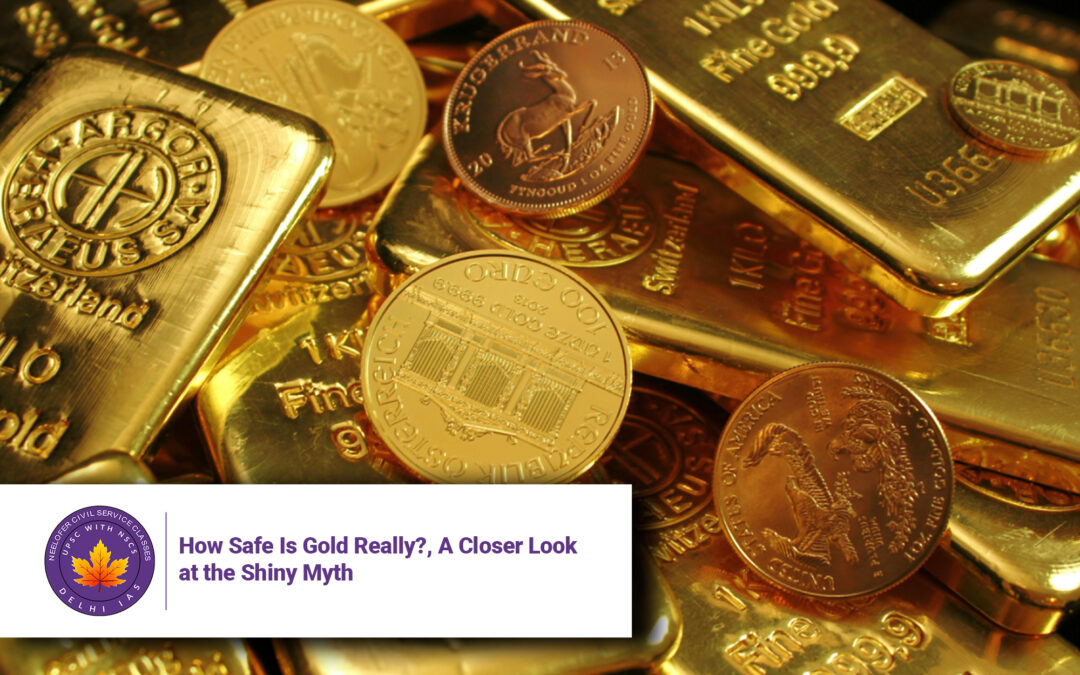
How Safe Is Gold Really?, A Closer Look at the Shiny Myth
Why in News?
Gold is back in the spotlight as a “safe haven” asset amid inflation concerns, global uncertainty, and economic slowdown. But recent trends and historical data reveal that gold may not be as risk-free as it appears. Financial expert Devina Mehra dissects the myths surrounding gold investments in her latest insights. 
Introduction
The common belief that gold is a “risk-free” or “safe haven” asset has led to a rush in gold investments globally. However, an evaluation of gold’s track record, price behavior, and returns over decades challenges this belief. While gold may appear stable, its performance, especially adjusted for inflation, reveals a different story.
Key Insights and Concerns
1. Gold Price Behavior Over Time
-
Gold hit a record price of $668 per ounce in 1980. Adjusted for inflation, it took 27 years (until 2007) to reach that level again.
-
After peaking in August 2020 at $2,067, gold prices fell and then had to wait until 2024 to reclaim that high.
-
Such long waiting periods for returns indicate that gold may not be as rewarding as believed.
2. Is Gold Truly Risk-Free?
-
Data since 1950 shows that gold has underperformed equities.
-
Gold experienced a maximum price drawdown of 82%, compared to 50% for US equities.
-
Even during crises, such as inflation or war, gold has shown significant volatility.
3. Illusion of Value Appreciation
-
Gold’s rising value often reflects currency depreciation or capital controls, not real appreciation.
-
In India, high gold prices were often due to local restrictions and limited overseas investment options.
4. Misplaced Inflation Hedge Belief
-
Gold is not a consistent inflation hedge. In fact, US equities have outperformed gold over the long term.
-
Periods of low interest rates or recession can make gold attractive temporarily, but not always reliable.
5. Central Banks and Gold Hoarding
-
The US Federal Reserve holds the highest gold reserves, with 6,300 tonnes stored in New York.
-
Countries like Germany and India store large quantities too, but many wonder if this is still wise.
-
Central banks are slowly reducing dependency on gold as monetary tools evolve.
Conclusion
Gold is not risk-free. Although it may glitter, it has shown long stretches of underperformance, high volatility, and limited inflation protection. Investors must treat gold as just another asset in a diversified portfolio, rather than a guaranteed safe haven. A careful strategy, rather than emotional attachment or historical myth, is key to wise investing.
Q&A Section
Q1. Why is gold considered a “safe haven” by many?
Because of its historical role in storing value during crises and inflation, but this view is not always supported by data.
Q2. Has gold always performed better than equities?
No. In fact, US equities have outperformed gold in the long term, both in returns and inflation protection.
Q3. How long did it take gold to recover from its 1980 peak when adjusted for inflation?
It took 27 years, from 1980 to 2007, to reach the same inflation-adjusted level.
Q4. What is the maximum drawdown gold has seen?
Gold saw an 82% drawdown, which is higher than the 50% maximum seen in US equities.
Q5. Should investors avoid gold altogether?
Not necessarily. Gold can be part of a diversified portfolio, but not as the primary or only safe investment.
