
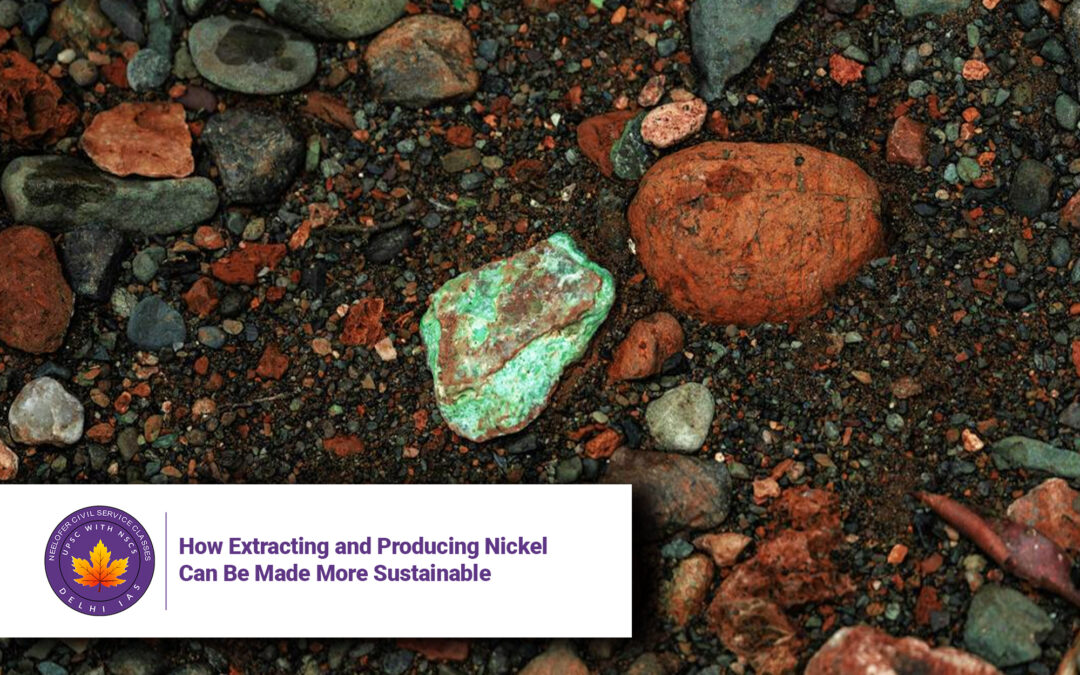
How Extracting and Producing Nickel Can Be Made More Sustainable
Why in News?
A new study by researchers at the Max Planck Institute for Sustainable Materials, published in Nature (April 30, 2025), introduces a hydrogen-plasma-based method to extract nickel — a breakthrough that could drastically cut carbon emissions and make the nickel industry cleaner and more efficient. 
Introduction
Nickel plays a crucial role in the global clean energy transition, especially in electric vehicle (EV) batteries. While EVs are marketed as a green alternative, the traditional production of nickel — a key input in lithium-ion batteries — remains extremely carbon-intensive, with over 20 tonnes of CO₂ emitted per tonne of nickel. This paradox shifts the pollution burden from fuel use to metal extraction, prompting the need for cleaner methods.
Key Features
● The Innovation: Hydrogen Plasma Reduction
-
Researchers developed a one-step, carbon-free metallurgical process using hydrogen plasma instead of carbon.
-
The process is conducted in an electric arc furnace, where hydrogen gas is split into high-energy ions (plasma) that reduce nickel oxide to metal.
● Energy and Emission Savings
-
The method is 18% more energy-efficient than traditional techniques.
-
It cuts CO₂ emissions by 84%, producing water as a byproduct instead of carbon dioxide.
● Ore Focus: Laterites, Not Sulphides
-
The method is tailored to extract nickel from laterite ores, which are abundant but harder to process.
-
Traditional nickel processing focuses on sulphide ores, which are depleting globally.
Specific Impacts or Effects
● Application in India
-
India has vast laterite reserves, especially in Odisha’s Sukinda region.
-
These deposits are low in nickel concentration (0.4–0.9%) and often ignored due to inefficiency in traditional methods.
-
The new process could help India unlock the economic and strategic value of underutilized ores.
● Enabling Net-Zero Goals
-
As India aims for net-zero emissions by 2070, this technology supports the twin goals of industrial growth and environmental responsibility.
-
Reduces reliance on imported high-grade ores by making domestic low-grade ores viable.
Challenges and the Way Forward
Challenges:
-
Scalability of hydrogen plasma technology to industrial scale is uncertain.
-
Requires high initial investments in infrastructure and renewable energy.
-
Needs further research on thermodynamic kinetics and continuous supply of free oxygen species at the reaction interface.
Steps Forward:
-
Pilot-scale deployment in mineral-rich states like Odisha.
-
Public-private partnerships to fund infrastructure and R&D.
-
Integration with renewable energy sources to ensure sustainability throughout the process.
Conclusion
The hydrogen plasma method is a game-changing innovation that aligns with global climate goals and national industrial ambitions. For India, it presents a rare opportunity to boost self-reliance in critical minerals while contributing to the global clean energy value chain. As the world electrifies, the focus must not only be on clean products but also on clean production — and nickel extraction is a key place to start.
Q&A Section
Q1. Why is nickel important in today’s economy?
Nickel is crucial for electric vehicle batteries, stainless steel production, and clean energy technologies.
Q2. What’s the problem with traditional nickel extraction?
It emits over 20 tonnes of CO₂ per tonne of nickel, making it highly polluting.
Q3. What’s new in the hydrogen plasma method?
It uses hydrogen instead of carbon to extract nickel in a single-step, emission-free process.
Q4. How can this benefit India?
India can utilize low-grade laterite ores, reduce imports, and progress toward net-zero goals.
Q5. What are the challenges ahead?
High infrastructure costs, scalability issues, and need for advanced research and energy input.

