
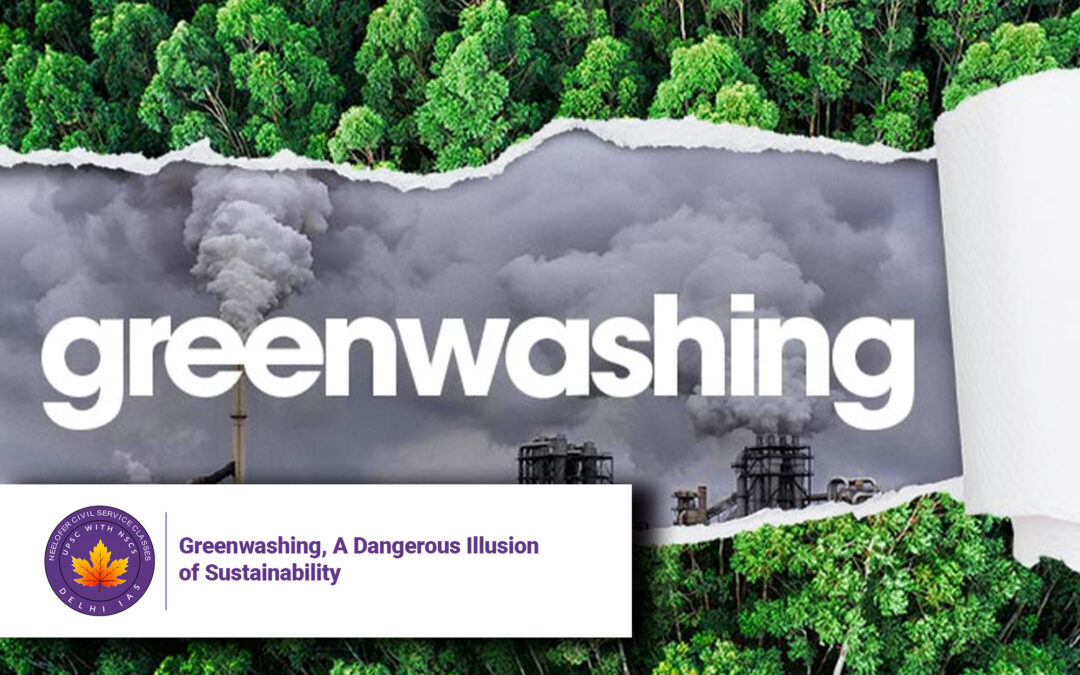
Greenwashing, A Dangerous Illusion of Sustainability
Why in News?
With the growing emphasis on sustainability and environmental accountability, many companies are accused of indulging in “greenwashing” – the act of misleading stakeholders through false or exaggerated claims about their environmental practices. In this context, K. Yatish Rajawat critiques how corporations use greenwashing to mask unsustainable practices and calls for urgent regulatory action. 
Introduction
Greenwashing is becoming a widespread concern globally, including in India. While companies are expected to follow sustainability reporting norms, many misuse these platforms to promote a false image of being eco-conscious. Without clear regulations and penalties, companies continue to deceive stakeholders under the guise of environmental responsibility.
Key Issues
-
What is Greenwashing?
Greenwashing refers to the practice where companies present a misleading picture of their environmental responsibility through selective disclosures or marketing campaigns. These tactics include reporting only partial emissions, using vague labels like “green” or “eco-friendly,” and focusing on non-critical sustainability efforts. -
Misleading Reporting Practices
A major strategy is the selective reporting of emissions. For example, firms may report only Scope 1 emissions (from company-owned sources) and ignore Scope 2 (indirect emissions from purchased energy) or Scope 3 (value chain emissions). This incomplete reporting creates a false perception of environmental responsibility. -
Lack of Uniform Standards
Currently, India does not enforce strict sustainability reporting frameworks. The BRSR (Business Responsibility and Sustainability Report) and ESG frameworks are underused and inconsistently applied. The absence of a central regulatory authority like the U.S. SEC allows companies to manipulate disclosures. -
Greenwashing in Practice
Examples include real estate developers declaring buildings as green while omitting the carbon emissions from construction, or FMCG companies highlighting “eco-friendly” packaging while ignoring larger environmental harms. Even labels such as “organic,” “cruelty-free,” or “natural” are often used without verification. -
Impact on Stakeholders
Investors, consumers, and regulatory bodies are misled. Greenwashing shifts focus from real environmental reforms to superficial changes, undermining trust and delaying genuine climate action.
Challenges and the Way Forward
-
Need for Robust Guidelines
A comprehensive framework with mandatory disclosures, strict penalties, and third-party audits is necessary. Reporting standards must cover full lifecycle emissions and discourage vague or unverifiable claims. -
Role of Regulatory Bodies
Institutions like SEBI must adopt a rigorous compliance mechanism, similar to the U.S. SEC. The Institute of Chartered Accountants of India (ICAI) must ensure all ESG reports align with international standards such as the Sustainability Accounting Standards Board (SASB). -
Stakeholder Awareness
Consumers and investors must be educated to identify greenwashing and demand greater accountability from companies.
Conclusion
Greenwashing is not just misleading — it’s fraudulent. In the absence of tough laws, many companies continue to project a fake image of sustainability, hurting the planet and stakeholders alike. Urgent reforms are needed to ensure that sustainability reporting is truthful, transparent, and effective in driving real change.
5 Q&A Based on the Article
Q1. What is greenwashing as explained in the article?
A: Greenwashing is the act of misleading stakeholders by making false or exaggerated claims about a company’s environmental responsibility and sustainability efforts.
Q2. What is a commonly used strategy by companies to greenwash their image?
A: Companies often engage in selective emission reporting, disclosing only Scope 1 emissions while hiding Scope 2 and Scope 3 data.
Q3. Why is greenwashing harmful to stakeholders?
A: It deceives consumers, investors, and regulators, delaying real environmental reforms and fostering distrust.
Q4. What regulatory reforms does the article suggest to counter greenwashing?
A: The article advocates for stricter laws, clearer reporting standards, penalties for non-compliance, and independent auditing of sustainability claims.
Q5. How can consumers and investors help combat greenwashing?
A: By demanding detailed, transparent reports and not being swayed by vague marketing terms like “eco-friendly” or “organic” without verification.
