
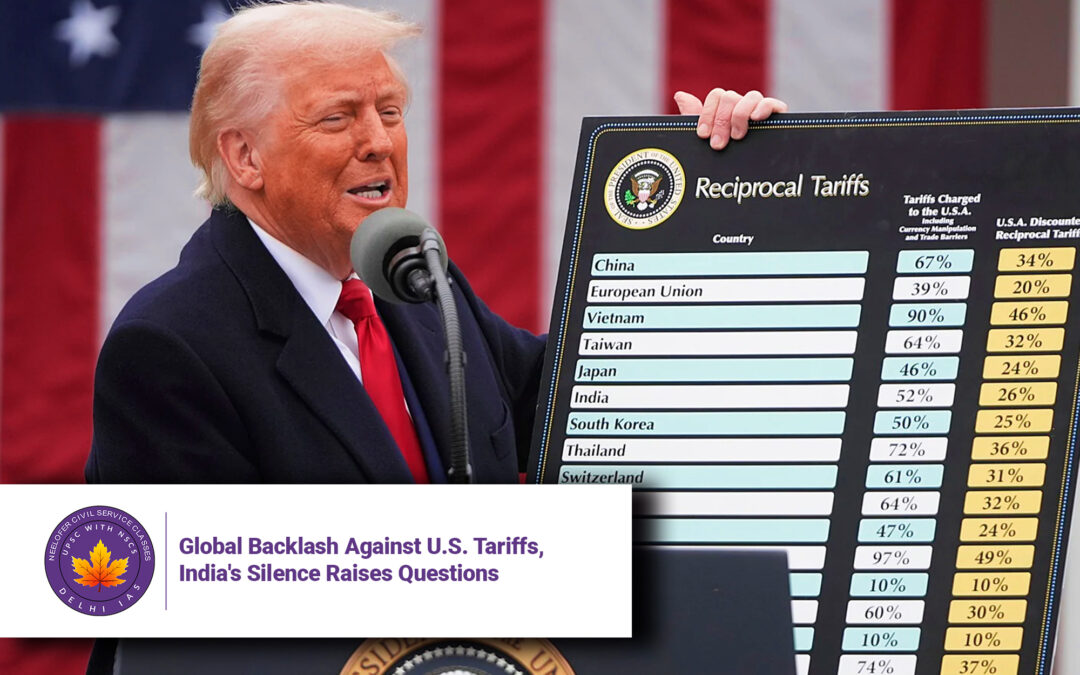
Global Backlash Against U.S. Tariffs, India’s Silence Raises Questions
Why in News?
The United States’ decision to impose reciprocal tariffs on several countries, including India, has drawn global criticism for violating World Trade Organization (WTO) laws. The move, announced on April 2, 2025, has been paused for 90 days (excluding China) but continues to spark international backlash. 
Introduction
The imposition of these tariffs by the U.S., under President Donald Trump, has been labeled illegal under international trade law. The WTO’s framework, based on multilateralism and fairness, is being directly challenged by these actions, raising concerns over the future of a rule-based trading system.
Key Issues and Background
Global Criticism of U.S. Tariffs
-
Countries like Singapore, Brazil, Canada, Japan, and China have openly criticized the U.S.
-
Singapore’s PM called it a “repudiation of the MFN principle”.
-
Canada filed a formal legal complaint at the WTO.
-
China and Japan also launched disputes and imposed retaliatory tariffs.
India’s Silence
-
India has neither condemned the U.S. nor imposed any retaliatory tariffs.
-
This silence comes despite India’s frequent emphasis on upholding international rules and justice, especially for the Global South.
The Core of the Concern
Why Is India Silent?
Two major reasons are suggested:
-
Bilateral Trade Agreement (BTA) Talks: India is in discussions with the U.S. and does not want to jeopardize negotiations.
-
WTO’s Dysfunctional Dispute System: It’s argued that since WTO mechanisms are currently weak, legal claims might be ineffective.
However, critics argue that these justifications are flawed. Even though the U.S. has criticized India’s own tariff laws, it hasn’t stopped trade talks. Other countries in similar trade talks have still taken a public stand.
Key Observations
-
India’s weak response is seen as inconsistent with its traditional leadership in defending Global South interests.
-
Nearly 40 WTO member nations recently issued a statement in support of multilateralism, but India did not sign.
-
Analysts believe India should take a stronger public stance, not only to uphold trade rules but to maintain its global image.
Conclusion
India must re-evaluate its position. While diplomatic caution is understandable, failure to stand up against illegal trade actions weakens India’s leadership image on the world stage. To ensure a fair and just global trade system, India must support rule-based multilateralism, both in words and action.
Q&A Section
Q1. What triggered global criticism against the U.S. in April 2025?
Ans: The U.S. announced reciprocal tariffs that many countries see as violations of WTO rules, prompting global backlash.
Q2. How have countries like Canada and China responded?
Ans: Canada filed a legal case at the WTO, while China and Japan imposed retaliatory tariffs and also initiated disputes within the WTO framework.
Q3. Why is India being criticized for its silence?
Ans: Despite being a proponent of fair trade and multilateralism, India has not publicly condemned the U.S. tariffs or taken countermeasures, raising questions about its global leadership.
Q4. What are the reasons given for India’s silence?
Ans: India is negotiating a bilateral trade agreement with the U.S. and doubts the effectiveness of WTO’s current dispute system, hence avoiding public criticism.
Q5. What is the global call from WTO members?
Ans: Around 40 WTO members issued a joint statement supporting trade multilateralism and opposing the U.S. tariffs, highlighting the need for rule-based trade.
