Geo-tagging of chinar trees in J&K
by rohit | Jan 28, 2025 | Courses |

About Geo-tagging of chinar trees in J&K
-
- The Jammu & Kashmir government has launched the “Tree Aadhaar” mission to conserve the region’s declining chinar trees.
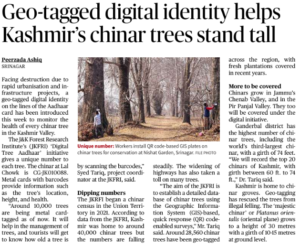
- The initiative includes conducting a census of chinar trees and assigning each tree a unique identity to monitor and protect them effectively.
- About Chinar Tree (Oriental plane tree)
- Characteristics:
- Maple-like tree with a vast canopy.
- Found in cool climates with sufficient water, mainly in the Eastern Himalayas.
- Grows up to 30 metres tall with a girth of 10-15 metres.
- Takes 30-50 years to mature and 150 years to reach full size.
- Origin of the Name ‘Chinar’
- Coined by the Mughals, possibly by Emperor Jahangir.
- Derived from the Persian phrase “Che naar ast” meaning “What flame is that?” – inspired by the crimson red leaves in autumn.
- Mughal Influence on Chinar Plantations
- Role: Mughals expanded chinar plantations in Kashmir and parts of Jammu’s Chenab region
- Symbol: Considered a “royal tree.”
- Notable Contributions by Jahangir:
- Created Naseem Bagh on Dal Lake’s banks with over 1,100 chinar trees.
- Planted chinars on a small Dal Lake island, now known as Chaar Chinari (Four Chinars).
- Importance of Chinar in Kashmir
- State Tree
- The chinar is the “state tree” of Jammu & Kashmir (now a Union Territory).
- Tourist Attraction
- The chinar becomes a major attraction in autumn when its leaves turn crimson red and golden.
- Cultural and Artistic Significance:
- Chinar motifs are commonly seen in local papier mache, embroidery, hand-woven carpets, and walnut wood carvings.
- The tree holds a special place in the art, literature, and craft traditions of Kashmir.
- Religious Significance:
- Chinar trees are found near many Muslim and Hindu shrinesin the region
- Oldest Chinar Tree:
- The oldest surviving chinar(around 700 years old) is located in Chattergam village in Budgam, central Kashmir, and was planted by a Sufi saint.
- Chinar Conservation Project Overview
- Government Permission for Tree Cutting:
- Cutting a chinar tree requires government approval, even on private property. Despite this, illegal cutting still occurs.
- Project Goals:
- The initiative aims to track the status of each chinar tree across the Kashmir valley and Chenab region.
- Census and Tree Aadhaar:
- A census of chinar trees has been conducted district-wise. Each tree has been assigned a unique Tree Aadhaar and geo-tagged for identification and monitoring.
- Current Status:
- As of now, 28,560 chinar trees have been enumerated and geo-tagged, out of an estimated total of 32,000 to 33,000
- Challenges:
- Some trees are inaccessible, such as those located near security installations or no-go areas.
- QR Code Implementation:
- A metallic QR codeis being placed on chinar trees. Scanning the code provides information on 25 parameters including:
- Longitude and latitude
- Age, height, and girth
- Number of branches and tree health
- Canopy size and eco-threats faced by the tree.


