
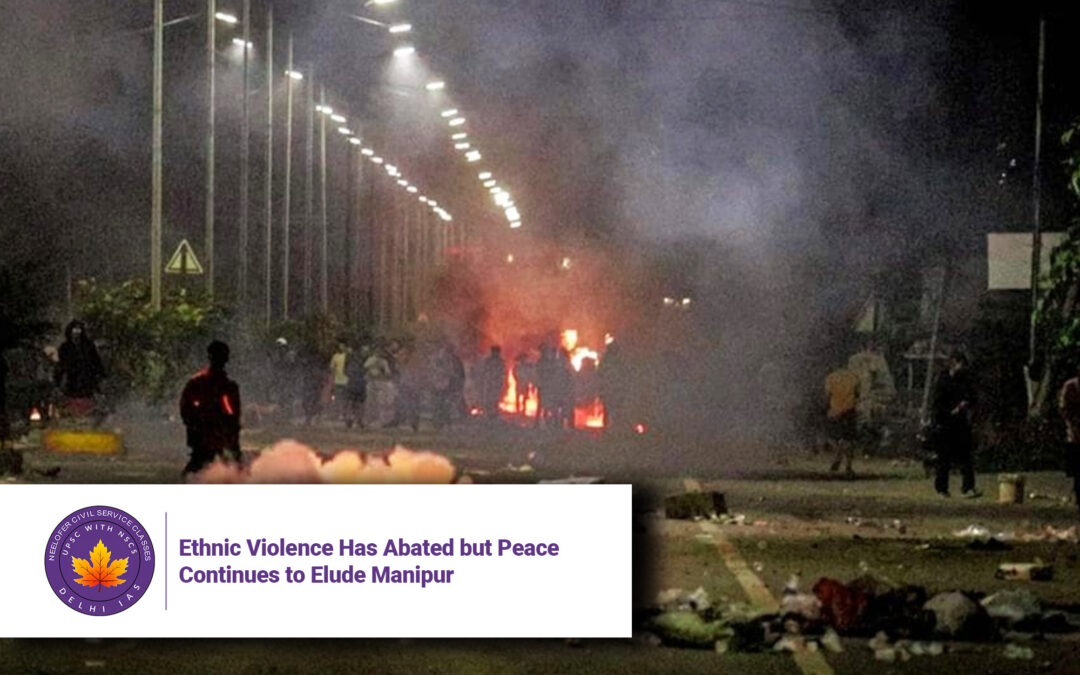
Ethnic Violence Has Abated but Peace Continues to Elude Manipur
Why in News?
Over three months have passed since President’s Rule was imposed in Manipur, yet despite a decline in violence, peace and reconciliation remain elusive. Ethnic tension between communities still runs high, with displaced persons unable to return home and unresolved political and administrative demands creating ongoing instability. 
Introduction
Manipur, plagued by months of ethnic conflict, entered a new phase when President’s Rule was declared following the collapse of state governance. While there has been a noticeable decline in violence and arson, the underlying issues remain unresolved. The state continues to be fragmented along ethnic lines, with blocked roads, halted public services, and an atmosphere of mistrust prevailing.
Key Issues and Background
❖ The Origin of the Crisis
-
The ethnic violence began in May 2023 between Meitei and Kuki-Zo communities, resulting in widespread displacement, arson, and lawlessness.
-
The state government under CM N. Biren Singh struggled to control the situation, eventually leading to the imposition of President’s Rule.
❖ Current Situation on the Ground
-
Gun violence and arson have reduced significantly.
-
However, movement of goods and people between the hills and valley is still severely restricted.
-
Thousands of displaced people remain in relief camps, unable to return to their homes.
-
Community divisions persist, with the Kuki-Zo groups demanding separate administration and some Meitei groups showing resistance.
❖ Flashpoints and Incidents
-
State transport buses and journalists were forced to reroute due to resistance in certain areas, including the valley.
-
The Imphal valley remains tense, and a recent incident before the Sangai Festival in May showcased the volatility.
-
Civil society continues to enforce silences in some areas, and demands for administrative autonomy fuel more division.
The Core of the Concern
-
The lack of visible peace efforts by the Centre and absence of inclusive dialogue mechanisms has made reconciliation difficult.
-
Community-level mistrust, combined with insufficient engagement by the government, is deepening the divide.
-
Key issues such as separate administration demands, transport blockades, and armed youth groups continue to hinder any form of unity.
Key Observations
-
The Centre must play a more proactive role in restoring normalcy, including through confidence-building measures and civil society engagement.
-
There is a need for stronger policing, inter-community dialogue, and restoration of political and administrative processes.
-
The current political vacuum under President’s Rule must be filled with healing initiatives, not mere law enforcement.
Conclusion
While the scale of violence in Manipur has reduced, the soul of peace is still absent. The path forward must involve inclusive political dialogue, restoration of trust, and commitment to justice for all affected communities. Without a vision for healing, administrative measures alone will not rebuild a fractured state.
Q&A Section
-
Why was President’s Rule imposed in Manipur?
Due to the failure of the state government to control the ethnic violence and restore law and order. -
What is the current status of violence in Manipur?
While gun violence and arson have reduced, peace has not returned as ethnic tensions persist. -
What are the demands of the Kuki-Zo groups?
They are demanding a separate administration due to mistrust with the current state apparatus. -
How has movement across regions been affected?
Movement of people and goods between the hills and valley remains restricted, and several roads are blocked. -
What steps can be taken to restore peace in Manipur?
Stronger central intervention, dialogue with all communities, and confidence-building efforts by civil society and the government.

