
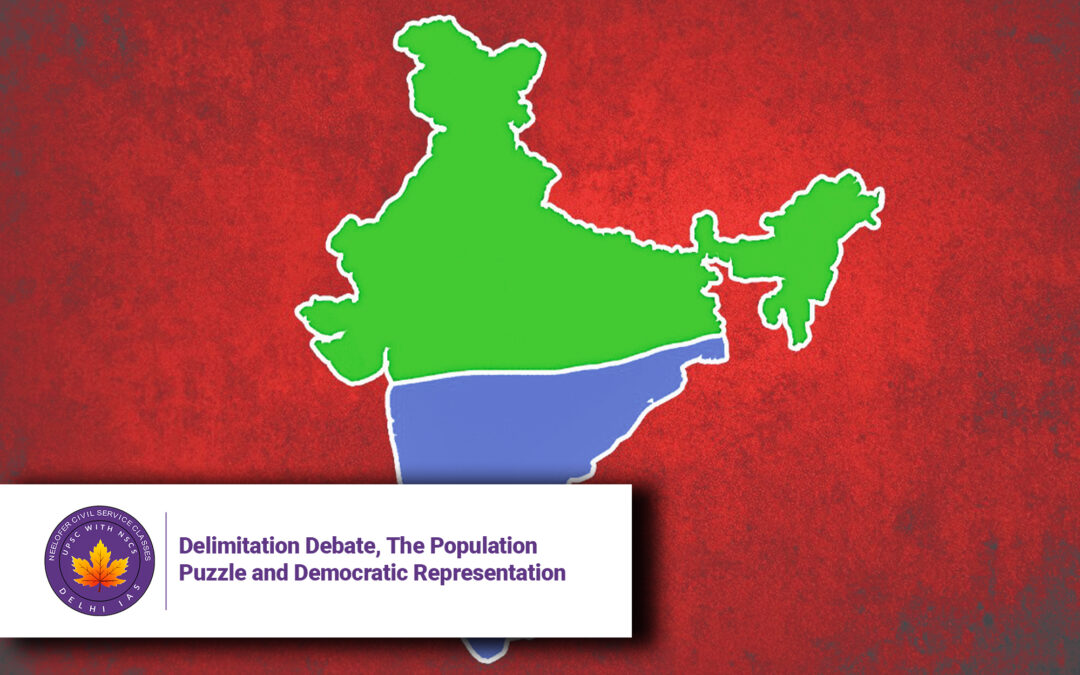
Delimitation Debate, The Population Puzzle and Democratic Representation
Why in News?
Delimitation, the redrawing of boundaries for electoral constituencies based on population data, has re-entered public discourse amid fears of regional imbalance and democratic dilution. With potential implications on representation and federalism, the issue has sparked both political and constitutional debates. 
Introduction
Delimitation in India, governed by Articles 82 and 170 of the Constitution, has historically been both a mathematical and a political exercise. With population disparities growing between southern and northern states, the idea of a new delimitation exercise based on the latest census figures has reignited concerns about fairness, representation, and federal equity. The central worry: Should population alone determine political power?
Key Issues / Background
1. Constitutional Basis and Amendments
The Constitution mandates that upon completion of each census, seats in the House of the People and state assemblies be reallocated. However, the 42nd and 84th Amendments froze this process until after the 2026 census to promote population control and avoid penalizing states that stabilized population growth.
2. Population Disparity and Political Power
New data suggests that northern states like Uttar Pradesh and Bihar have gained population rapidly, while southern states like Kerala and Tamil Nadu have seen controlled growth. This raises the specter of southern states losing parliamentary representation despite their governance success.
3. Impact on Representation and Governance
Using population as the sole criterion risks over-representing populous regions while under-representing those with better human development indices. For instance, a single Member of Parliament from Lakshadweep represents just 57,000 people, while one from Uttar Pradesh may represent up to 25 lakh people.
4. Concerns about Equity and Federalism
A one-size-fits-all approach based purely on numbers undermines federal balance and the spirit of cooperative governance. States that adhered to national population policies now fear being politically punished.
5. Quality vs. Quantity in Representation
Elected MPs do much more than vote—they ask questions, serve on committees, and represent diverse views. Thus, the role of an MP cannot be reduced to just numbers. The article stresses a need to redefine what “representation” truly means in a modern democracy.
The Core of the Controversy: Numbers vs. Values
At the heart of the delimitation debate is the question: Should democracy prioritize quantity (population) over quality (governance outcomes and inclusivity)? Critics argue that focusing solely on population ignores critical factors like literacy, economic growth, healthcare, and administrative efficiency. A mere mathematical redistribution may undermine democratic fairness and deepen political polarization.
Missed Perspectives
-
Delimitation is not just technical — it’s deeply political.
-
The quality of representation matters as much as the quantity.
-
Southern states are being penalized for governance success.
-
Lack of uniform development skews population-centric politics.
-
Representation must be more holistic, factoring in geography, diversity, and governance.
Conclusion
Delimitation cannot be reduced to population figures alone. It must balance equity with efficiency, representation with reason. A politically sensitive and institutionally inclusive process is needed — one that recognizes diversity, respects federalism, and redefines representation beyond mere numbers. As the 2026 census nears, India must prepare for a nuanced, consultative approach to preserve the core ideals of democracy.
Q&A Section
Q1. What is delimitation and why is it controversial now?
Delimitation is the redrawing of electoral constituencies based on population data. It is controversial because a population-based approach could disproportionately increase the political power of more populous northern states, reducing representation for southern states that controlled population growth.
Q2. Why was delimitation frozen after 1976?
To incentivize states to adopt family planning, the 42nd and 84th Constitutional Amendments froze delimitation until after 2026. This move was meant to prevent states that successfully controlled population from being politically penalized.
Q3. How does population disparity impact representation?
States with larger populations may gain more seats in Parliament, giving them greater influence. Conversely, smaller states may feel under-represented despite their efficiency and high development standards.
Q4. What other factors should be considered besides population?
Experts argue for a multi-criteria approach that includes development indicators, geography, accessibility, and governance quality — not just raw population numbers.
Q5. What is the proposed way forward?
Rather than relying solely on numbers, the article suggests defining “representation” more broadly — factoring in institutional roles, functional efficiency, and ensuring balanced federal participation. Constitutional changes or innovative frameworks may be required to safeguard equity.
